MAM
Students’ foreheads and cars for promoting brands

LONDON: Marketers looking at new innovative approaches to spread brand awareness are letting their imagination run wild. However, their wacky strategies could be a blessing in disguise for students who get to earn money for doing the same.
The Guardian has reported that a creative marketing agency, Cunning Stunts, has started an initiative to turn students’ foreheads into billboards for carrying brand messages.

Meanwhile, a second marketing firm, Comm-Motion, has offered car owners money if they allow their cars to be “wrapped” in the livery of a high-profile brand. The firm’s marketing director D Lindsay Kennard has offered remuneration up to ?220 a month.
Students can earn up to ?88.20 a week for merely wearing a corporate logo on their head for a minimum of three hours each day. The brand or product message will be attached by a vegetable dye transfer and the students will be paid to leave the logos untouched.
The report also states that the “lads” magazine FHM and the youth pay-TV channel CNX, have signed up in addition to a recruitment drive for students at Oxford, Umist in Manchester, Leeds, and Roehampton in London.
“With student debt becoming such a massive issue, we thought we’d offer students maximum reward for minimum input,” Cunning Stunts MD Anna Carloss, was quoted as saying in the report. “Participating brands get a unique advertising medium as well as giving something back to students.” She added the students would need to be mobile so that more people could see it.
The scheme is already finding some enthusiastic takers. Oli Merrel, at Falmouth College of Arts, in Cornwall, was quoted as saying: “I don’t see the difference between an advert on a billboard and one on my forehead – except I’ll be earning money from it.”



Brands
Parle-G celebrates Bihu with music-led campaign rooted in culture
Two-part films blend nostalgia and storytelling to capture Assam’s festive soul
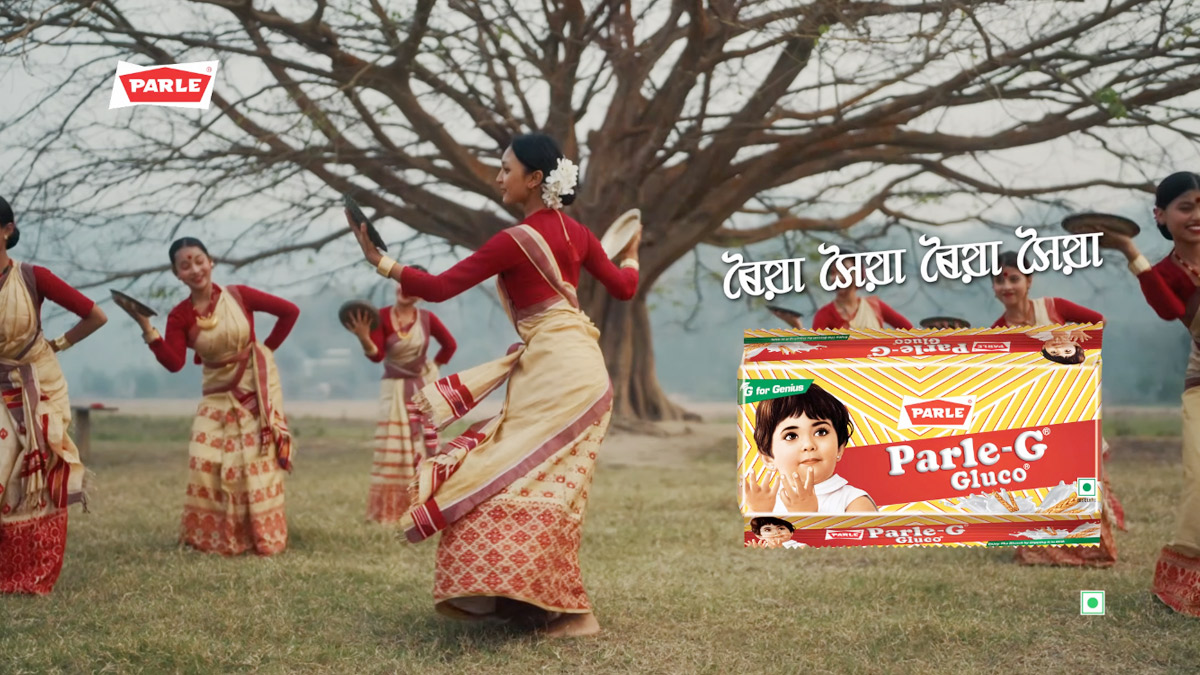
MUMBAI: Parle-G has turned to music, memory and meaning in its latest campaign celebrating Bihu, offering a culturally rooted tribute that goes beyond typical festive advertising.
Created by Thought Blurb Communications, the two-part campaign builds on the brand’s long-standing thought of finding joy in others’ happiness. It begins with a music-led prequel and culminates in a narrative-driven film that explores the emotional essence of the festival.
The campaign opened with a two-and-a-half-minute Bihu music video featuring Partha Hazarika, with music composed by Nilotpal Bora and vocals by Dikshu. Rather than positioning itself as a conventional brand piece, the video leaned into authenticity, capturing the vibrancy and rhythm of Bihu. Viewers also drew emotional parallels to Zubeen Garg, whose absence lent the film a nostalgic undertone. The response was swift, with over 12 million combined views across YouTube and Instagram within a week.
Building on this momentum, the main film tells the story of Ahir, a musician struggling to compose a Bihu song within the confines of a studio. His journey takes him into the open landscapes of Assam and eventually to the banks of the Brahmaputra, where a boatman helps him rediscover the true spirit of Bihu. The narrative underscores a simple idea that the festival cannot be manufactured in isolation, it must be experienced in nature, community and shared joy.
Speaking about the campaign, Parle Products vice president Mayank Shah said the initiative aims to celebrate not just the festival but the emotion behind it. He noted that Bihu reflects the idea that joy multiplies when shared, a theme that sits at the heart of the story.
From the agency side, Thought Blurb Communications chief creative officer Vinod Kunj said the team sought to tap into Assam’s cultural pulse, acknowledging the emotional void left by the absence of Zubeen Garg while celebrating the enduring spirit of the festival.
Adding to this, Thought Blurb Communications national creative director Renu Somani Karwa said the campaign draws from deeply human stories, where small acts of generosity become powerful expressions of connection.
Meanwhile, Thought Blurb Communications executive creative director Auryndom Bose highlighted the importance of nature in shaping Bihu’s identity, noting that the film attempts to capture how music and movement emerge organically from the landscape itself.
With this campaign, Parle-G leans into cultural storytelling with a lighter brand footprint and a stronger emotional core. By placing music and community at the centre, it offers a reminder that some stories are best told not in studios, but in the shared rhythms of real life