MAM
Stand out and be heard this festive season, with Spotify


The upcoming festive season is one of the busiest times for any marketer and planner in India. It will be a festive season that will be drastically different from previous years and any marketing campaign will have to stand out to work. This will be even more difficult for marketers who want to specifically reach out to Gen Zs and millennials and engage with them. And here is where Spotify can make all the difference.
Here’s a quick overview of why marketers should consider talking to their audience on Spotify, especially now. All these details and possibilities are also just an email away at spotify-advertising-india@spotify.com.
Spotify: The ‘new normal in media

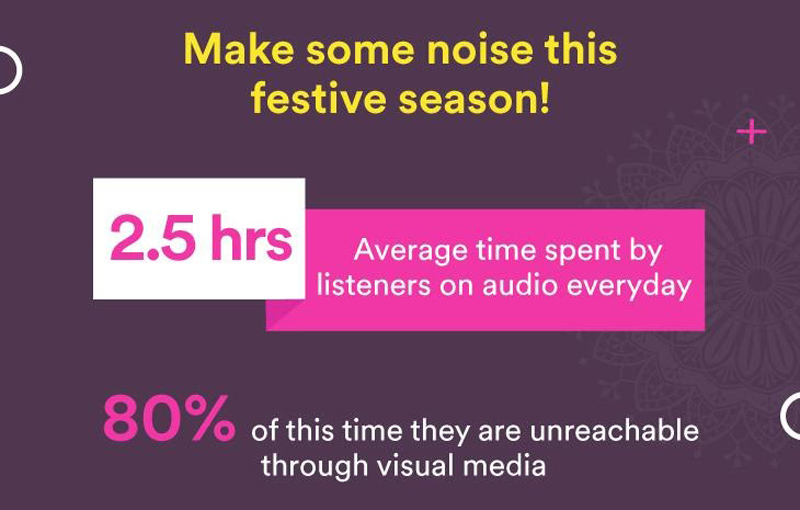
On average, an Indian listener spends 2.5 hours per day on audio and 80 per cent of this time, they can’t be reached through visual media1. eMarketer reports that streaming music was the #1 activity that people adopted during the pandemic. And with the increasing adoption of connected devices, the portability of audio (car, watch, Smart TV, game console, home speakers) means that marketers have ways to reach their audience in key screenless moments when they otherwise could not.
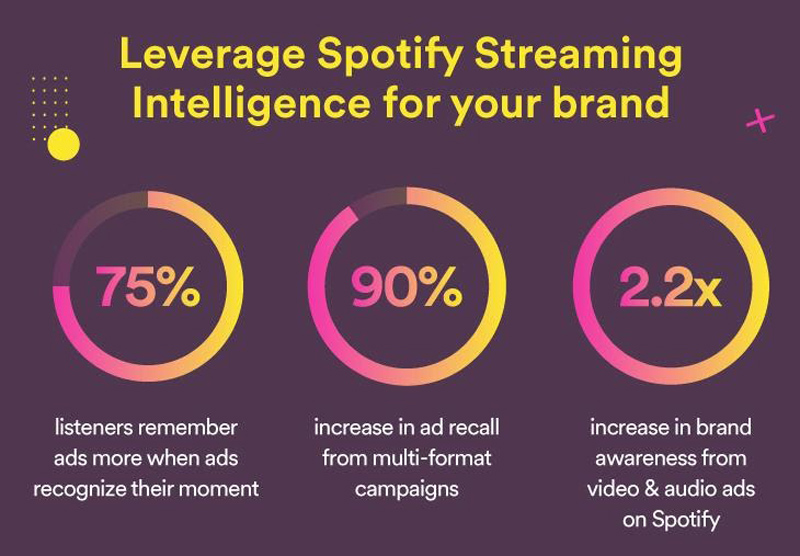
As the world’s largest streaming service, Spotify sits at the centre of culture thanks to its ever-growing music catalogue, and a slate of owned and exclusive podcast content. The more our listeners stream, the more insights we derive from their listening behaviour – and this powers what we call our “Streaming Intelligence”. Streaming intelligence helps brands make their communication more relevant, engaging, and meaningful. For instance, 75 percent of Spotify listeners say they tend to remember those ads more which recognise their moment or setting2. Furthermore, this sensory combination extends your creative options, giving you the best of both worlds.
Spotify data shows that running both video and audio increases ad recall by 90 per cent and results in a 2.2x increase in brand awareness3. This means that a plan which includes only display or video advertising is missing out on valuable time and engagement with its intended audience. Spotify fans are creating and curating playlists for every mood and soundtracking every moment of their lives.
Spotify can help brands reach consumers when they are unavailable for other forms of advertising.
Now, that’s music to every marketer’s ears.
Comfort in the time of uncertainty
One reason this year’s festive season will be unlike any other is the fact that listeners are looking to reset their lives. Sample this: After delaying purchases in 2020, one in three Spotify users are looking at large, big-ticket purchases in a clear case of revenge shopping4. And this is a user base that is likely to spend 15 per cent more on what they want than any other cohort4.
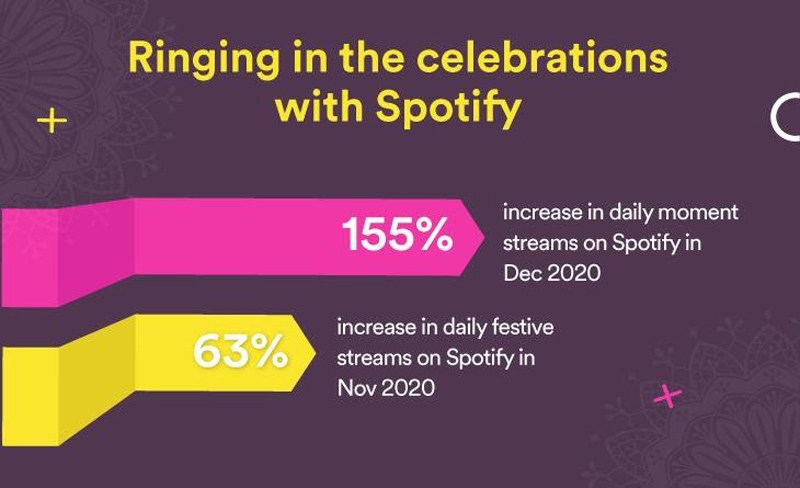
With music emerging as the warm blanket of comfort in these unsettling and uncertain times, it is no surprise that users are turning to Spotify for festive content. Daily festive streams saw an increase of 63 per cent, and occasion and activity-based streams grew 155 per cent5. It’s going to be the same this year, perhaps even more so. With music being an integral part of the celebrations, and bringing friends and family together on Spotify, it’s one platform that marketers need to plug into ASAP.
Turn on, tune in
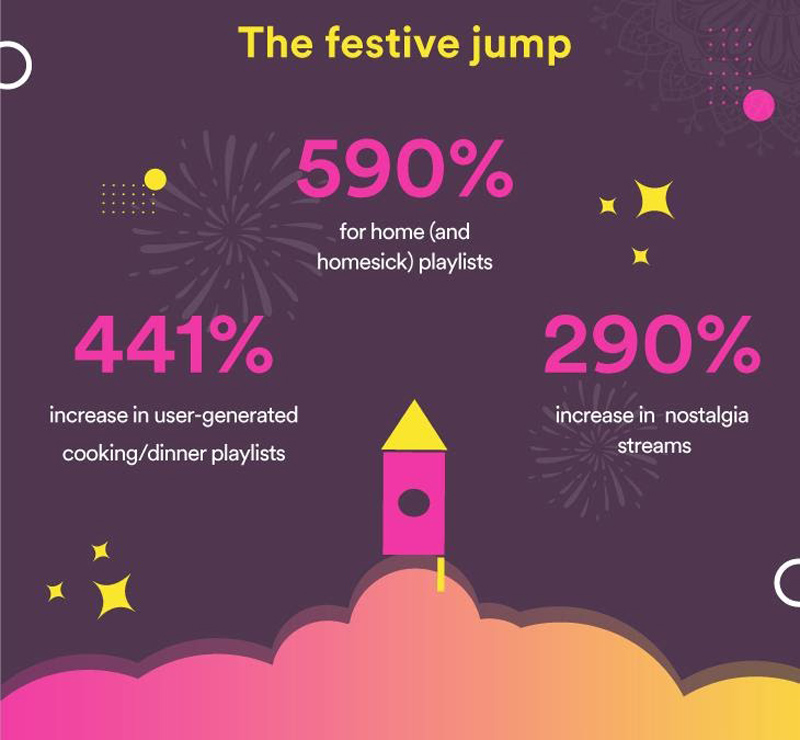
Spotify lets brands engage with their audience in moments that truly matter. This festive season, the key moments will be shopping, nostalgia, party, and cooking/dining with family. As friends and families start to come together after more than a year of physical distancing, familiar festive customs and traditions will return but in a way that’s unique. Listeners are in the mood for memories as much as living in the moment with activities such as festive cooking. A massive 441 per cent increase in user-generated cooking/dinner playlists bears this out while a growth of 290 per cent for nostalgia streams and 590 per cent for home (and homesick) playlists shows that listeners are turning to music to connect with memories of good times6.
It is in the moments like this – when people are inaccessible by other forms of media – that brands can truly reach out to their consumers and engage with them in ways that are only possible through Spotify.
A never-ending stream of ideas for brands
Spotify offers limitless possibilities for brands when it comes to connecting with their audiences. Want to sponsor the most-streamed festive playlists? Sure.
Want to deliver real-time audio ads while your targeted audience is listening to specific moods? You got it.
Want to turn your brand profile into a cookbook with every special recipe having its own unique playlist?
Want to create a special campaign with a unique digital experience that will truly drive your brand’s message home? Done!
Co-branded digital experiences around festive or shopping wishlists, multiple branded playlists crafted keeping into consideration the specific consumer personas and/or festive moods, creative audio to complement a brand’s in-store experience – the list of possibilities goes on and on.
So if you’re looking to add a sparkle to your media plan this festive season, choose Spotify. Write into spotify-advertising-india@spotify.com and let the festivities begin.
Click here to download Diwali ad solutions packages from Spotify Advertising.
SOURCES:
1 – Spotify First Party Data, global, based on daily content hours / daily active users, free users multiplatform, May 2019
2 – Key Moments Survey, Spotify Users A15-40, US, UK, DE, IT, SP, MX, BR, AU, October 2019
3 – Nielsen Brand Effect on Spotify, March 2020
4 – GWI, IN, Wave 5 – Outbreak Report 2021
5 – Spotify Internal Data, India, Diwali Q4. Sept Vs Oct vs Nov-Dec 2020
6 – Source: Spotify Internal Analytics, 1st October – 28th February 2021
(This is an Advertorial, published in association with Spotify)







Digital
Content India 2026 opens with a copro pitch, a spice evangelist and a £10,000 prize for Indian storytelling
Dish TV and C21Media’s three-day summit puts seven ambitious projects before an international jury, and two walk away with serious development money
MUMBAI: India’s content industry gathered in Mumbai this March for Content India 2026, a three-day summit organised by Dish TV in partnership with C21Media, and it wasted no time making a statement. The event opened with a Copro Pitch that put seven scripted and unscripted television concepts before an international panel of judges, and by the end of it, two projects had walked away with £10,000 each in marketing prize money from C21Media to support development and international promotion.
The jury, comprising Frank Spotnitz, Fiona Campbell, Rashmi Bajpai, Bal Samra and Rachel Glaister, evaluated a shortlist that ranged from a dark Mumbai comedy-drama about mental health (Dirty Minds, created by Sundar Aaron) to a Delhi coming-of-age mystery (Djinn Patrol, by Neha Sharma and Kilian Irwin), a techno-thriller about a teenage gaming prodigy (Kanpur X Satori, by Suchita Bhatia), an investigative crime drama blending mythology and modern thriller (The Age of Kali, by Shivani Bhatija), a documentary on India’s spice heritage (The Masala Quest, hosted by Sarina Kamini), a documentary on competitive gaming (Respawn: India’s Esports Revolution, by George Mangala Thomas and Sangram Mawari), and a reality-horror competition merging gaming and immersive fear (Scary Goose, by Samar Iqbal).
The session was hosted by Mayank Shekhar.
The two winners were Djinn Patrol, backed by Miura Kite, formerly of Participant Media and known for Chinatown and Keep Sweet: Pray & Obey, with Jaya Entertainment, producers of Real Kashmir Football Club, also attached; and The Masala Quest, created and hosted by Sarina Kamini, an Indian-Australian cook, author and self-described “spice evangelist.”
The summit also unveiled the Content India Trends Report, whose findings made for bracing reading. Daoud Jackson, senior analyst at OMDIA, set the tone: “By 2030, online video in India will nearly double the revenue of traditional TV, becoming the main driver of growth.” He noted that in 2025, India produced a quarter of all YouTube videos globally, overtaking the United States, while Indians collectively spend 117 years daily on YouTube and 72 years on Instagram. Traditional subscription TV is declining as free TV and connected TV gain ground, forcing broadcasters to innovate. “AI-generated content is just 2 per cent of engagement,” Jackson added, “highlighting the dominance of high-quality human content. The key for Indian media companies is scaling while monetising effectively from day one.”
Hannah Walsh, principal analyst at Ampere Analysis, added hard numbers to the picture. India produced over 24,000 titles in January 2026 alone, with 19,000 available internationally. The country now accounts for 12 per cent of Asia-Pacific content spend, up from 8 per cent in 2021, outpacing both Japan and China. Key exporters include JioStar, Zee Entertainment, Sony India, Amazon and Netflix, delivering over 7,500 Indian-produced titles abroad each year. The top importing markets are Saudi Arabia, the UAE, Egypt, the United States and the Philippines. Scripted content dominates globally at 88 per cent, with crime dramas and children’s and family titles performing particularly strongly.
Manoj Dobhal, chief executive and executive director of Dish TV India, framed the summit’s ambition squarely. “Stories don’t need translation. They need a platform, discovery, and reach, local or global,” he said. “India produces more movies than any country, our streaming platforms compete globally, and our tech and creators win international awards. Yet fragmentation slows growth. Producers, platforms, and tech move in different lanes. We need shared spaces, collaboration, and an ecosystem where ideas, technology, and people meet. That is why we built Content India.”
The data, the pitches and the prize money all pointed to the same conclusion: India is not waiting for the world to discover its stories. It is building the infrastructure to sell them.







