MAM
Sports emerging as preferred marketing tool for brands: SportzConsult

MUMBAI: Sports emerged as the most preferred marketing tool over celebrities, events and product placements in movies, music or art, according to a survey conducted by SportzConsult, a Mumbai-based sports management company.
The survey spoke to over a hundred senior marketing professionals across sectors such as FMCG, Automotive, Telecom and BFSI. Of this group, 83 per cent have already used sports in their marketing campaigns and 72 per cent have seen positive results.
Of the brands that have not yet used sports as a marketing tool, 77 per cent have affirmed it as a course of action in the near future, as per the survey.

The survey was designed to demonstrate the trends and perceptions in the use of sports as a marketing tool among brands in India, including the primary reasons to engage sports for brand marketing, the channels of engagement, key audiences and evaluation of sport based marketing campaigns.
Commenting on the results of the survey, SportzConsult Co-Founder and CEO Jitendra Joshi said, “Sports has the power to mobilise and motivate. In the coming years, brand managers have the huge opportunity to leverage the positive attributes of sports and earn better ROI on marketing spends. The growing adoption of sports for marketing among corporate India will be a win-win for both brands and consumers.”
Passion drives brands to sports
Passion, youthfulness and the association with active lifestyle came up as the top attributes for choosing sport over other options. Nearly 75 per cent of the respondents favoured one of these attributes as the key driver for a sports engagement.
Only one quarter of the respondents cited iconic nature of the sportsmen as the key reason for associating with sport. Given the fact that over 50 per cent of the population are under the age of 26 years, marketers believe that sports is the most attractive platform to engage their target audience.
While popular sports like cricket and football are still the top choices for marketers, it emerged in the survey that these choices may not always provide the real bang for buck, especially if you want to concentrate on a niche audience.
According to many brands ( more than 40 per cent of the respondents), an exclusive sport like golf or traditional sports like Kho-Kho & Kabaddi are a much better way to engage the relevant target group.
Moreover, the heightened need for a healthy and active lifestyle among working professionals is making marathons increasingly popular among marketers, as 24 per cent of the respondents cite a marathon as an ideal marketing opportunity.
Sports is a strategic and long term commitment among Indian marketers
More than half the respondents looked at their association with sports for brand-building as strategic and long term, indicating the growing relevance of sports in the marketing mix. Of this group, 67 per cent of the respondents considered using sports as a strategic long term decision rather than a tactical approach.
While over 70 per cent of respondents count TV advertising spots as the main component of their engagement with sports, almost 95 per cent cited professional event sponsorships as the best option for brands looking at stepping up their reach among the TA. While over 85 per cent of the brands used existing sports properties, 45 per cent of them had also created their own properties around sports as part of their marketing campaign. However, the survey also revealed the perception that creation of sports properties is risky, as against investments in popular properties.
The number of participants and spectators emerged as the most important criteria that brands cite in evaluating a sports program. The next two important factors while evaluating a sports program were the opportunities to leverage brand with the event and media promotion and impressions.
Spend on sports sponsorships to go up
Over 65 per cent of the brands responding to the survey have spent over Rs 10 million on sports-led marketing campaigns, while 35 per cent of the group has spent over Rs 50 million. Not surprisingly, IPL attracts the big chunk of sports sponsorships spends. 60 per cent of the total respondents have confirmed an increase in their investments in sports in the coming years. However, despite this buoyant interest in sports as a marketing tool, around 30 per cent of the respondents still spend less than 10 per cent of their marketing budget on sports, citing the nebulous nature of sports sponsorships in India.
Effectiveness of sports-led marketing campaigns tied to sales and customer perceptions
As much as 82 per cent of the respondents measure perception changes owing to the sports-led campaigns, while 62 per cent of the group preferred tangible results such as direct impact on sales as the top criteria for evaluating the success of a sport-led marketing campaign. Yet, over 50 per cent of the group believe that the need of the hour is a more effective evaluation toolkit to measure the impact of sports-led campaigns.
Leveraging sports sponsorships
The survey revealed that while sports sponsorships are popular, Indian marketers, have not mastered the art of leveraging sponsorship programs for continued and long-term marketing success. While sponsorships help brands attain reach and visibility among TA, leveraging the sponsorship is generally more crucial to meeting one’s marketing and organisational goals. In India, only 7.2 per cent of the brands have invested 100 per cent equivalent of the sports sponsorship investments (a norm in markets such as the US and Europe) in leverage programmes, while nearly 38 per cent of the brands invested an equivalent of less than 25 per cent of the sponsorship spend on these programmes.






MAM
Madison World to launch AI platform M BrAIn for media planning
Agency group invests about $1 million as it shifts to AI driven growth planning.
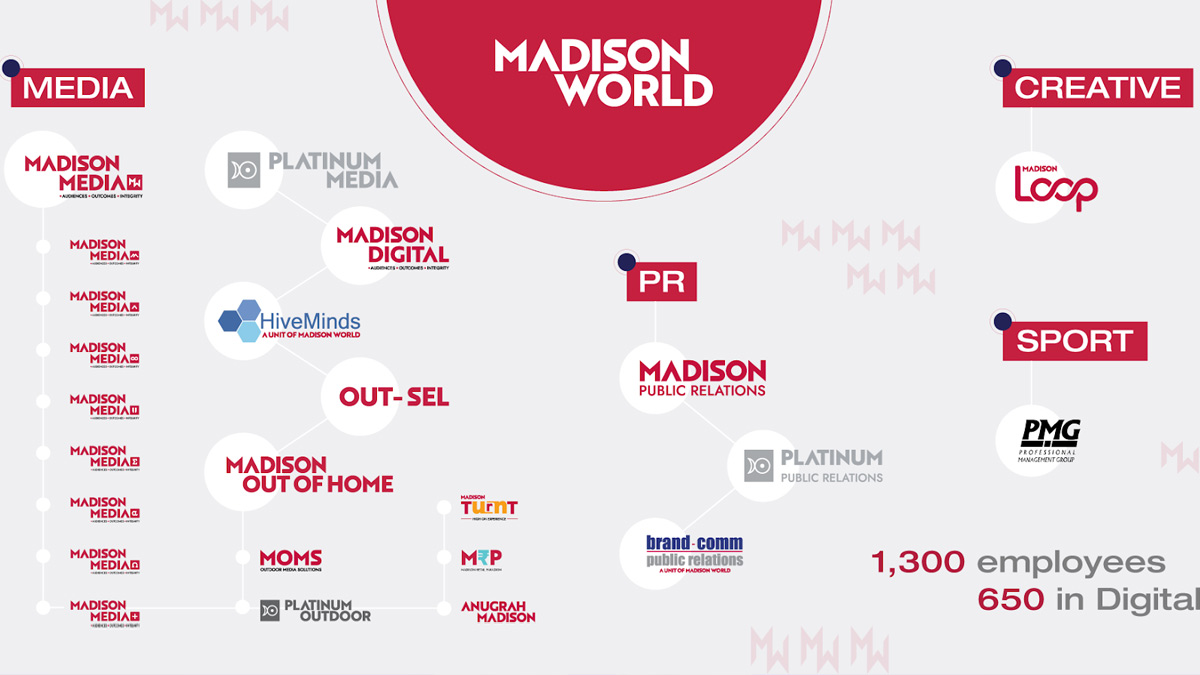
MUMBAI: If media planning once ran on spreadsheets and gut instinct, the next chapter may run on algorithms and curiosity. Madison World is preparing to roll out the first version of its proprietary artificial intelligence platform Madison M BrAIn in early April, as the independent agency group accelerates its transition toward AI driven planning and product led media services.
The platform, expected to involve an investment of around $1 million, is designed to reshape how the agency approaches strategy by combining internal knowledge, external data sources and advanced AI models into a single intelligence ecosystem.
According to Madison Media, OOH and Hiveminds partner and group CEO Ajit Varghese the initiative forms part of a larger structural rethink within the organisation. “Traditionally agencies built frameworks around media planning and allocation. We are redesigning that structure into what we call a Growth Planning System (GPS),” Varghese said.
The shift reflects a growing belief that effective media strategy must begin earlier in the decision making process. Instead of jumping directly to channel allocation, planners must first decode the market itself identifying consumer barriers, purchase triggers and the core challenges facing a brand.
Once those insights are mapped, agencies can build clearer growth agendas for clients and design media strategies that connect more closely with business outcomes.
To support that approach, Madison has built Madison M BrAIn as what it describes as a human AI cognitive ecosystem. Acting as a central intelligence hub, the platform aggregates proprietary insights alongside external data sources and large language models, enabling planners to access deeper market intelligence before building campaign strategies.
Varghese said one of the core objectives is to democratise knowledge across the organisation. “In the past, this level of understanding was largely available to senior leaders or experienced strategists. With Madison M BrAIn, even a junior planner should be able to access the same intelligence and approach clients with a far more informed perspective,” he said.
The agency has already implemented the new planning philosophy internally and completed three months of testing for the AI platform, with early trials showing encouraging results in terms of learning capability and system performance.
While the first version relied on global large language models, Madison is now developing its own proprietary Small Language Model (SLM) to serve as the core of the M BrAIn ecosystem.
“The SLM will be able to read global LLMs, but the LLMs cannot read the SLM,” Varghese explained. “That ensures all the intelligence we build remains within the Madison ecosystem and strengthens our proprietary knowledge base.”
The first version of Madison M BrAIn is expected to go live in early April, with a more refined version targeted by the end of June. Over time, the platform will integrate additional external data streams and APIs including consumer insight platforms, social listening tools and client datasets.
These integrations are expected to enhance the system’s learning capability and enable it to generate increasingly sophisticated strategic recommendations.
Although the platform is currently being deployed for internal use, Madison sees potential for it to evolve into a licensable product in the future.
“At the moment, our focus is to stabilise and strengthen M BrAIn internally. But over time there is potential for this to become a product that could be licensed externally,” Varghese said.
The AI platform is also part of a wider technology transformation underway at the agency group. Alongside M BrAIn, Madison is building a broader digital infrastructure called the Catalyst operating system, which aims to integrate operational processes, data and product platforms into a unified ecosystem.
This broader technology stack could require an additional $1 million to $1.5 million investment over time, though spending will be phased and reviewed regularly.
“We are evaluating progress every three months and prioritising the most critical capabilities first,” Varghese said.
Madison expects the full AI and operating ecosystem to be fully functional within 12 to 18 months, positioning the agency to combine human strategy with machine intelligence as the advertising industry enters its next data driven phase.