MAM
Roy of the newsroom: Jayanta to helm UNI’s English news service
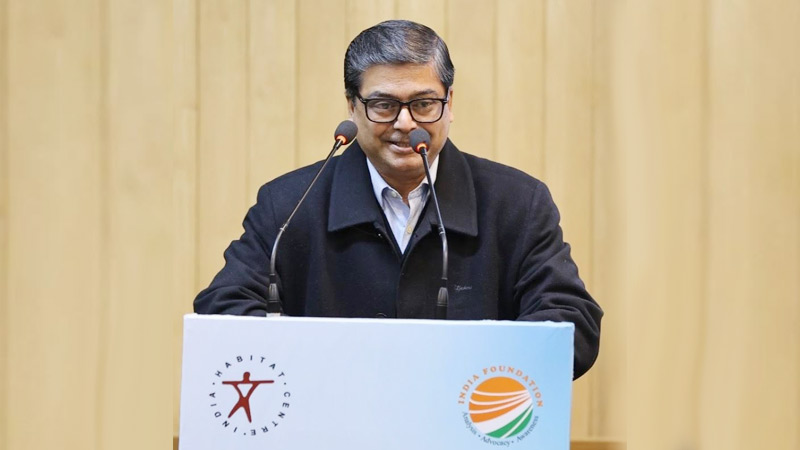
MUMBAI: He’s no stranger to breaking news but this time, he is the news. Veteran journalist Jayanta Roy Chowdhury has been appointed editor in charge of United News of India’s english news wire services, marking another milestone in a distinguished media career spanning over three decades.
Based in Delhi, Roy Chowdhury steps into the role at UNI after a prolific run that has seen him steer editorial teams across some of India’s most respected newsrooms. From Press Trust of India (PTI) to The New Indian Express and The Telegraph, his byline has long been synonymous with sharp economic analysis and credible journalism.
Before joining UNI, he served as Editor of The Secretariat, a multimedia news platform dedicated to long-form, analytical stories on policy and the economy. There, he led a team of a dozen journalists across print, video, and social media shaping in-depth reportage that blended rigour with accessibility.
Roy Chowdhury also recently wore a think-tank hat, serving as director of arthaniti (Economy), where he explored intersections of policy and reform. His earlier tenure as acting resident editor (eastern region) at PTI (2021–2023) further cemented his reputation as a newsroom leader with a knack for both precision and perspective.
His editorial stints have been matched by his academic pursuits, a chevening fellowship at the University of Bradford in 2010 saw him present a paper on the long-term impact of the global financial crisis on India’s reform journey. A Delhi University economics graduate, Roy Chowdhury brings both intellectual depth and newsroom agility to his new role.
Over the years, he has chronicled everything from budget seasons and banking reforms to the fine print of India’s economic transitions. Now, as he takes the reins at UNI’s English service, the journalist who has long interpreted India’s economic story will once again help shape how it’s told.
With his move to UNI, it seems Roy Chowdhury isn’t just editing the headlines, he’s making one.

Brands
Domino’s Q1 profit falls 6.6 per cent, announces $1 billion buyback
Sales rise 3.4 per cent as pizza giant balances growth and shareholder returns
NEW YORK: Domino’s reported a mixed start to 2026, with first-quarter net income slipping even as global sales and store expansion held steady. The company also announced a fresh $1 billion share buyback, underlining its continued focus on shareholder returns.
Global retail sales rose 3.4 per cent on a constant-currency basis to $4.74 billion. The US remained a key growth engine, with same-store sales inching up 0.9 per cent, supported by a 1.5 per cent rise at company-owned outlets.
International markets, however, painted a more uneven picture. While Domino’s added 161 net new stores overseas during the quarter, international same-store sales declined 0.4 per cent. Overall revenues still climbed 3.5 per cent to $1.15 billion, driven by higher supply chain revenues and a 2.6 per cent increase in food basket pricing for franchisees.
On the profitability front, net income fell 6.6 per cent to $139.8 million, compared to $149.7 million a year earlier. Diluted earnings per share dropped to $4.13 from $4.33. The decline was largely attributed to a $30 million unfavourable swing in unrealised gains linked to its investment in DPC Dash Ltd.
Despite this, operational performance showed resilience. Income from operations rose 9.6 per cent to $230.4 million, supported in part by a $7.8 million pre-tax gain from the sale of a corporate aircraft.
Domino’s footprint continued to expand, with the company ending the quarter at 22,322 stores across more than 90 markets. In the US, digital orders remained dominant, accounting for over 85 per cent of retail sales in 2025.
The company also maintained its dividend payout, declaring $1.99 per share, payable on 30 June 2026. After repurchasing $75.1 million worth of stock during the quarter, the new authorisation lifts the total available for buybacks to $1.29 billion.
Domino’s chief executive officer Russell Weiner said the company’s scale and store-level economics position it well to capture further market share in 2026, even as competition intensifies.
As Domino’s leans into expansion and capital returns, the latest results show a business managing short-term pressures while keeping its long-term growth strategy firmly in play.