MAM
Roohafza gets innovative on billboards


MUMBAI: Over the last two months, Roohafza has spread its communication across several multimedia platforms.
Roohafza’s advertising campaign idea for 2014, centred on ‘Be Natural Be Cool’ has been stepped up on the outdoor medium and is targeted towards youngsters of SEC AA, A and B. The task behind the campaign was to bring alive the over 100 years old iconic brand and speak to the new age audience. Kinetic India is the agency that has executed the outdoor campaign.

The campaign brief given to Kinetic was to ensure that the innovativeoutdoor display should serve the brand objective of addressing the natural lineage of the product head-on. Also the campaign is aimed to support and amplify outdoor to TV and print.
Hamdard India brand manager Puneet Kapoor further elaborated, “People perceive Roohafza as a rose based syrup. What’s less known is that Roohafza is a unique blend of 15 herbal ingredients and fruit juices. The campaign aims to build on the natural goodness of the product and at the same time refresh our connect with the younger generation with the message of ‘Be Natural Be Cool’.”
The two month outdoor campaign has rolled out in Mumbai, New Delhi, Aurangabad, Kanpur, Lucknow, Agra, Amritsar, Ludhiana, Chandigarh, Panchkula, Mohali, Ambala, Jaipur, Jodhpur, Ajmer, Indore and Bhopal and ends in mid July.
The main areas covered in this outdoor campaign are key junctions and main arterial routes of the tar. The inventories used in traditional media are billboards, unipole, bus shelters and metro panels with innovation. The innovation is done by keeping in mind a Roohafza bottle of which half indicates different ingredients of the drink and the other half show syrup inside the bottle.
Other than this, the bottle is depicted to be tilted and is being poured in the glass with a cut out of a glass and a base of a lot of ice indicating its best had cold to feel refreshed.
“Our challenge was to bring the wow factor in the outdoor innovation and highlight the unique ingredients of Roohafza. We came up with a solution where we used a larger than life 3D bottle of Roohafza on the outdoor media highlighting the unique mixture of ingredients that goes in making Roohafza,” said Kinetic India vice president and business head Raj Mohanty.





Brands
Wellbeing Nutrition ropes in Malavika Mohanan as brand ambassador
Actor fronts Marine Collagen and Skin Fuel Glutathione portfolio.
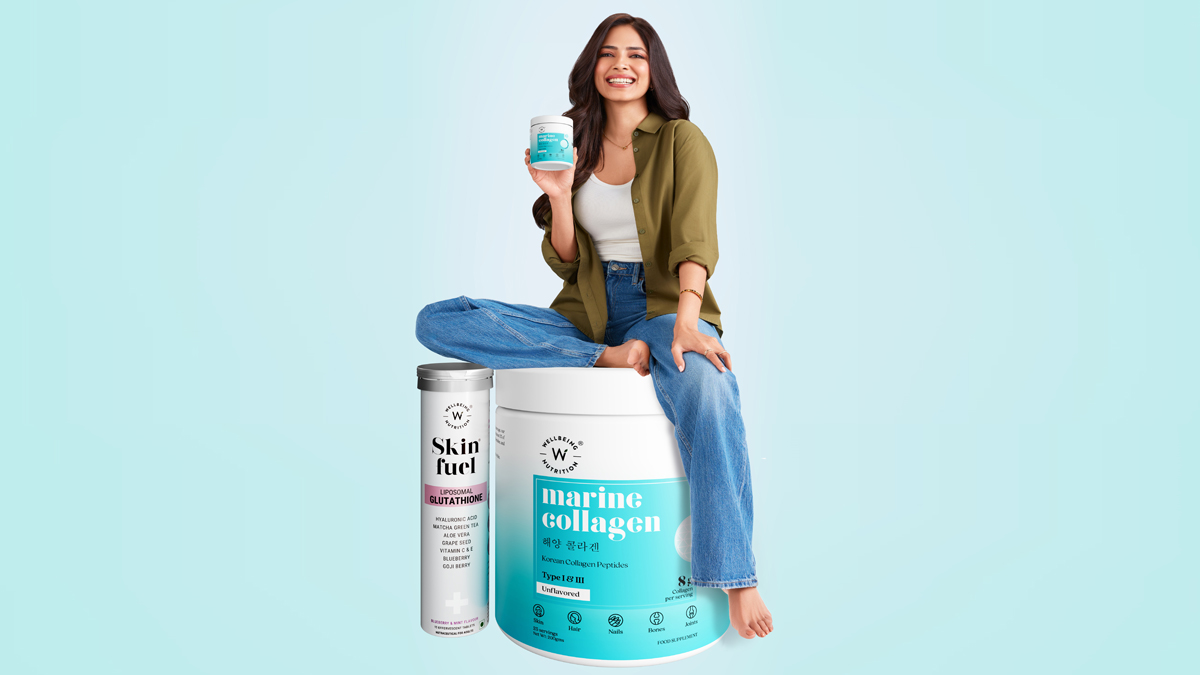
MUMBAI: Malavika Mohanan just became the face of inner glow because when your skincare starts in the bottle instead of the jar, even beauty gets a glow-up from the inside out. Wellbeing Nutrition has appointed acclaimed actor Malavika Mohanan as brand ambassador for its premium Korean Marine Collagen and Skin Fuel Glutathione range. The move signals a deliberate shift in the Indian ingestible beauty segment from surface-level routines to foundation-level nutrition that supports skin health from within.
The campaign positions collagen as the essential “beauty protein” that maintains elasticity and firmness, with daily supplementation reframed as a consistent ritual rather than a quick cosmetic fix. It aims to simplify the science behind collagen and build awareness around long-term skin nourishment.
Wellbeing Nutrition co-founder Saurabh Kapoor said, “In India, collagen is still largely viewed through a cosmetic lens, associated with glow and quick fixes. In reality, it is the primary structural protein of the skin, and we begin losing nearly 1 per cent of it every year in the late 20s. Yet a significant number of consumers remain unaware of its foundational role in long-term skin health. Our goal is to shift the conversation from fixing visible signs to feeding the foundation.”
Malavika Mohanan added, “For me, skincare has always been about consistency and taking care of myself in ways that go beyond just what I apply on my skin. I love the idea of supporting skin health from within, and that’s what drew me to Wellbeing Nutrition’s Marine Collagen and Skin Fuel Gluta.”
The Korean Marine Collagen uses nano-hydrolyzed peptides for better bioavailability, while Skin Fuel Glutathione complements the inside-out approach. The portfolio targets structure, brightness and resilience over time, backed by clinical research.
The ambassador announcement kicks off a broader collagen-focused roadmap for the brand, with planned innovations across formats and functional blends.
In an era where beauty routines are getting deeper than skin, Wellbeing Nutrition isn’t just selling supplements, it’s selling the quiet power of feeding your glow from the inside, one daily scoop at a time.







