MAM
Rising number of SMEs drives growth of Asia-Pacific VSAT market


MUMBAI: The Asia-Pacific VSAT (very small aperture terminal) market is firmly in its growth stage, and has come to represent the new battleground for global VSAT players who are faced with declining growth in other regional markets.
VSAT services are beginning to gain greater acceptance among the SME (small and medium enterprise) and SOHO (small office/home office) segments. The continuous expansion of corporate VSAT networks is also beckoning the next stage of growth for satellite services.
New analysis from global growth consulting company, Frost & Sullivan reveals that revenues of VSAT customer premise equipment (CPE) – covering 13 major Asia-Pacific economies – totaled US$73 million in 2005 and is forecasted to reach an estimated US$109 million by end-2012. The total installed base for VSAT applications is likely to grow to over 900,000 sites by end-2012, from the approximate 300,000 recorded in 2005.

“Future growth in the corporate and enterprise VSAT segment will result from the booming number of SMEs and the associated demand for easily deployable, reliable broadband connections in areas underserved by terrestrial services,” notes Frost & Sullivan research analyst James Lye.
Growth of the VSAT market is also likely to be driven by the increasing deployments of rural telecommunications, telemedicine and distance education programs across the region. Rural telecommunications, in particular, is expected to contribute significantly to growth in this segment as many rural communities in emerging markets of the region still lack modern telecommunication access. Most governments in the region have universal access programs that set aside funds and subsidies to tackle this issue. Such developmental subsidies help to partially offset the initial capital expenditure required to deploy wireless and satellite infrastructures.
VSAT service providers in Asia-Pacific will however need to brace themselves for increasing competition from telecom service providers. Sensing the same opportunities in the underserved areas, terrestrial telecommunication providers have been rolling out infrastructure as fast as they can justify it. These telcos are furthermore emphasizing the managed services model among enterprise customers, which increases revenue per customer and builds very strong loyalty due to the provision of complete solutions.
“Telecom service providers often wait until the local market is sufficiently developed before moving in with lower pricing to oust the VSAT providers,” explains Lye. “The hardest hit segment is where VSAT is used solely to deliver broadband access.”
The overall Asia-Pacific VSAT market is expected to experience continued and steady growth over the next few years, offering considerable opportunities for both VSAT equipment vendors and satellite service providers. India and Indonesia are seen as markets with high growth potential. Indonesia’s geography, combined with the lack of foreseeable terrestrial infrastructure build-out has already created a lucrative SME market in the corporate VSAT segment.
While growth in India’s VSAT sector will come mainly from the myriad of small and medium businesses that are flourishing as the country opens-up its economy with the liberalization of regulatory barriers to foreign players.







MAM
One Hand Clap acquires Agenseed to enter distribution space
Creative agency expands into full-stack services with strategic buyout.
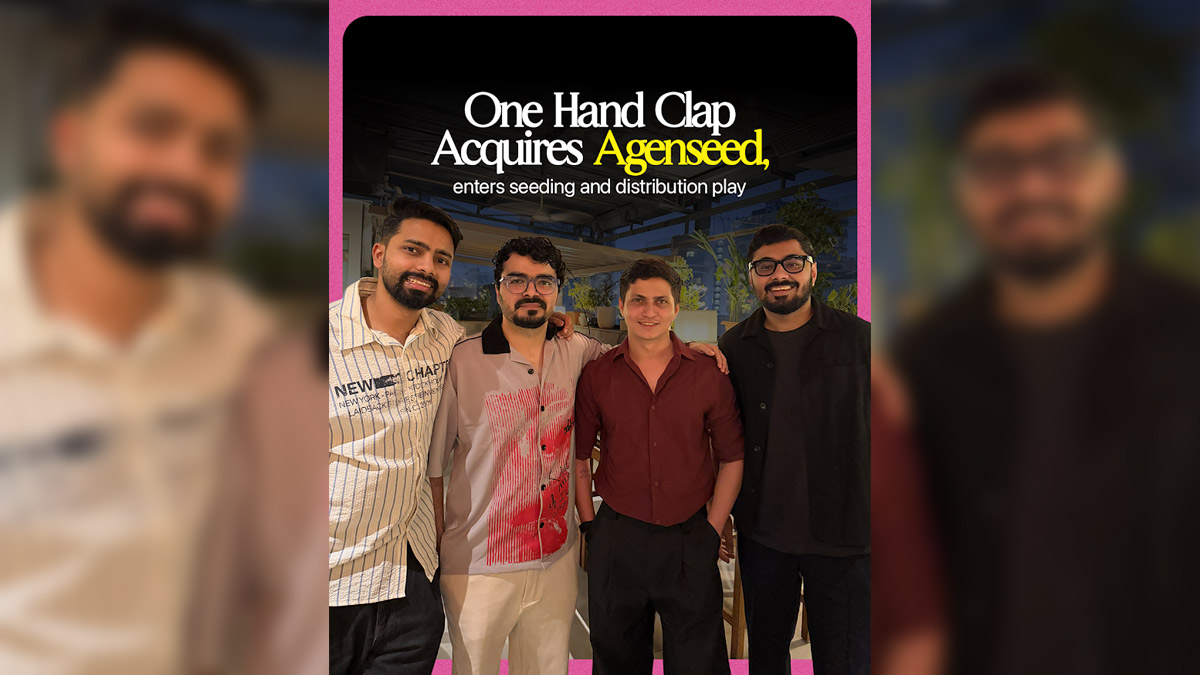
MUMBAI: One Hand Clap has decided to stop just clapping for great ideas now it wants to make sure they actually travel. The leading new-age creative agency and production house has acquired Agenseed, a seeding and distribution firm, marking its formal entry into the distribution segment. The move is aimed at expanding its role across the entire marketing value chain and unlocking new growth opportunities.
One Hand Clap expects the new distribution vertical to contribute up to 15 per cent of its overall revenues over the next 12–18 months, signalling a clear strategic shift beyond pure creative services.
Agenseed, founded by Monish Hardasani and Akram Malik, will function as the agency’s dedicated distribution arm. This acquisition strengthens One Hand Clap’s position as it aims to become a full-stack creative and distribution company in India’s rapidly growing digital advertising market.
With over 90 million posts shared daily on Instagram and brands allocating 25–35 per cent of their digital budgets to distribution and creator-led reach, amplification has become critical to campaign success. By integrating distribution early into the creative process, the agency hopes to help campaigns gain stronger cultural traction and momentum.
One Hand Clap founder Aakash Shah said, “The future of advertising is not just about executing great ideas, but about placing them intelligently. By owning both storytelling and distribution, we can drive greater impact for brands while opening up new revenue streams.”
Agenseed co-founder Monish Hardasani added, “The future belongs to ideas designed to travel. This partnership allows us to integrate distribution thinking at the source.”
Founded in 2019 by former AIB leaders Aakash Shah and Naveed Manakkodan, One Hand Clap has worked with major brands including Swiggy, Google, Netflix India, Crocs, Duolingo, CRED, Bumble, BGMI and Chetak. The agency also secured investment from Zerodha co-founder Nikhil Kamath last year.
In an increasingly fragmented attention economy, this acquisition reflects a broader industry shift where agencies are building end-to-end capabilities to stay competitive. One Hand Clap is clearly clapping louder and ensuring its ideas now reach much further.






