MAM
Redifining the Rules

Two years ago, the top brass of India ‘s numero uno media agency Mindshare, huddled together in Lonavla’s Fariyas Hotel. In the room, were Mindshare MD South Asia Vikram Sakhuja, Group M CEO South Asia Ashutosh Srivastava and his predecessor Andre Nair. The discussion centered around the challenges that media agencies were facing, Mindshare’s role in the entire Group M scheme of things, and the road that the agency should take. The brainstorming went on for hours and the result was a gameplan strategy which is being rolled out now and changing the very innards of Mindshare.(To know more about how Group M the holding company of Mindshare is structured in India,click here)
 Hear out what Sakhuja has to say what brought about the rethink on Mindshare. Says he: “In this competitive environment, where dog eats dog, and where everybody is undercutting their business, a client goes where he gets it cheaper. This is only because they are still viewing life from a media buying perspective. We discovered we were not getting value for the services we were providing.”
Clearly, even the largest media agency understands that it cannot sit back and relax. It has to constantly innovate and even re-engineer itself to survive; which is the process that is on in Mindshare today. Shedding its skin of that of a traditional media buying/planning outfit, Sakhuja and his team are donning a garb which allows them to transform the agency into one with a communications based approach.
“Fame & Money, 20 by 6 and extending into non-traditional media is what we decided to zoom in on,” says Sakhuja.

The catch-all phrase “fame and money” encompasses a philosophy which espouses that Mindshare will get its clients brand recognition at a cost effective price and give them a return on their investment that will make them sing.
Explains Sakhuja: “Most of the agencies are looked at as media buying shops. We want to be known as more than media buying shops. We will make out clients’ brands famous and rich on the back of plans routed on insight which activates the brand using content, touch points and direct. Marketing is using communication to get consumers to behave in a particular manner. All of this is wrapped up in the ROI mode where one demystifies the science of media and brings in accountability.” (To know more about the Group M buying process click here)
To ensure this, Mindshare has woven its strategy around five basic tenets or pillars which will help it attain the unit’s avowed goal of Fame & Money for its clients:
* Insight: The communication plan will draw insights that will underline consumer behavior, media consumption and accordingly, sketch a solution that uses these angles, not restricting it only to plans based on reach, frequency and ratings.
* Content: The planning approach will bring in the activation platform ensuring personification of the brand via brand-consumer experiences. This activation would be done by using content and touch points in a big way. Content could be in the form of films, serials, properties, in-product placement.
* Touch Points: Mindshare has listed eight touch points where a consumer can be impacted – Home, On the move, Work, Education, Entertainment, Lifestyle, Eating joints, and Shopping. According to Sakhuja, Mindshare is geared up in the entertainment and education space, and the focus today is on ‘Shopping’ and a division called D-mart has been set up to beef up skills in this area.
* Direct – Which entails the interactive digital route – SMS, Web,…
* Return On Investment (ROI) – Working on the modeling which will tell the client how their sales will grow.
So, while ‘Fame& Money’ is Mindshare’s new lingo, the vision is called 20/6. The 20/6 vision stands for a guaranteed tangible return of at least 20 per cent of the client’s total marketing investment. Once that is delivered, Mindshare opines that it would be fairly entitled to a 6 per cent commission on that marketing investment.
Sakhuja asserts, “We are telling our clients that they will be tangibly growing their topline, reducing their costs and hence also growing their bottom line not only by better rates but also by using numerous other factors and elements. Hence, six per cent in this scenario for the media agency is definitely not an unfair ask.”
Apparently, clients who have been communicated this proposition have taken well to it, as this would bring about ownership, accountability and more importantly, Mindshare will be putting its money where its mouth is.
|
New Biz : 04′- 05′
|
|
Boots Healthcare
|
|
HSBC
|
|
ICICI Prudential
|
|
Apollo Tyres
|
|
Motorola
|
|
Tata Steel
|
|
Century Plyboards
|
|
Indian School of Business
|
|
PCI
|
|
Venkateshwaran Hatcheries
|
|
Kingfisher Airlines
|
|
Star TV
|
|
SS Music
|
|
Duke Biscuit
|
|
DNA
|
|
Legrand (India)
|
|
Vedant Aliumanium
|
|
Gini & Johny
|
In keeping with its thinking that it cannot work below a certain margin, the agency’s management is jettisoning business that does not match with that philosophy. Bajaj was one such account which sent a ripple through the media market when Mindshare chose not to continue with it.
“Bajaj was an account where they wanted us to work on a very low commission and hence we resigned the business,” say Ashutosh Srivastava and Sakhuja. “The second reason being, sharing rates with a media audit company. We feel it erodes our competitive advantage in the market. Also, considering we have a third of the market with us, we’d rather use our own bench marks than a media audit company which also gets rates from everybody else.”
Another reason the agency chose to drop the account was because media owners called up and told Mindshare’s managers not to divulge the rates the agency commanded from them if they wanted to continue getting them. “We have our benchmarks and it hurts our business to share rates. But the basic issue why we chose not to continue with Bajaj was they wanted us to work on a low commission.”
| Key Accounts |
|
HLL
|
|
Pepsico Intl
|
|
Frito Lay
|
|
Pizza Hut
|
|
GSK
|
|
HSBC
|
|
ICICI Prudential
|
|
ICICI Mutual Funds
|
|
ICICI Bank
|
|
Gillete
|
|
IBM
|
|
Ford
|
|
DTC
|
|
HPCL
|
|
Onida
|
|
UB Group |
|
Kingfisher Airlines
|
|
Godrej
|
|
Motorola
|
|
Castrol
|
|
Tata Steel
|
|
Berger Paints
|
|
Star TV
|
|
Nike
|
Mindshare currently commands 23 per cent of the market with a total of 130 clients. Seventy per cent of the business comes from media only clients. Mindshare currently has offices in Bangalore, Calcutta, Chennai, Delhi, Bangalore and Mumbai. The Mumbai office is split into units – Mindshare 1 & Mindshare 2 due to conflicting businesses. Mindshare Fulcrum – which is Unilever’s dedicated media unit has two offices – Mumbai and Bangalore. (To know more about each of Mindshare’s offices its revenue pie click here.)
A sub-brand termed Motivator came into existence a year and a half ago. With two offices located in Delhi & Mumbai, Motivator was formed for clients who by and large have buying and planning implementation needs. Hence, plans are simpler and do not delve into heavy analytics. The current base of Motivator is 65 clients; the focus being productivity, efficiencies and a horses-for-courses set up.
In terms of its revenue split up, 60 per cent of Mindshare’s revenue comes from global businesses, 35 per cent from local businesses and 15 per cent from the emerging non traditional mediums (NTM). (Have a look at what Mindshare’s clients and media owners have to say.)
Explains Sakhuja, “Although all of the three streams are on the growth path, the engines of growth are more in the non traditional space. Two years ago, the contribution in terms of revenue from non traditional media (NTM) stood at 2 per cent, while today it accounts for a good 15 per cent.”
In the NTM space, entertainment, modeling, digital and Touchpoints (in that order) are revenue drivers. Mindshare states that it has scaled up and made huge investments to support its work in the entire communications arena.
“We have made investments in a research called 3D, which is in the insight area, where one can go much beyond the NRS’ and the TGIS’ into actually having a single source data tracking brand relationships, consumer psychographics and behaviors that will deliver a report on how to deliver specifically for a brand.”
He adds that 3D modeling allows tracking of several thousand people across 25 categories across brands. “We invest over Rs 10 million every year to get this up and running. It makes eminent sense to be able to offset that cost across a much larger set of clients.”
 |
|
Mindshare Fulcrum’s award winning innovation
|
Similarly, the agency has opened a separate unit for entertainment.
“We have tied up with studios, distributors and exhibitors, music and content owners. With each of them, we have built certain linkages and got relationships going. Also, for a lot of these initiatives, we have struck strategic alliances with specialists in different areas,” says Sakhuja.
Sakhuja states that Mindshare’s strength comes from its global clients, adding that the agency has a fair collection of large blue chip Indian clients as well. Industry estimates peg Mindshare’s billings at Rs 17,000 million. It has had a good run since the beginning of 2004, pocketing a total of 30 clients from then till date; its biggest win being HSBC, which is a global business. Other significant wins in terms of spends were ICICI Prudential, HPCL, Tata Steel, UB Group and Motorola. (Click here for Mindshare’s award winning Horlicks Whizkids case study.)
An important factor that Sakhuja highlights that will help the agency achieve its ’20/6′ and ‘Fame & Money’ vision is Mindshare’s strongly cemented global network.
“We’re probably the best global network in the world. Hence any multinational client who has got interests outside India cannot get a better network. In fact, in a number of cases, we find our network stronger that the clients own network. If a client has a global brand vision which has to be cascaded over several markets; we have a strong network in India, Pakistan, Sri Lanka and Bangladesh where we can implement the brief in a flash. Also the network extends to the rest of Asia.”
He pointed out that Mindshare has made heavy investments in building the network. Moreover, global accounts and regional teams meet on a regular basis. Says Sakhuja, “I spend 10 -15 per cent of my time on some of our global businesses at a global forum where we take these agendas and move them. The power of synergies comes to bear in a big way in these things. And at times when we see our clients trying to work their network to do the same things, I find us faster and more synergised. Increasingly, global businesses are seeing a value in all of this.”
Scale is an unmatchable advantage that Mindshare has being part of the large megalith called the WPP group and Group M. With an array of agencies right from the recent Mediacom to Maxus to MEC, Group M the holding company, has almost 40 per cent of the market under its belt.
States Srivastava, “This is where we use our benchmark systems, when one has 40 per cent of the market share and if the data is mined intelligently, the power that one has to make decisions is immense, and I think we are doing it very responsibly.”
Sakhuja adds that the agency has a strong bench strength, “We have some serious talent, and when talent is scarce in the industry; our top brass is very stable. We also have the bench strength which other agencies don’t have.”

While that might be true, Mindshare today faces the highest attrition rate in the industry. And interestingly, most of them them quit the industry.
Agrees Sakhuja. “The reason for this is quite clear. Media professionals who join us have to start with doing a lot of grunt work. Although we have made some serious investments in the back end automation to reduce this as far as possible, we are still not there yet. The returns on the investment made are yet to come. “
Sakhuja points out that the management has not done a very good job in showing people good career paths. “…despite actually having very good career opportunities; but these come in spurts,” he says
“Today, we offer career paths either in the GM route / entrepreneur route – content, modeling/ functional skills in the area of buying, planning and training related areas and being a part of the global account teams which is an increasing trend – where global teams are formed for MNC’s.”
He adds: “The manpower planning side needs to move into a well oiled segment. And although the plan and vision is there, the staff is not seeing it.”
 Mindshare seems to be losing all its people to either media owners or clients. “By giving them a large 360 degree space bandwidth, Mindshare for a lot of new entrants becomes a training ground hence become hot recruits for clients.”
“Also, we also have to look into client continuity as clients don’t like disruptions in their business. We also need to ensure that our internal shop has able hands as outside talent is also slow to come. Somewhere along the way, with some concerted effort, things should fall into place,” Sakuja says with confidence.
As an organization, the perception is that Mindshare is quite “uptight” and the aim for the top management is clearly to loosen up. Says a thoughtful Sakhuja, “Yes, we are quite uptight, considering the pressures and deadlines. We do need to ease out and add a human touch.”
That touch might well help him achieve the vision he has set for Mindshare.





MAM
One Hand Clap acquires Agenseed to enter distribution space
Creative agency expands into full-stack services with strategic buyout.
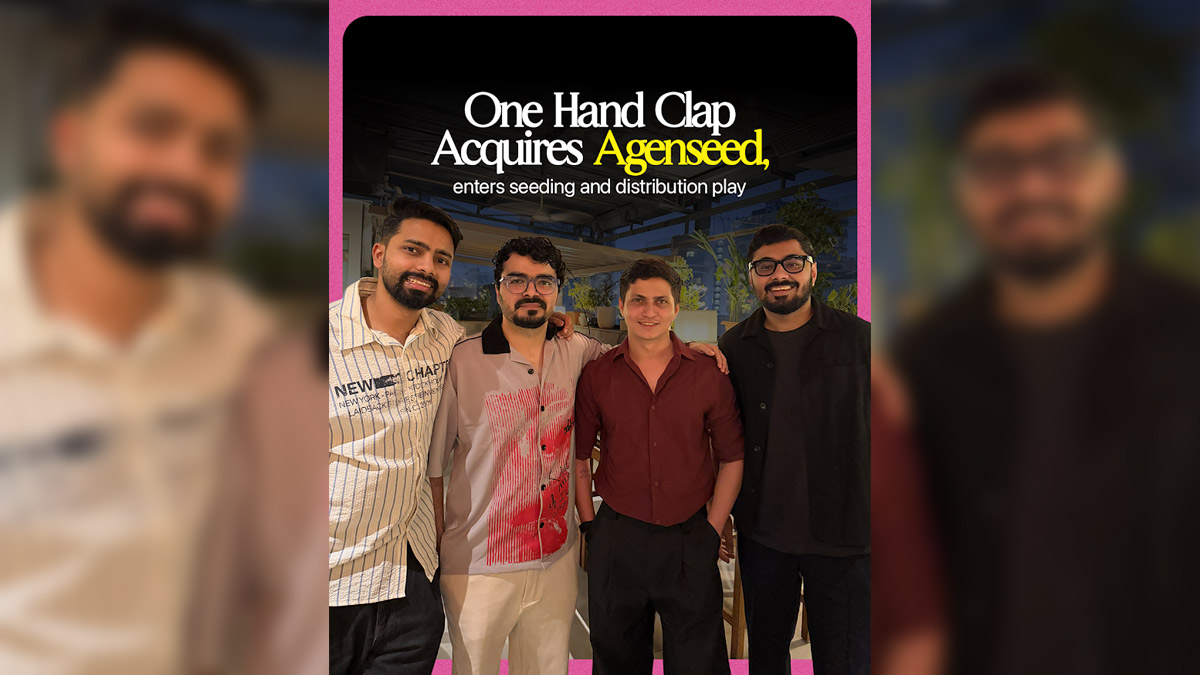
MUMBAI: One Hand Clap has decided to stop just clapping for great ideas now it wants to make sure they actually travel. The leading new-age creative agency and production house has acquired Agenseed, a seeding and distribution firm, marking its formal entry into the distribution segment. The move is aimed at expanding its role across the entire marketing value chain and unlocking new growth opportunities.
One Hand Clap expects the new distribution vertical to contribute up to 15 per cent of its overall revenues over the next 12–18 months, signalling a clear strategic shift beyond pure creative services.
Agenseed, founded by Monish Hardasani and Akram Malik, will function as the agency’s dedicated distribution arm. This acquisition strengthens One Hand Clap’s position as it aims to become a full-stack creative and distribution company in India’s rapidly growing digital advertising market.
With over 90 million posts shared daily on Instagram and brands allocating 25–35 per cent of their digital budgets to distribution and creator-led reach, amplification has become critical to campaign success. By integrating distribution early into the creative process, the agency hopes to help campaigns gain stronger cultural traction and momentum.
One Hand Clap founder Aakash Shah said, “The future of advertising is not just about executing great ideas, but about placing them intelligently. By owning both storytelling and distribution, we can drive greater impact for brands while opening up new revenue streams.”
Agenseed co-founder Monish Hardasani added, “The future belongs to ideas designed to travel. This partnership allows us to integrate distribution thinking at the source.”
Founded in 2019 by former AIB leaders Aakash Shah and Naveed Manakkodan, One Hand Clap has worked with major brands including Swiggy, Google, Netflix India, Crocs, Duolingo, CRED, Bumble, BGMI and Chetak. The agency also secured investment from Zerodha co-founder Nikhil Kamath last year.
In an increasingly fragmented attention economy, this acquisition reflects a broader industry shift where agencies are building end-to-end capabilities to stay competitive. One Hand Clap is clearly clapping louder and ensuring its ideas now reach much further.






