Brands
Q3 Results – Adani Wilmar Limited records 13 per cent volume growth

Mumbai: Adani Wilmar Limited (AWL) records a strong 13 per cent volume growth in 9M FY24, with broad based growth across all segments. Sequential revenue growth of 5 per cent QoQ (Q3’24 vs. Q2’24). In 9M ’24, the food & FMCG segment recorded a revenue of Rs 3653 crore, a 26 per cent YoY growth company achieved best EBITDA till date, at Rs 504 crore in Q3.
The company’s growth trajectory remained steady with a volume growth of 5 per cent YoY in Q3’24 and 13 per cent YoY in 9M FY’24. Consumer demand in packaged staple foods stayed strong during the festive season of Q3. The branded products that comprises 80 per cent of edible oils and Foods & FMCG sales, grew faster than the overall sales in both segments. Rural sales also stayed steady for us. Despite good volume growth, revenue is optically lower by 17 per cent YoY in Q3, as product pricing has been lower during the year, in-line with lower raw-material costs.
The company recorded revenue of Rs 12828 crore in Q3 and Rs 38024 crores in 9M FY’24. The profitability of the company has again normalised with EBITDA at Rs 504 crore. In Q3, after witnessing 2 quarters of subdued profits due to high-cost inventory and hedge dis-alignment. Profitability of the Bangladesh subsidiary continues to be in stress due to the local currency issues. Standalone EBITDA was higher at Rs 530 crore in Q3.

The company is progressively using more regional approaches to drive deeper penetration into the local markets. The company is on track to more than double its rural town coverage during the financial year from 13,000 towns to more than 30,000 rural towns by the end of this financial year. The company has been adding new markets and our branded products are now available in 38 countries across six continents.
Edible oil
The volume was flat YoY in Q3 and grew by 8 per cent YoY during 9M FY’24. Branded products have been growing at a faster pace. Branded products grew by 3 per cent YoY in Q3 and 15 per cent YoY in 9M FY’24. ROCP (refined oil consumer pack) market share of AWL in edible oils reached 19.8 per cent in Dec ‘23 on MAT basis (source: Nielsen), which is an improvement of 30 bps vis-à-vis the same period last year.
The segment recorded revenue of Rs 9711 crores in Q3, with sequential growth of 7 per cent compared to Q2. In YoY terms, revenue is optically lower by 23 per cent YoY in Q3 ‘24, as product pricing has been lower during the year, in line with lower raw-material costs.
The growth in the edible oils segment continues to be driven by strong growth in sunflower oil and mustard oil, which have been growing faster than the industry due to strong brand equity.
Food & FMCG
The Food & FMCG segment, which includes products such as wheat flour, rice, pulses, besan, sugar, poha and soap continued to outperform. During the quarter, the segment revenues grew at 25 per cent YoY, with an underlying volume growth of 17 per cent YoY.In 9M FY’24, the segment delivered a turnover of Rs 3653 Crores, a robust growth of 26 per cent YoY.
Exports restriction has been a drag on foods growth in the last three quarters. In the domestic market, branded products revenue has been growing at 40 per cent plus YoY for the last nine quarters.
Wheat business gained share in South India from multiple interventions. This led to a significant improvement in volume off take in Q3, increased penetration in retail outlets, and created pull demand from retailers. In South India, branded penetration is high for the industry, along with good pricing power for brands. We will continue to focus on the South India market to gain our fair share.
Industry essentials
The industry essentials volume grew by 17 per cent YoY in Q3 ’24 and 21 per cent YoY in 9M FY’24, supported by robust growth in Castor & Oleochemical businesses. The segment recorded revenue of Rs 1844 in Q3 and Rs 5777 in 9M FY’24.
Key highlights –
1 Volumes show strong resilience and reflect robust consumer demand, growing at 5 per cent YoY in Q3 and 14 per cent YoY for 9M FY24 across all segments.
2 Branded products, which are 80 per cent of sales of edible oils, Foods & FMCG, show higher growth.
3 Branded Food & FMCG in the domestic market has shown market-beating growth of over 40 per cent YoY in the past 9 quarters with the segment expected to touch a milestone revenue of Rs 5000 crores for FY ‘24.
4 Rural demand is stable, belying expectations of weak rural demand having a major impact on consumer goods sales.
5 Company on track to more than double rural coverage from 13000 to over 30000 rural towns by the end of FY24.
6 Revenue dip reflects lower prices of edible oils in response to decline in input costs of raw materials. However, strong brand equity drives growth in sunflower oil and mustard oil faster than the industry.
Commenting on the results Adani Wilmar Limited MD & CEO, Angshu Mallick said: “We continued to witness the growth momentum in packaged staple foods driven by shift in consumer preferences for hygienic and quality products. The revenues from the branded products in the domestic market, under the Food & FMCG segment have been growing at 40 per cent plus YoY in the past 9 quarters enabling us to close FY ’24 with an estimated Rs 5,000 crores of revenue in the segment.
We are putting our energies in rapidly scaling up our distribution network for general trade to realise the immense opportunity available in the packaged staple foods. At the same time, we are developing our HORECA and exports channels which will continue to witness much faster growth in the near future. Our strong market share in the alternate channels put us in an advantaged position from the fast-growing rate of this channel.”


Brands
Samsung certifies 1,000 Maharashtra students in AI and coding
The South Korean electronics giant marks its first large-scale skilling push in the state, with women making up nearly half the national programme’s enrolment
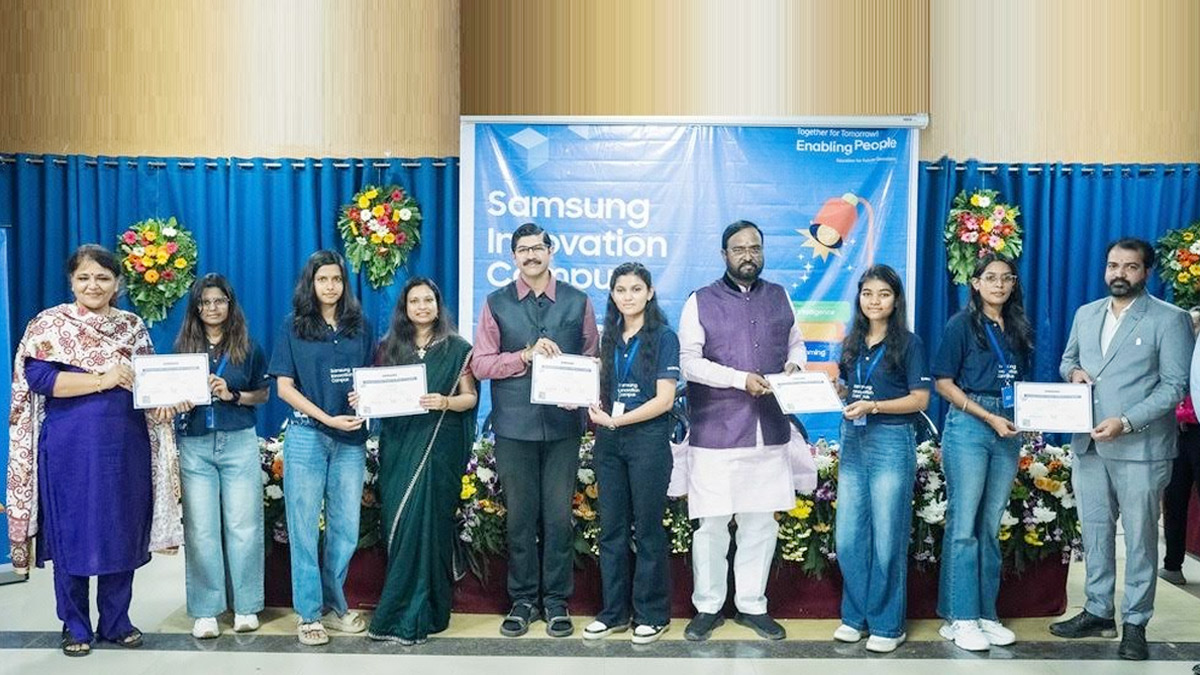
PUNE: Samsung has put 1,000 students in Maharashtra through a certified training programme in artificial intelligence and coding, the largest such drive the South Korean electronics company has run in the state and a signal that corporate India’s skilling ambitions are moving well beyond the boardroom brochure.
The certifications were awarded under Samsung Innovation Campus (SIC), the company’s flagship corporate social responsibility programme, which launched in India in 2022 with the stated aim of democratising access to future-technology education. The 1,000 graduates were drawn from four institutions: 127 from Savitribai Phule Pune University, 373 from Pimpri Chinchwad University, 250 from D.Y. Patil University’s Ramrao Adik Institute of Technology and 250 from Anjuman-I-Islam’s Kalsekar Technical Campus. All completed training in either AI or coding and programming, the two disciplines Samsung has identified as the critical pillars of the digital economy.
The programme does not stop at technical training. Soft-skills development and career-readiness modules are baked into the curriculum, a deliberate attempt to close the gap between what universities teach and what employers actually want.
“India’s digital growth story will ultimately be shaped by the quality of its talent pipeline,” said Shubham Mukherjee, head of CSR and corporate communications at Samsung Southwest Asia. “As technologies like AI move from the periphery to the core of industries, skilling must evolve from basic training to building real-world capability. This milestone in Maharashtra reflects how industry and academia can come together to create a future-ready workforce that is both globally competitive and locally relevant.”
The Maharashtra drive sits within a rapidly scaling national effort. Samsung Innovation Campus trained 20,000 young people across India in 2025, hitting its stated target for the year. Women account for 48 per cent of national enrolments, a figure the company cites as evidence of its push for an inclusive technology ecosystem. The programme is implemented in partnership with the Electronics Sector Skills Council of India and the Telecom Sector Skill Council.
Samsung, which is marking 30 years in India this year, runs SIC alongside two other initiatives, Samsung Solve for Tomorrow and Samsung DOST, as part of a broader effort to build what it calls a generation of innovators with both the technical depth and the problem-solving mindset to thrive in a fast-moving digital world.
A thousand certified students is a tidy headline. Whether they find jobs that match their new skills is the harder question, and the one that will ultimately determine whether corporate skilling programmes like this one are genuine pipelines or well-photographed gestures.






