Brands
Q2-2016: Ad exp down 30.5 percent; watches sales grow, jewellery pulls down Titan’s numbers

BENGALURU: Last quarter (Q1-2016) Titan Company Limited (Titan) spent the highest amount towards advertisement (Ad spend) both in terms of absolute rupees and percentage of Total Income from Operations (TIO) at Rs 128.84 crore and 4.8 percent of TIO. This quarter (quarter ended September 30, 2015, Q2-2016, current quarter), Titan reduced its Ad Exp by 15.4 percent YoY to Rs 89.52 crore (3.3 percent of TIO as compared to Rs 105.83 crore (2.9 percent of TIO) and reduced Ad exp QoQ by 30.5 percent from the figures mentioned above for Q1-2016.
Note: 100,00,000 = 100 lakh = 10 million = 1 crore
Segment Performance

Titan has 4 revenue segments – watches having the brands –Titan, Xylus, Nebula, Sonata, Fastrack and Zoop; Jewellery with Tanishq, Zoya, Gold Plus from Tata, Mia and Fq teen diamonds; Eyewear under the Titan EYE+ brand and ‘Other’ such as precision engineering among others.
Titan’s Jewellery business is its major revenue generating stream that contributes more than 70 percent to the company’s revenue. In the current quarter, jewellery business revenue reduced 32.9 percent (declined by Rs 1,000 crore) YoY to Rs 1,929 crore (72.7 percent net sales) from Rs 2,929 crore (82.2 percent of net sales). The company’s Watches division is the next major division in terms of revenue contribution. Revenues from watches grew 4.4 percent (increased by Rs 23 crore) YoY to Rs 546 crore (20.6 percent net sales) from Rs 523 crore (14.7 percent net sales). Titan explains the reason for the decline in a release that says that retail sentiment has been extremely poor in this quarter and that the watches division, backed by activations for both Titan and Fastrack brands grew in income by 4.4 percent. A new sub-brand ‘SF’ by Sonata in the adventure sports segment was launched during the current quarter.
Titan’s Eyewear business which contributes just 2 to 3 percent to the company’s revenue, reported 14.3 percent (increased by Rs 11 crore) YoY growth in revenue to Rs 88 crore (3.3 percent of TIO) from Rs 77 crore (2.2 percent of TIO). On a YTD basis, (6 months of the current fiscal), Titan says that the decline in profits from this segment is due to higher Sales promotion and Advertising costs in the first quarter.
As a consequence of the huge decline in revenue from Jewellery sales, Titan’s TIO in the current quarter fell 25.6 percent (reduced by Rs 919.59 crore) YoY to Rs 2,673.48 crore from Rs 3,593.07 crore. Net Sales fell 25.5 percent (reduced by Rs 910 crore) YoY to Rs 2655 crore from Rs 3565 crore. Qoq, the TIO decline was much lower at 1.3 percent from Rs 2708.59 crore. QoQ, net sales in the current quarter reduced by 1.2 percent (reduced by Rs 32 crore) as compared to Rs 2,687 crore.
Advertisement spend trends
Please refer to fig A below for Titan’s Ad expenses over a fifteen month period starting Q4-2012 (quarter ended March 31, 2012) until the current quarter.
As mentioned above, during the fifteen quarter period under consideration in this report, Titan’s Ad spends were the highest in the previous quarter (Q1-2016), both in absolute rupees and in terms of percentage of TIO. Lowest Ad spends during the same period in absolute rupees and in terms of percentage of TIO were in Q4-2103 at Rs 66.63 crore and 2.5 percent of TIO respectively.
During the fifteen quarter period under consideration in this report, Titan’s ad spends show a linear increasing trend in terms of absolute rupees as indicated by the broken blue trend line, while ad spends in terms of percentage of TIO show a slow linear decline as indicated by the broken maroon line in Fig A.

Please refer to Figure B below. As mentioned above, the company’s TIO in Q2-2016 fell 25.2 percent YoY and reduced 1.3 percent QoQ. During the fifteen quarter period under consideration in this report, TIO shows a linear increasing trend as indicated by the broken orange trend line in the figure below.
PAT in Q2-2016 at Rs 145.39 crore (5.8 percent margin) reduced 39.4 percent YoY from Rs 239.98 crore (7.3 percent margin) and reduced 3.8 percent QoQ from Rs 151.06 crore (6 percent margin). PAT in absolute rupees and in terms of percentage of TIO (margin) show a linear increasing trend as indicated by the broken military green and broken grey trend lines in the figure below during the fifteen month period under consideration in this report.

Company Speak
Titan Managing Director Bhaskar Bhat said, “This was an extremely challenging quarter for the company and we witnessed an income decline of 25 percent. While our watches business witnessed a growth of low single digit at 4.4 percent the jewellery business had a difficult quarter with a decline over last year. The industry saw a tough period with gold imports declining significantly. The decline in jewellery sales was also on account of discontinuation of our Golden Harvest Scheme. The Eyewear business continues to register double digit growth. All our brands are working on new product and marketing campaigns for the festive season ahead.”







Brands
ITC Sunfeast Farmlite launches Sugar Free Cookies range
New variants offer guilt-free indulgence for health-conscious snackers.
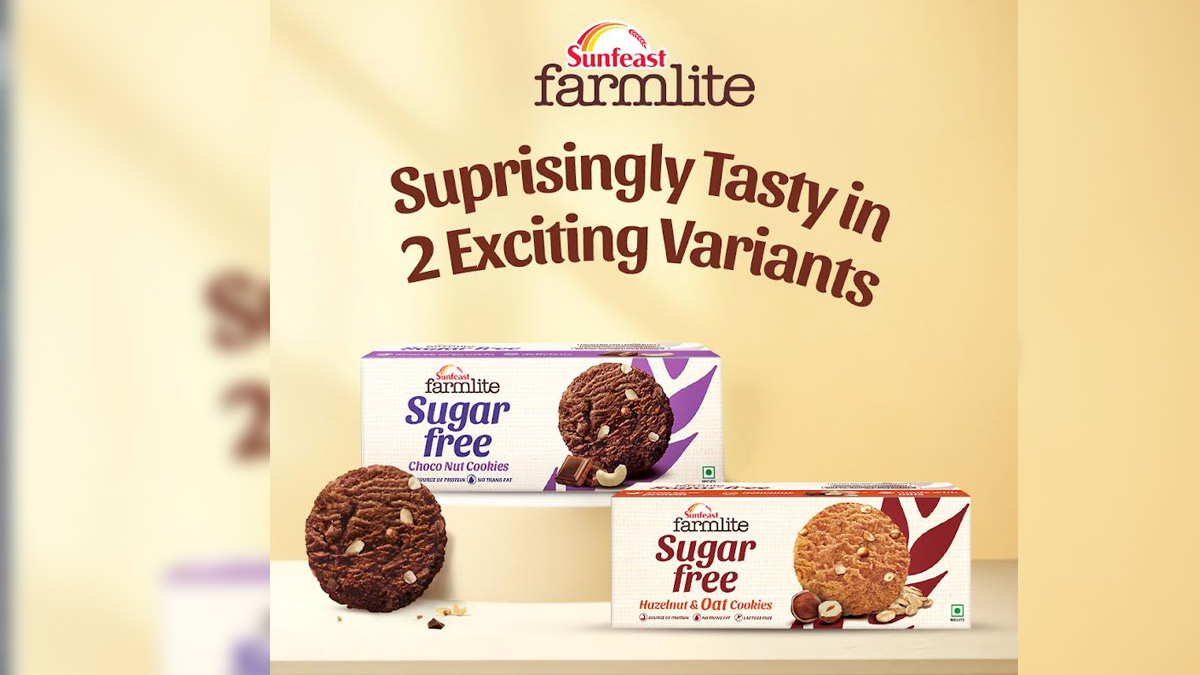
MUMBAI: ITC Sunfeast Farmlite is sweetening the deal for biscuit lovers who want to have their cookie and eat it too without the sugar. The better-for-you biscuits range from ITC Foods has expanded its portfolio with the launch of an all-new Sugar Free Cookies line, aligning with the company’s vision of ‘Help India Eat Better’. The range is designed for consumers who are rethinking sugar in their daily snacking but refuse to compromise on taste and indulgence.
The collection debuts with two tempting variants: Choco Nut Cookies and Hazelnut & Oats Cookies. Both are a source of protein and contain no trans-fat, while the Hazelnut & Oats variant is also lactose-free.
ITC Ltd. vice president (marketing), biscuits, foods division, Suraj Kathuria said, “At Sunfeast Farmlite, we believe mindful snacking should never come at the cost of indulgence. With this launch, we are catering to the growing need for guilt-free snacking while delivering a rich, satisfying cookie experience.”
ITC Ltd. vice president & head of food sciences for foods division Dr Shantanu Das added, “We have applied robust food science to develop cookies that are sugar-free while preserving the taste and texture consumers love.”
Each cookie comes in convenient single-serve packs to maintain texture and freshness. Both variants are available in 100g packs priced at ₹100 and can be found on quick-commerce platforms including Blinkit, Swiggy Instamart, and Zepto.
In a market increasingly leaning towards healthier choices, ITC Sunfeast Farmlite’s new Sugar Free Cookies prove that cutting sugar doesn’t mean cutting joy. For the health-conscious yet indulgent snacker, this could be the perfect bite-sized solution.






