MAM
Publicis undertakes major client-centric restructuring for 2016


MUMBAI: Publicis Groupe is undertaking a major client-centric restructuring of its business model, which will see agency breaking down its disciplines into four distinct ‘solution hubs’ with each client that will be led by a chief client officer.
With effect from 2 January, 2016, the change also includes a new role for Leo Burnett’s APAC chairman and CEO Jarek Ziebinski.

The Groupe’s disciplines will now be organised across four solutions hubs namely Publicis Communications, Publicis Media, Publicis.Sapient and Publicis Healthcare.
Publicis Communications will be led by CEO Arthur Sadoun and will comprise all creative networks: Publicis Worldwide, MSL, Nurun, Saatchi & Saatchi, Leo Burnett as well as BBH and Marcel. It will also include the production hub, Prodigious.
Publicis Media will be led by CEO Steve King and will bring together Starcom Mediavest, ZenithOptimedia, Vivaki, Performics, MRY, Moxie or RUN and all the associated entities. All clients will benefit from the economies of scale and research efforts, key elements in this field.
Publicis.Sapient is a platform designed for tomorrow’s world: a world of digital platforms. Led by Alan Herrick as CEO, this hub includes Sapient Consulting, SapientNitro, DigitasLBi, Razorfish and all the associated entities. Clients fully benefit from R&D investments, cutting edge technology solutions and the Groupe’s leading position in e-commerce, as well as new tools that will transform their marketing approaches and their business models.
Publicis Healthcare led by CEO Nick Colucci is a fully integrated Health and Pharma solution. It covers all of the Groupe’s clients’ needs, from a new product launch to the transition to generic branding, including digital applications and sales force management.
Each Brand, for instance Saatchi & Saatchi, ZenithOptimedia or DigitasLBi, will keep expanding, with its own culture and specific approach to creativity and services. The identity and the success of each of the Groupe’s brands will be preciously preserved and nurtured.
The Groupe generates more than 90 per cent of its revenue in about 20 countries. As a result, many other countries don’t get the attention they rightfully deserve and the Groupe footprint is often too fragmented. This is why all of these countries will now be managed through a dedicated Groupe entity, Publicis ONE, with will be led by Ziebinski as CEO.
In the Publicis ONE countries, all entities will be reunited under one roof and one management team. This will ensure a better coordination of all client services while respecting strictly confidentiality rules. These structures will attract great talent, both through their scale and comprehensiveness.
Businesses all over the world, no matter their industry, are continuously faced with the upheavals brought on by digital and the constant evolutions affecting our society, the way we work, communicate and consume. In order to better advise and serve its clients, Publicis Groupe decided to radically modify its business model by putting the client at the heart of its organisation.
The idea consists of reversing its current structure, built around the concept of worldwide networks, by breaking down silos in order to offer clients the Groupe’s entire know-how and expertise through the “Power of One”: all Publicis Groupe capabilities will be available to each of its clients – in a simple, flexible and efficient way. A bit like a smartphone: powered by sophisticated technology but very easy to use.
From now on, the Groupe will gauge its performance using a new standard: client service, led for each client by a chief client officer. This person will be responsible for the entire range of services and skills the client can benefit from, no matter the discipline or the country. Whenever possible, the dedicated teams will be gathered under one roof.
The teams of chief client officers will be supervised by a Groupe chief revenue officer. Laura Desmond will fulfil this newly created role. The mission will be to simplify the way clients access the range of solutions, without duplication or delay, and to accelerate the Groupe’s growth and development. Laura Desmond will also be responsible for the Groupe’s growth (new business and future developments).




MAM
Lego brings Messi, Ronaldo, Mbappé, Vinicius together
Campaign clocks 314 million views ahead of FIFA World Cup 2026 buzz.
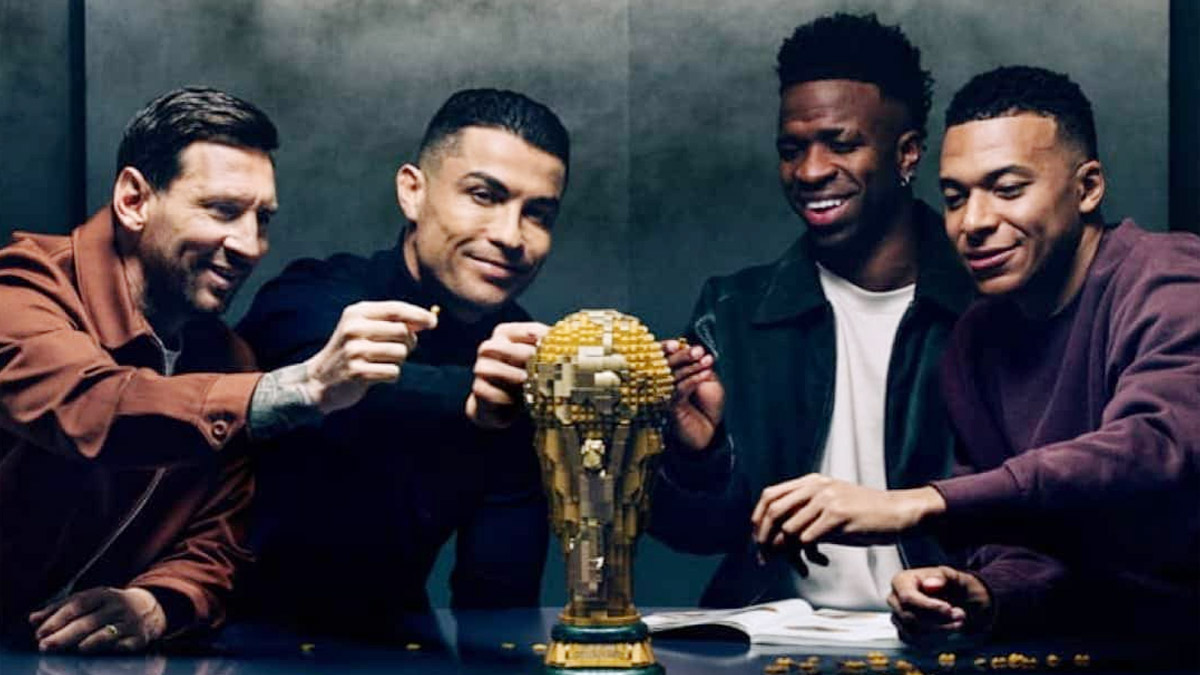
MUMBAI: Four legends, one frame and not a single tackle in sight. Lego has pulled off a crossover few thought possible, uniting Lionel Messi, Cristiano Ronaldo, Kylian Mbappé and Vinícius Júnior in a single campaign ahead of the FIFA World Cup 2026 only this time, they’re building dreams brick by brick.
Titled “Everyone wants a piece”, the campaign features the quartet assembling a Lego version of the World Cup trophy, before placing miniature versions of themselves atop it, a playful nod to football’s ultimate prize. Shared widely across social media, the ad carries a pointed disclaimer: it is not AI-generated, a subtle but telling signal in an era where even reality is often questioned.
The numbers tell their own story. The campaign has already crossed 314 million views on Instagram across the players’ accounts, with fans hailing it as a rare, almost nostalgic moment particularly for the reunion of Messi and Ronaldo, whose last shared campaign ahead of the 2022 World Cup became one of the platform’s most-liked posts.
Beyond the film, Lego is extending the play with exclusive, player-themed sets tied to each of the four stars, part of a broader football-led programme designed to ride the global momentum building towards 2026. The idea, as echoed by the players themselves, leans into the parallels between football and play experimentation, creativity, failure, and triumph.
Messi described the sets as a way to bring on-pitch moments into an imaginative, hands-on world, while Ronaldo called the transformation into a Lego figure a rare honour, blending sport with storytelling. Vinícius, meanwhile, struck a more personal note, recalling childhood moments of building with Lego and framing creativity as a universal language that transcends borders.
The timing is no accident. With the 2026 World Cup set to run from June 11 to July 19 across the United States, Canada and Mexico, and featuring an expanded 48-team format, global anticipation is already building. Argentina, led by Messi, will enter as defending champions, adding another layer of intrigue.
For Lego, the campaign does more than celebrate football, it taps into its mythology. Because when icons become figurines and rivalries turn into play, the beautiful game finds a new kind of pitch. one built, quite literally, by hand.






