MAM
Print faced setback in advertising & circulation in 2020, could re-grow this year


NEW DELHI: Who could have known that a microscopic organism would disrupt the global economy and adversely impact businesses across the board in a single year – but the Coronavirus did. And the media industry was no exception to its rampage. In 2020, print media de-grew 36 per cent, and this unexpected plummet came at a time when the industry has been ceding ground to digital media.
Advertising and circulation impacted
A recent FICCI-EY study report indicates that advertising revenues for newspapers in 2021 fell by 41 per cent in 2020. Subscription revenues for print media also plummeted by 24 per cent last year. Compared to regional newspapers, it was English newspapers that witnessed a more pronounced decline.

Advertising revenues of English news publications fell by 52 per cent in 2020, while revenues of Hindi and other regional language contents dropped by 35 per cent.
As the world limps back to normalcy, industry experts believe that advertising and subscription revenues could increase in 2021. According to the study report, advertising revenues will grow by 25 percent in 2021, thus elevating the revenue share to Rs 152.1 billion. The subscription revenues are also showing signs of revival, and it is expected to grow 25 per cent in 2021 and exceed 2019 levels by 2023. Meanwhile, magazine revenues that were halved in 2020 may not recover until 2023.
Print companies adopting measures to stay financially afloat
To combat the ongoing crisis, print media companies have implemented significant cost reduction measures to achieve between 25 per cent and 40 per cent efficiencies, and this trend is expected to continue in the upcoming years as well.
Some of the noted cost-cutting measures adopted by print media include shutting down unprofitable editions, downsizing the employee base, curtailing the rental of leased properties, and giving work from home options to certain employees. Some publications pulled the plug on low-cost subscription packages, while a few others implemented salary reductions and abeyances.
Even though most of these measures are reversible when the business environment picks up again, industry experts believe that some of these reductions may be here to stay and could eventually enable print companies to stay financially afloat.
Print ad revenues rely on FMCG, auto, and education
Further, the report suggests that the top five categories that contributed to print ad revenue in 2020 were FMCG, auto, education, retail and real estate, and home improvement. These five categories contributed 59 per cent of ad revenues, up from 50 per cent in 2019.
Almost all categories showed de-growth as advertisers fear that print media circulation has not returned back to pre-Covid levels.
Due to the Coronavirus outbreak, digital hands of print media gained massive popularity in 2020. Online news viewership has surged to 454 million unique visitors in 2020, much greater than 394 million unique visitors in 2019. Many print companies have now started to give importance to digital news publications as well, and they are focusing on products like websites, apps, and e-papers. Amid these positive signs, monetisation remained an issue with most print companies, as they generated only five percent of their revenues from their digital handles.
Contribution by ad-volumes
Amid the Covid pandemic, Hindi has continued as the largest contributor to ad volumes with the largest reach of any language in India, growing its share by four per cent. In 2019, the ad volume generated by Hindi newspapers was 37 per cent, and it grew to 41 per cent in 2020. English language publications had slight degrowth in 2020 and have lost two per cent volume share since 2018.






Brands
KKR sixes to power EV charger rollout under VIDA campaign
Cricket meets clean mobility as big hits spark India’s charging growth
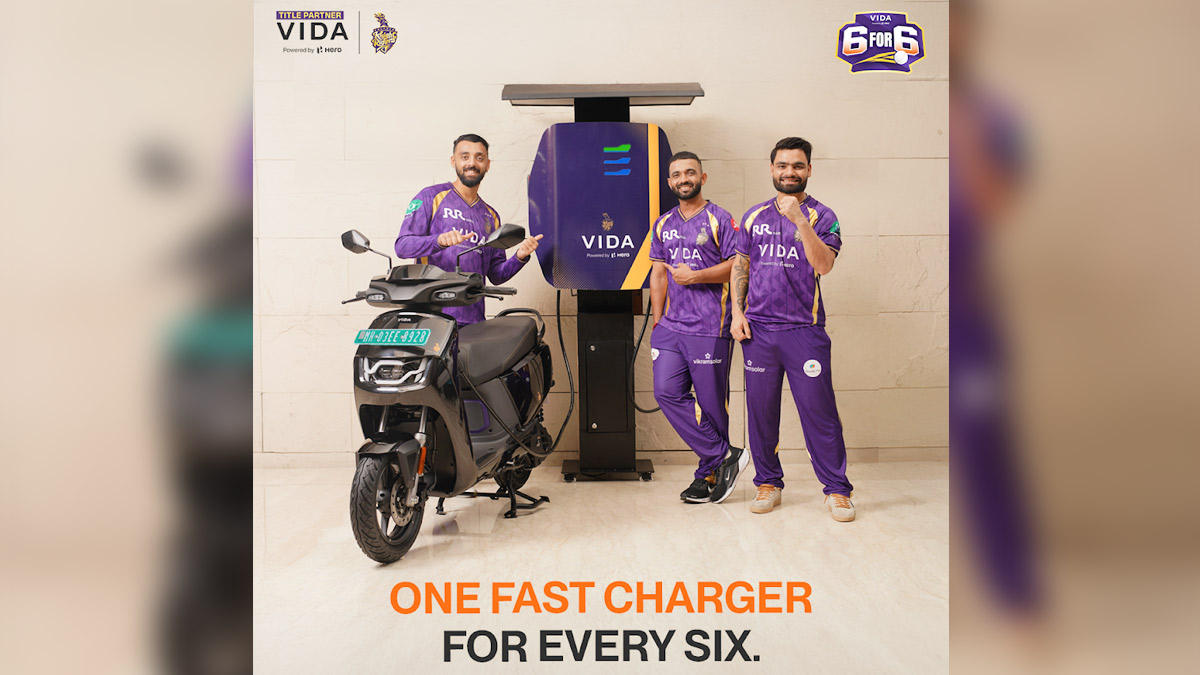
NEW DELHI: VIDA, the electric mobility arm of Hero MotoCorp, has teamed up with Kolkata Knight Riders to launch a campaign that turns cricketing flair into real-world impact.
Titled ‘6 for 6’, the initiative promises to install a 6kW fast EV charger for every six hit by KKR during the ongoing Indian Premier League season. The idea is simple but powerful, as each big hit on the field contributes directly to expanding India’s fast-charging infrastructure.
The campaign builds on VIDA’s growing network, which already spans over 5,300 fast-charging points across more than 430 cities. With EV adoption gaining pace, the brand is using cricket’s mass appeal to accelerate both awareness and infrastructure growth.
Explaining the thinking behind the move, Hero MotoCorp emerging mobility business unit chief business officer Kausalya Nandakumar said, “Cricket has an incredible ability to unite and inspire millions across the country. With the ‘6 for 6’ campaign, we are turning every big hit on the field into a step towards a cleaner and a more accessible mobility future.”
She added that VIDA’s expanding fast-charging network and removable battery technology are designed to make EV ownership more convenient and practical for everyday users.
From the franchise’s side, the campaign is also about giving on-field moments a larger purpose. Kolkata Knight Riders chief executive officer Venky Mysore said, “The ‘6 for 6’ campaign exemplifies the potential of sport as a platform for meaningful, real-world impact. By linking every six to the expansion of EV charging infrastructure, this partnership transforms fan excitement into tangible progress.”
As part of the rollout, VIDA has introduced co-branded charging stations in KKR’s signature colours, with a flagship installation unveiled alongside team players. The chargers are designed for quick top-ups, powering VIDA scooters from zero to 80 percent in about an hour, while also being positioned along key highways to support longer journeys.
The initiative also taps into VIDA’s removable battery system, which allows users to charge using standard household plug points, adding flexibility to the charging ecosystem.
By blending the thrill of cricket with the urgency of clean mobility, VIDA and KKR have found a neat way to make every six count twice, once on the scoreboard and again on India’s road to an electric future.








