MAM
Pepsi launches ad campaign with new brand ambassador Unmukt Chand

MUMBAI: Pepsi has launched the second leg of ‘Oh Yes Abhi!‘ ad campaign featuring the Under-19 Indian Cricket Team captain Unmukt Chand as its new brand ambassador.
Chand features in the ad-film that brings alive the ultimate face-off between him and the captain of the Indian cricket team MS Dhoni along with Virat Kohli and Suresh Raina. The fun and entertaining campaign captures their impatient moments and promises to leave the audiences engaged like never before.
PepsiCo India senior director – marketing (Colas, Juices and Hydration) Homi Battiwalla said, “Pepsi is known to be the first brand to identify youth icons early in time and tap talent with tremendous potential and credibility. We are proud to associate with Unmukt Chand, who truly reflects Pepsi‘s Oh Yes Abhi! attitude and are confident that he will lead the next-generation of players who personify the same philosophy. He is eager to be a part of the Indian cricket team and is performing consistently to achieve his goals… we wish him all the best and look forward to an exciting journey with him”.

“Our latest campaign takes forward the ‘Oh Yes Abhi‘ philosophy and brings alive Unmukt‘s impatient moments in his first ever ad-film with MS Dhoni, Virat Kohli and Suresh Raina. The film showcases the young emerging star impatient to be a part of the Indian cricket team which exemplifies our positioning in a fun and exciting manner,” he further added.
The TVC brings alive Pepsi‘s youthful irreverence and demonstrates the â€?Oh Yes Abhi!‘ moments of these Pepsi brand ambassadors and youth icons.
Chand is shown waiting impatiently, all anxious to get hold of a Pepsi bottle, while Dhoni, Kohli and Raina are also waiting to get their hands on it. What one sees next is an entertaining war of words between the youth icons and the rising star.
The campaign has been created by Pepsi‘s creative AoR JWT.
JWT India ECD Surjo Dutt said, “The young cricket star Unmukt shows his impatient side in a refreshing and cool manner, bringing alive the philosophy of Oh Yes Abhi!.”
The campaign takes forward Pepsi‘s new journey in India with a refreshed new positioning and belief – “Oh Yes Abhi!”. To bring it alive for consumers, the brand had launched a mega campaign starring Ranbir Kapoor, Dhoni and Priyanka Chopra last month that captured their impatient moments.






MAM
One Hand Clap acquires Agenseed to enter distribution space
Creative agency expands into full-stack services with strategic buyout.
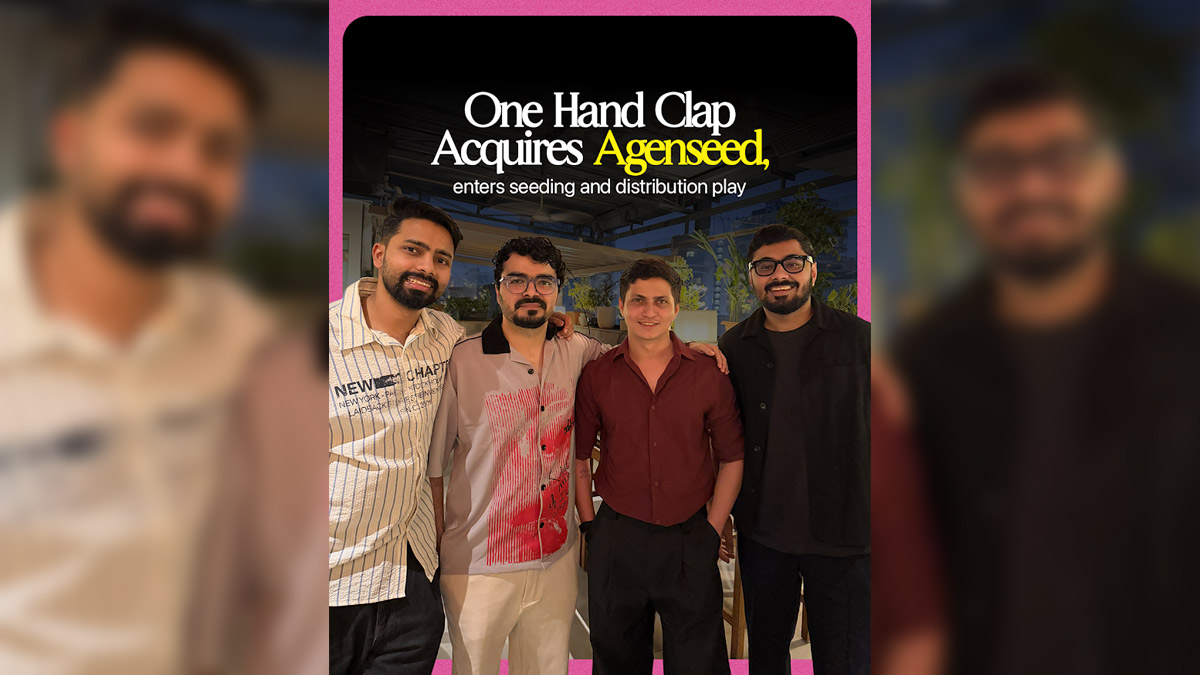
MUMBAI: One Hand Clap has decided to stop just clapping for great ideas now it wants to make sure they actually travel. The leading new-age creative agency and production house has acquired Agenseed, a seeding and distribution firm, marking its formal entry into the distribution segment. The move is aimed at expanding its role across the entire marketing value chain and unlocking new growth opportunities.
One Hand Clap expects the new distribution vertical to contribute up to 15 per cent of its overall revenues over the next 12–18 months, signalling a clear strategic shift beyond pure creative services.
Agenseed, founded by Monish Hardasani and Akram Malik, will function as the agency’s dedicated distribution arm. This acquisition strengthens One Hand Clap’s position as it aims to become a full-stack creative and distribution company in India’s rapidly growing digital advertising market.
With over 90 million posts shared daily on Instagram and brands allocating 25–35 per cent of their digital budgets to distribution and creator-led reach, amplification has become critical to campaign success. By integrating distribution early into the creative process, the agency hopes to help campaigns gain stronger cultural traction and momentum.
One Hand Clap founder Aakash Shah said, “The future of advertising is not just about executing great ideas, but about placing them intelligently. By owning both storytelling and distribution, we can drive greater impact for brands while opening up new revenue streams.”
Agenseed co-founder Monish Hardasani added, “The future belongs to ideas designed to travel. This partnership allows us to integrate distribution thinking at the source.”
Founded in 2019 by former AIB leaders Aakash Shah and Naveed Manakkodan, One Hand Clap has worked with major brands including Swiggy, Google, Netflix India, Crocs, Duolingo, CRED, Bumble, BGMI and Chetak. The agency also secured investment from Zerodha co-founder Nikhil Kamath last year.
In an increasingly fragmented attention economy, this acquisition reflects a broader industry shift where agencies are building end-to-end capabilities to stay competitive. One Hand Clap is clearly clapping louder and ensuring its ideas now reach much further.






