MAM
Pee Safe, SBI & Sky Social partner for menstrual hygiene initiative in MP & Chhattisgarh

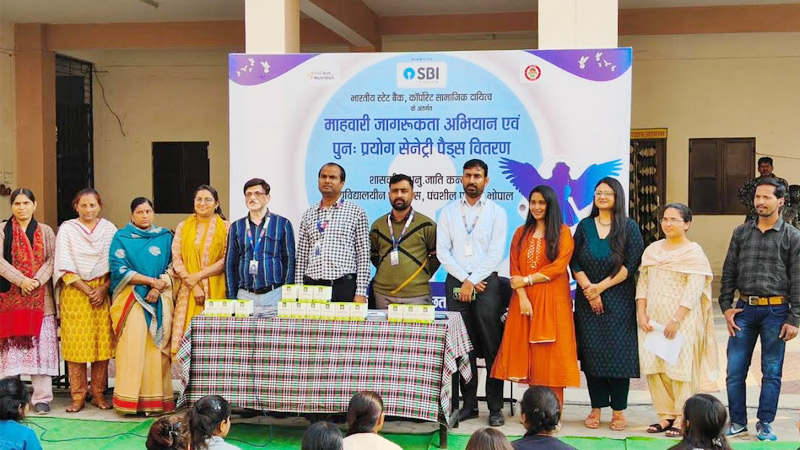
Mumbai: In a unified effort to address menstrual health challenges and uplift young girls, SBI Foundation in collaboration with Sky Social and Pee Safe, a prominent proponent of menstrual hygiene, has initiated an endeavor across 35 districts in Madhya Pradesh and Chhattisgarh. This initiative aims to promote menstrual health and hygiene practices among girls in the region.
The plan was guided by the expertise of Anil Kumar Shriwastava and Deepak Kumar Jha from the State Bank of India and championed by a committed team under the leadership of Srishti Pragat, Founder of Sky Social, and including Arunima Tiwari, Sudha Tiwari, Akshay Shukla, Raju Bele, and Anil Rangdale, alongside passionate youth volunteers, has received substantial backing from influential figures such as Binay Kumar Sahoo, Anupam Kumar, and Vikas Mishra, with invaluable contributions from Nupur Aggarwal and Sanat Sahu from Pee Safe, this collaboration is poised for impactful results.
Covering 25 districts in Madhya Pradesh and 10 in Chhattisgarh, the project has reached over 17,500 school girls, providing practical support and empowering them with knowledge about safe and sustainable menstrual practices. Through workshops, sensitization sessions, and the distribution of reusable pads, the initiative aims to reduce school dropouts due to menstruation-related issues and create a supportive environment for discussing menstrual health.

Vikas Bagaria from Pee Safe expressed his commitment to the cause, stating, “We are honored to collaborate with SBI Foundation and Sky Social as a Resource Partner, providing reusable pads and comprehensive training. This initiative reflects our joint commitment to menstrual hygiene, women’s empowerment, and sustainable solutions.”
SBI chief manager PR and CSB Vikas Kumar said, “SBI is proud to collaborate with Sky Social and Pee Safe on this impactful initiative to address menstrual health and hygiene. By reaching out to more than 17500 girls across 35 districts, we’re demonstrating our commitment to empowering communities and fostering sustainable development. We’ve reached out to many remote locations across Madhya Pradesh and Chhattisgarh and have travelled 6,500 kms across both the states. More than 800 teachers and school wardens were also reached out through this project and are now more aware of menstrual health and hygiene issues.
The girls have been provided with a sanitary pad kit consisting of three reusable pads that’ll last up to two years. Through a project like this, we’re able to make a tangible difference in the lives of girls, ensuring access to essential resources and promoting dignity for all.
By distributing reusable sanitary pads sourced from Pee Safe, we are not merely offering a temporary fix, but actively promoting long-term solutions that empower girls to manage their menstrual health. This project exemplifies our belief in the transformative power of collaboration and collective action.
The initiative, a part of SBI Foundation’s CSR activities, emphasizes the collective effort to promote menstrual hygiene, break taboos, and ensure access to safe period products, ultimately contributing to the holistic well-being of women in Madhya Pradesh and Chhattisgarh.
Sky Social founder Srishti Pragat said, “Our dedication to promoting menstrual health and hygiene transcends mere advocacy—it’s a mission deeply rooted in our belief in the fundamental rights and dignity of every individual. The project has been implemented in over 120 schools and hostel facilities, equipping not only girls but school teachers and wardens on menstrual health and hygiene management. By addressing the taboo surrounding menstruation head-on, we aimed to dismantle stigma and foster open conversations that empower girls to manage their menstrual health with confidence and pride. The distribution of reusable sanitary pads has empowered many girls and has given them the confidence to manage their menstruation in a hygienic manner.”
Through collaborative efforts SBI, Pee Safe, Sky Social are paving the way for a future where menstrual health is prioritized, stigma is eradicated, and every individual has the opportunity to thrive with dignity and respect.






Digital
Content India 2026 opens with a copro pitch, a spice evangelist and a £10,000 prize for Indian storytelling
Dish TV and C21Media’s three-day summit puts seven ambitious projects before an international jury, and two walk away with serious development money
MUMBAI: India’s content industry gathered in Mumbai this March for Content India 2026, a three-day summit organised by Dish TV in partnership with C21Media, and it wasted no time making a statement. The event opened with a Copro Pitch that put seven scripted and unscripted television concepts before an international panel of judges, and by the end of it, two projects had walked away with £10,000 each in marketing prize money from C21Media to support development and international promotion.
The jury, comprising Frank Spotnitz, Fiona Campbell, Rashmi Bajpai, Bal Samra and Rachel Glaister, evaluated a shortlist that ranged from a dark Mumbai comedy-drama about mental health (Dirty Minds, created by Sundar Aaron) to a Delhi coming-of-age mystery (Djinn Patrol, by Neha Sharma and Kilian Irwin), a techno-thriller about a teenage gaming prodigy (Kanpur X Satori, by Suchita Bhatia), an investigative crime drama blending mythology and modern thriller (The Age of Kali, by Shivani Bhatija), a documentary on India’s spice heritage (The Masala Quest, hosted by Sarina Kamini), a documentary on competitive gaming (Respawn: India’s Esports Revolution, by George Mangala Thomas and Sangram Mawari), and a reality-horror competition merging gaming and immersive fear (Scary Goose, by Samar Iqbal).
The session was hosted by Mayank Shekhar.
The two winners were Djinn Patrol, backed by Miura Kite, formerly of Participant Media and known for Chinatown and Keep Sweet: Pray & Obey, with Jaya Entertainment, producers of Real Kashmir Football Club, also attached; and The Masala Quest, created and hosted by Sarina Kamini, an Indian-Australian cook, author and self-described “spice evangelist.”
The summit also unveiled the Content India Trends Report, whose findings made for bracing reading. Daoud Jackson, senior analyst at OMDIA, set the tone: “By 2030, online video in India will nearly double the revenue of traditional TV, becoming the main driver of growth.” He noted that in 2025, India produced a quarter of all YouTube videos globally, overtaking the United States, while Indians collectively spend 117 years daily on YouTube and 72 years on Instagram. Traditional subscription TV is declining as free TV and connected TV gain ground, forcing broadcasters to innovate. “AI-generated content is just 2 per cent of engagement,” Jackson added, “highlighting the dominance of high-quality human content. The key for Indian media companies is scaling while monetising effectively from day one.”
Hannah Walsh, principal analyst at Ampere Analysis, added hard numbers to the picture. India produced over 24,000 titles in January 2026 alone, with 19,000 available internationally. The country now accounts for 12 per cent of Asia-Pacific content spend, up from 8 per cent in 2021, outpacing both Japan and China. Key exporters include JioStar, Zee Entertainment, Sony India, Amazon and Netflix, delivering over 7,500 Indian-produced titles abroad each year. The top importing markets are Saudi Arabia, the UAE, Egypt, the United States and the Philippines. Scripted content dominates globally at 88 per cent, with crime dramas and children’s and family titles performing particularly strongly.
Manoj Dobhal, chief executive and executive director of Dish TV India, framed the summit’s ambition squarely. “Stories don’t need translation. They need a platform, discovery, and reach, local or global,” he said. “India produces more movies than any country, our streaming platforms compete globally, and our tech and creators win international awards. Yet fragmentation slows growth. Producers, platforms, and tech move in different lanes. We need shared spaces, collaboration, and an ecosystem where ideas, technology, and people meet. That is why we built Content India.”
The data, the pitches and the prize money all pointed to the same conclusion: India is not waiting for the world to discover its stories. It is building the infrastructure to sell them.







