Brands
Oben powers ahead with 50th showroom, eyes 150 outlets by year-end

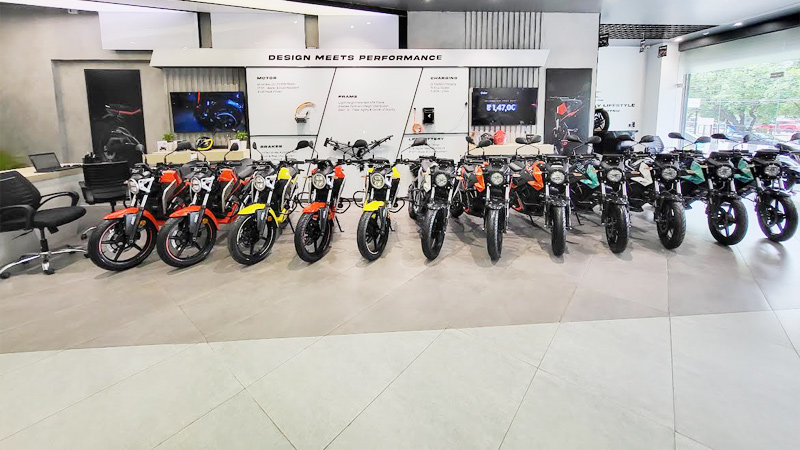
MUMBAI: From zero to fifty, Oben Electric is revving up India’s EV race at full throttle. The homegrown R&D-driven motorcycle brand has just cut the ribbon on its 50th showroom and service centre in Visakhapatnam, Andhra Pradesh marking a pit stop on its road to 150 outlets by the close of this financial year.
The milestone comes on the back of rapid expansion. In recent months, Oben has entered Visakhapatnam and Guntur in Andhra Pradesh, Ranchi in Jharkhand, Jabalpur in Madhya Pradesh, Aligarh and Unnao in Uttar Pradesh, and Palakkad in Kerala. With this, its network now spans 15 states and 37 cities, a footprint fuelled by soaring demand for its flagship Rorr EZ and the newly launched Rorr EZ Sigma.
The Rorr EZ Sigma pitched as the commuter’s next-gen ride builds on the success of the original Rorr EZ with better performance, smarter tech, and everyday practicality. Together, the duo has become the brand’s biggest growth engine, drawing in first-time EV buyers as well as seasoned riders looking for clean mobility alternatives.

“Inaugurating our 50th dealership is a powerful milestone,” said Oben Electric founder & CEO Madhumita Agrawal. “Andhra Pradesh is a key clean mobility market for us, and with in-house manufacturing and customer-focused service, we’re set on raising benchmarks for electric motorcycle ownership across India.”
Oben Electric also stands out in the crowded EV space for its vertical integration: it designs and manufactures critical EV components in-house from high-performance LFP batteries to motors, chargers and vehicle control units. This, the company claims, ensures durability and consistency tailored to India’s diverse riding conditions.
With the Visakhapatnam showroom now open, Oben has 100 more outlets in its sights before March 2026. Each will come equipped with a service centre, promising customers not just a flashy ride but robust after-sales support too.






Brands
Dunkin’ Donuts to exit India as Jubilant FoodWorks ends 15-year franchise deal
The quick service restaurant giant is ending a 15-year franchise partnership with the American doughnut chain, even as it renews its Domino’s agreement for another 15 years
NOIDA: Dunkin’ is done in India. Jubilant FoodWorks Ltd, the country’s leading quick service restaurant operator, has decided not to renew its franchise agreement with the American coffee and doughnut chain, and will wind down its Indian stores in a phased manner before December 31, 2026, bringing a 15-year partnership to a quiet, loss-laden close.
The decision, approved by JFL’s board on March 30, 2026, ends a relationship that began with a Multiple Unit Development Franchise Agreement signed on February 24, 2011. JFL will now evaluate and undertake what it described in a regulatory filing as the “rationalisation and/or cessation of certain operations and/or sale, transfer or disposal of assets and/or assignment or transfer of franchise rights,” all in consultation with Dunkin’s brand owners and strictly within the terms of the original agreement.
The numbers tell the story bluntly. In the financial year 2024-25, Dunkin’ India posted a revenue of Rs 37 crore against a loss of Rs 19 crore — a haemorrhage that was always going to test the patience of a parent company recording revenues of Rs 6,104 crore and a profit of Rs 194 crore in the same period. Doughnuts, it turns out, were never going to move the needle.
The contrast with JFL’s handling of its other marquee franchise could hardly be sharper. Even as it walks away from Dunkin’, the company has just doubled down on Domino’s, signing a fresh Master Franchise Agreement on March 31, 2026, granting it exclusive rights to develop and operate Domino’s Pizza stores in India for 15 years, with an option to renew for a further 10.
JFL, incorporated in 1995 and promoted by the Bharatia family, operates a network of more than 3,500 stores across six markets — India, Turkey, Bangladesh, Sri Lanka, Azerbaijan and Georgia. Its portfolio includes Domino’s and Popeyes on the global side, and two home-grown brands: Hong’s Kitchen and COFFY, a café brand in Turkey.
For Dunkin’, India was always a stretch. The brand never quite cracked the cultural code in a market where filter coffee and chai command fierce loyalty and where the doughnut remains, at best, an occasional indulgence rather than a daily habit. Fifteen years, mounting losses and a parent with better things to spend its capital on was always going to be a difficult equation to solve.
The doughnut has had its last day. The pizza, however, is staying.






