MAM
New launches in a tough Gujarati TV news market

 MUMBAI: Narendra Modi is not only shaping a new Gujarat but also breathing life into a dead TV news market. A slew of Gujarati news channels are getting readied for launch ahead of the assembly elections as Modi weighs his prospects of being named as the next prime ministerial candidate for BJP.
TV9 and VTV are the only two pure Gujarati news channels and their business life has not been too easy so far. But unnerved by the thin ad revenue market pegged at Rs 200 million this year, two leading dailies, Sandesh and Gujarat Samachar, are planning launch of their Gujarati-language TV news ventures in November, a month ahead of the December assembly elections.
“There has been no great improvement in the market potential of Gujarati news channels. But the new launches are extensions of print media businesses. The local print market is quite strong in Gujarat and it has been more or less politically aligned,” says ABCL vice president operations KVN Murthy.
Murthy should know. TV9 Gujarati, the channel owned by Associated Broadcasting Company Ltd, runs the most successful TV news channel in Gujarat from a viewer‘s perspective and its footage has been used by national news networks. Gujarat News Broadcasters‘ VTV launched last year and is still struggling to find space in the nascent Gujarati TV news market while ETV Gujarati airs daily news bulletins in between its main general entertainment content.

The Gujarati news channels also have to adjust to the reality that the national news networks are quite popular there. National news broadcasters have not yet forayed into Gujarat as they realise there is a high level of cannibalisation from their Hindi and English channels. Zee, which runs a clutch of regional entertainment and news channels across India, had an entertainment channel, Zee Gujarati, which it shut in 2009.
“Hindi general news and business channels do well in that market. The Gujarati news market will take time to evolve,” says Murthy.
Aas Pass TV, floated by Gujarat Samachar co-promoter Shreyans Shah, and Sandesh hope to change that feeble marketplace with the backing of their strong print lineage.
Says Gujarat Samachar’s Aas Pass TV director-sales and marketing Nilesh Thakkar, “Compared to the markets in Bengal and Maharashtra, Gujarat is at a very nascent stage. But there is scope for growth here. Only the right strategy has to be employed and patience is required.”
The right strategy will mean a heavy load of political and crime news. And some industry sources who did not want to be named said paid news will also play a part.
TV9 content head Vikas Upadhyay believes that pure news lineup will not work in Gujarat. “People are not interested in only news. They want a mixed offering. Also, Gujarat is a quiet place. Barring the elections, nothing unusual happens to grab eyeballs. So mixing up content is a good option.”
Which is why TV9 has a cookery show in its lineup. And Aas Pass TV will also have other content that will help in generating revenues.
The ad market for Gujarati news channels is set to expand. Says Thakkar, “There will be a conversion from print to TV news channels in Gujarat. This is what has happened in other regional markets as well and here it will be more obvious as two print players are entering the TV business. We will also be launching AFP (advertiser funded programme) and see great potential in real estate and retail advertisers supporting the local news channels.”
What will also help in Gujarat is that its four main cities – Ahmedabad, Rajkot, Surat and Vadodara – are turning into mini metros. The spending capacity in these cities is increasing steadily and advertisers will want to capture this market.
The distribution cost will also ease as the main cities of Gujarat fall under digitisation in the second phase. “The carriage cost should fall after digitisation comes in in the next phase,” avers Murthy.






Brands
HP launches Smart Champs learning game show with JioStar for students
Sanya Malhotra hosts quiz series blending fun, learning and prizes
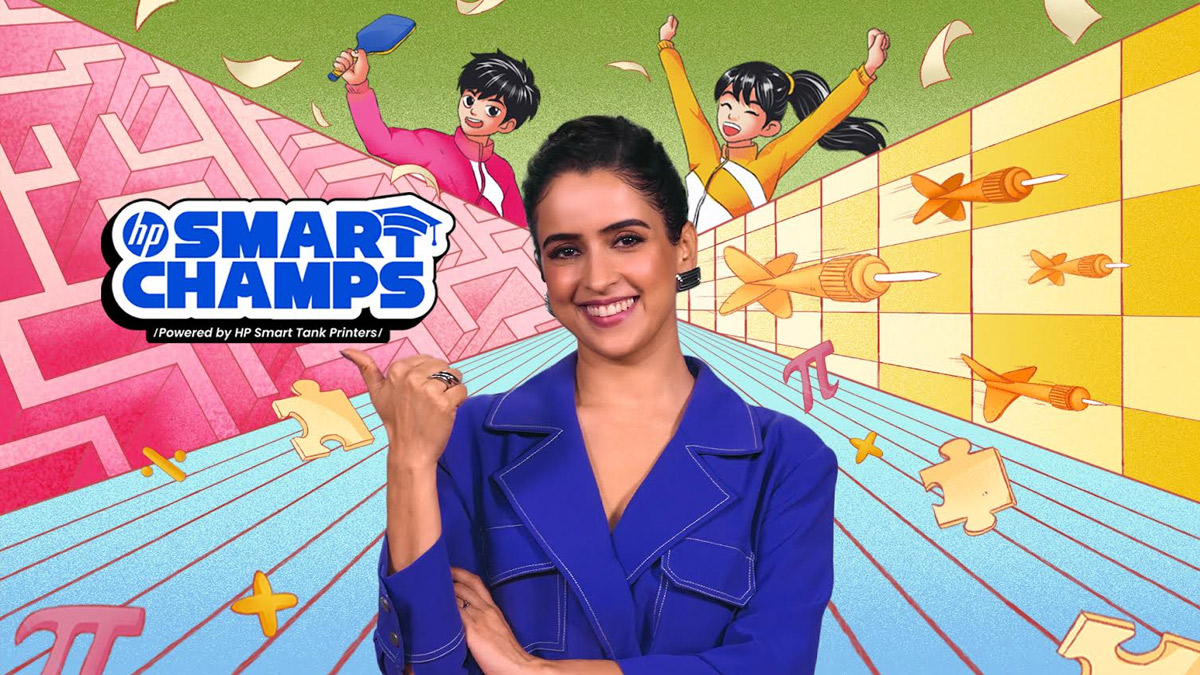
NEW DELHI: HP India has teamed up with JioStar to launch HP Smart Champs, a new learning-based game show designed to make education engaging for school students across the country.
Hosted by Sanya Malhotra, the 10-episode series brings together students from Grades 5 to 9, who compete in teams through quiz and puzzle-based challenges that test knowledge, logic and teamwork. The show will begin streaming on JioHotstar from April 11 and will premiere on Nick on April 18, with weekend episodes airing at 7 PM.
Powered by HP Smart Tank printers, the format integrates print-based learning into the gameplay, using worksheets, clues and visual problem-solving tools to encourage hands-on participation. The idea is to move students beyond rote memorisation and towards more applied, curiosity-led learning.
The competition promises high stakes, with winners set to receive a cash prize of Rs 10 lakh, while runners-up will take home Rs 5 lakh. Additional rewards include HP AI laptops, Smart Tank printers and accessories, while the winning school will be awarded an HP Smart Tech Lab.
Speaking about the initiative, HP India managing director Ipsita Dasgupta said, “At HP, we believe nurturing India’s youth is key to the country’s progress, and technology plays a foundational role in enabling this. With HP Smart Champs, we wanted to create something beyond traditional learning, a fun-filled platform where curiosity, creativity and critical thinking take centre stage.”
On the show’s reach, JioStar head entertainment sales Mahesh Shetty said, “HP Smart Champs reflects how children today learn through exploration and experience. With Nick and JioHotstar, we are creating a multi-screen approach that is both engaging and meaningful.”
Highlighting the role of print, HP India senior director print Satish Kumar said, “The show brings print-based learning to life in an engaging format, helping students develop deeper understanding through hands-on experiences.”
The journey to the finale began with participation from over 1,000 schools across 26 cities, narrowing down to 34 finalists who will compete in a studio showdown in Mumbai.
With its blend of entertainment, education and technology, HP Smart Champs is positioning itself as more than just a quiz show. It is a nationwide push to make learning interactive, accessible and, above all, a lot more fun.







