Brands
MRF accelerates with 121pc profit jump as tyre demand grips roads


CHENNAI: MRF has delivered a blistering performance for the quarter ending 31st December 2025, with consolidated profit after tax surging 121 per cent to Rs 691.83cr from Rs 315.46cr a year earlier. The Chennai-based tyre major’s revenue climbed 15 per cent to Rs 8,050.43cr, driven by robust replacement demand and improved product mix across its domestic and export markets.
The company’s standalone profit jumped 121 per cent to Rs 679.14cr on revenue of Rs 7,933.69cr, up 15 per cent year-on-year. For the nine months ending December, consolidated profit reached Rs 1,717.94cr on revenue of Rs 23,104.84cr, marking growth of 27 per cent and 10 per cent respectively.
Buoyed by the strong showing, MRF’s board declared a second interim dividend of Rs 3 per equity share (30 per cent) for the financial year ending 31st March 2026. The company fixed Friday, 13th February 2026 as the record date, with payment scheduled on or after 27th February.

The stellar numbers came despite a Rs 77.20cr exceptional charge triggered by India’s new consolidated labour codes, which took effect on 21st November 2025. The legislation required MRF to immediately recognise increased gratuity and leave liability arising from past service costs under accounting standards.
Earnings per share for the quarter stood at Rs 1,631.23 on a consolidated basis and Rs 1,601.33 standalone, more than doubling from Rs 743.80 and Rs 723.20 respectively in the corresponding period last year. Operating margins expanded significantly to 11.94 per cent from 6 per cent, whilst net profit margins nearly doubled to 8.46 per cent from 4.44 per cent.
The company’s board meeting, chaired by managing director Rahul Mammen Mappillai, commenced at 11:00 am and concluded at 1:30 pm on 6th February 2026. The results were reviewed by the audit committee and subjected to limited review by statutory auditors MM Nissim & Co and Sastri & Shah, who issued unqualified reports.
Finance costs declined to Rs 91.23cr from Rs 93.65cr year-on-year, reflecting improved working capital management. Employee benefits expense rose 9 per cent to Rs 522.48cr, driven by headcount expansion and wage increases. Raw material costs climbed marginally to Rs 4,688.45cr, though inventory changes of Rs 257.91cr suggest careful stock management ahead of seasonal demand variations.
The consolidated results incorporate four subsidiaries: MRF Corp Limited, MRF Lanka (Private) Limited, MRF SG Pte Ltd, MRF International Limited, and step-down subsidiary MRF DB-FZCO. The company operates primarily in the manufacture of rubber products including tyres, tubes, flaps and tread rubber, which constitute a single reportable segment under accounting standards.
MRF’s debt-equity ratio remained comfortable at 0.03 times, whilst the current ratio improved to 1.69 times from 1.47 times, indicating strengthening liquidity. Debtors turnover accelerated to 9.24 times on an annualised basis from 8.82 times, suggesting tighter credit management and faster collections.
Other comprehensive income included remeasurements of employee defined benefit plans totalling Rs 18.75cr and gains on cash flow hedges of Rs 12.16cr net of tax, reflecting prudent treasury operations in volatile currency markets.
With raw material pressures easing and pricing power intact, MRF has demonstrated that even regulatory speed bumps cannot slow a company firing on all cylinders. The tyre maker’s shares trade on both the BSE and NSE, with the company maintaining its registered office at 114 Greams Road, Chennai.





Brands
Samsung certifies 1,000 Maharashtra students in AI and coding
The South Korean electronics giant marks its first large-scale skilling push in the state, with women making up nearly half the national programme’s enrolment
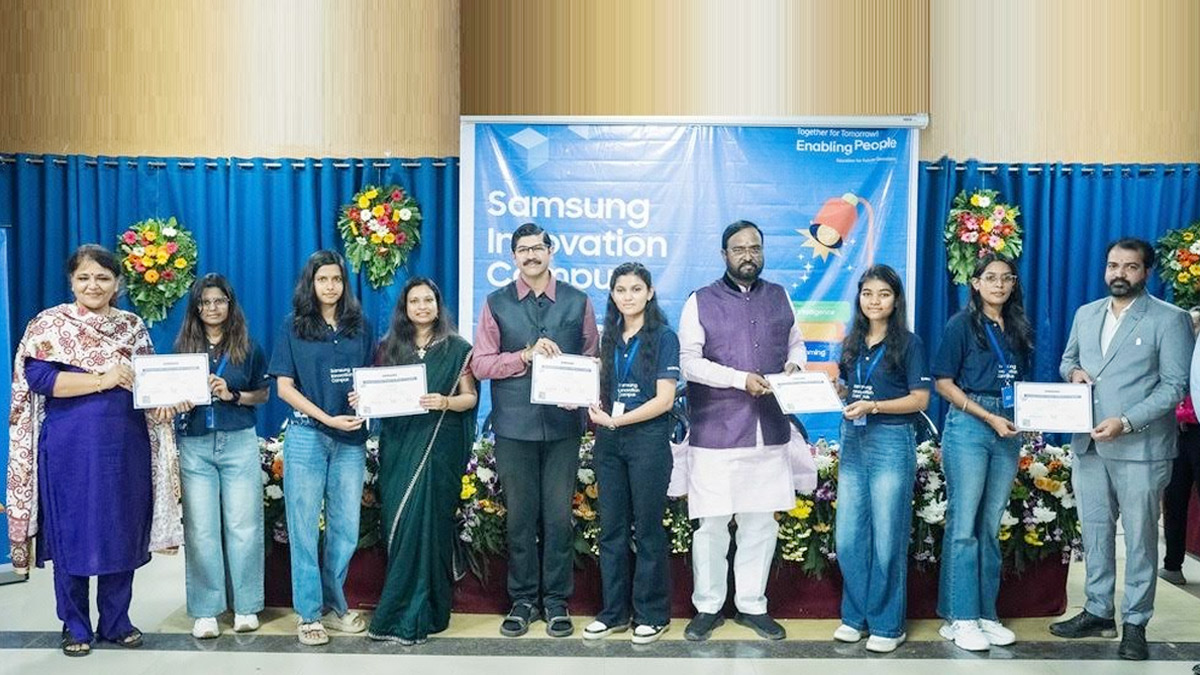
PUNE: Samsung has put 1,000 students in Maharashtra through a certified training programme in artificial intelligence and coding, the largest such drive the South Korean electronics company has run in the state and a signal that corporate India’s skilling ambitions are moving well beyond the boardroom brochure.
The certifications were awarded under Samsung Innovation Campus (SIC), the company’s flagship corporate social responsibility programme, which launched in India in 2022 with the stated aim of democratising access to future-technology education. The 1,000 graduates were drawn from four institutions: 127 from Savitribai Phule Pune University, 373 from Pimpri Chinchwad University, 250 from D.Y. Patil University’s Ramrao Adik Institute of Technology and 250 from Anjuman-I-Islam’s Kalsekar Technical Campus. All completed training in either AI or coding and programming, the two disciplines Samsung has identified as the critical pillars of the digital economy.
The programme does not stop at technical training. Soft-skills development and career-readiness modules are baked into the curriculum, a deliberate attempt to close the gap between what universities teach and what employers actually want.
“India’s digital growth story will ultimately be shaped by the quality of its talent pipeline,” said Shubham Mukherjee, head of CSR and corporate communications at Samsung Southwest Asia. “As technologies like AI move from the periphery to the core of industries, skilling must evolve from basic training to building real-world capability. This milestone in Maharashtra reflects how industry and academia can come together to create a future-ready workforce that is both globally competitive and locally relevant.”
The Maharashtra drive sits within a rapidly scaling national effort. Samsung Innovation Campus trained 20,000 young people across India in 2025, hitting its stated target for the year. Women account for 48 per cent of national enrolments, a figure the company cites as evidence of its push for an inclusive technology ecosystem. The programme is implemented in partnership with the Electronics Sector Skills Council of India and the Telecom Sector Skill Council.
Samsung, which is marking 30 years in India this year, runs SIC alongside two other initiatives, Samsung Solve for Tomorrow and Samsung DOST, as part of a broader effort to build what it calls a generation of innovators with both the technical depth and the problem-solving mindset to thrive in a fast-moving digital world.
A thousand certified students is a tidy headline. Whether they find jobs that match their new skills is the harder question, and the one that will ultimately determine whether corporate skilling programmes like this one are genuine pipelines or well-photographed gestures.






