MAM
Mobile third largest ad medium; may grow to Rs 10,000 cr by ’18


MUMBAI: The Mobile Marketing Association (MMA), in association with GroupM, one of India’s largest media and marketing conglomerate, has released a report on the mobile marketing ecosystem in India. Called the ‘Mobile Ecosystem and Sizing Report’, this report states that the mobile medium is the third largest mass media in India in terms of ad spends, after television and print. The ad spends on mobile media is estimated to be Rs. 4200 crore by the end of 2016, and is expected to grow to Rs. 10,000 crore by end of 2018.
The report is an endeavour to decode the burgeoning Indian mobile market in terms of reach of the medium, rural-urban divide in-terms of usage habits and increasing mobile data usage. The report takes into account the mobile service providers and handset manufacturers ecosystem as well. It is a collaborative effort by the marketing and mobile industry, championed by the research team at GroupM India.
The growing use of mobile in rural media-dark markets has made brand marketers look at increasing their ad spends on mobile marketing. While spends are increasing, organizations are still evolving in terms of familiarity with mobile marketing. Industry sectors such as e-commerce and BFSI are leading the way in mobile advertising, while sectors such as FMCG are now going beyond the SMS and IVR-based mobile solutions The report also brings in perspective on the role of local language in enabling the next spurt of growth in rural India.

CVL Srinivas, CEO, GroupM South Asiasaid, “It is clear that brands cannot ignore the power of the small screen. It may be the third largest (after TV and print) in terms of ad spends but is by far the leader in terms of time spent and consumer engagement.”
PepsiCo India Holdings chairman and CEO, D Shivakumar, said, “MMA felt there was a distinct need for a single comprehensive report that covers the mobile marketing ecosystem in India and provides insights to marketers to help them make sharper decisions.”
“Marketers are aware that mobile is arguably the closest you can get to the consumer with its powerful promise of ‘immediacy’. The consumer is getting steadily used to everything in the ‘now’ with regards to content, commerce, information or utilitarian. This very concept has transformed the mobile into a tool of action and transaction,” said Mobile Marketing Association India manager, Preeti Desai.
2015 has been a good year for mobile subscriber growth in India. Over 60 million new mobile subscribers were added since the start of year, at an average 5 million subscribers added every month. This was a 20% growth in comparison to 2014. Research has found that in the last 5 years, rural tele-density in India has increased by 60%; rural mobile internet subscriber saw a 90% YOY growth in 2015 and they are using the internet primarily with their mobile phones.
In terms of usage, the report clearly states the varied usage patterns between urban and rural consumers. While urban consumers are adopting 3G and 4G technology at a much faster rate, the growth spurt in new technology and smartphone penetration is coming from the Tier 2, Tier 3 and rural markets. There is a high demand for affordable smartphones in rural markets, as mobile phones are replacing or supplementing TV as an important entertainment and marketing medium, alongside other traditional communication methods. Handset manufacturers are also looking at developing distribution channels to meet this high demand and thus as seen in the report, eTailers are gaining significance where 29% of smartphone purchases in 2015 happened via e-commerce channels.
This increase in higher speed data penetration along with growth in smartphones will lead to data driven marketing. It is also reported that traditional TV players are getting more vertical with OTT driving the case for mobile as the stronger secondary screen. [Leading video publishers have seen watch-time in India grew 80% over the last one year, of which 55% of the watch time was on mobile. 90% content upload on these services was from mobile as well]. All this could mean that Native and Video formats are set to dominate mobile marketing in the years to come. Consumers look at Native ads 53% more often than they look at traditional mobile display ad. Also, mobile based audio and video streaming apps provide measurable reach, with 100+ million monthly active user base in India according to the report.
MMA’s objective through this report is to give the readers a comprehensive view of the mobile marketing ecosystem in India and the various factors that influence it like the various mobile marketing channels, the mobile marketing landscape and the growing subscriber, internet and app user base. It also highlights some of the case studies that readers of the report can leverage to better understand the medium from a marketing perspective. Going forward, MMA also plans to follow up with a second report that will deep dive on topics like use of location and other signals on mobile for predictive analytics and intelligence and mobile measurability.







Brands
KKR sixes to power EV charger rollout under VIDA campaign
Cricket meets clean mobility as big hits spark India’s charging growth
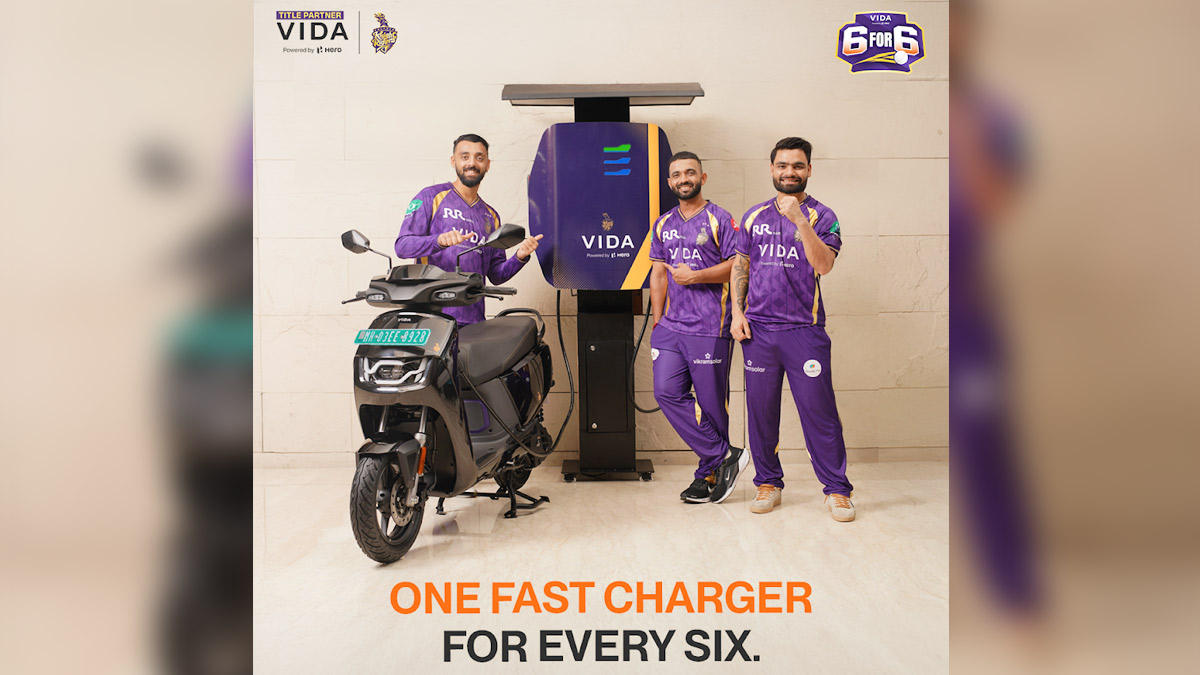
NEW DELHI: VIDA, the electric mobility arm of Hero MotoCorp, has teamed up with Kolkata Knight Riders to launch a campaign that turns cricketing flair into real-world impact.
Titled ‘6 for 6’, the initiative promises to install a 6kW fast EV charger for every six hit by KKR during the ongoing Indian Premier League season. The idea is simple but powerful, as each big hit on the field contributes directly to expanding India’s fast-charging infrastructure.
The campaign builds on VIDA’s growing network, which already spans over 5,300 fast-charging points across more than 430 cities. With EV adoption gaining pace, the brand is using cricket’s mass appeal to accelerate both awareness and infrastructure growth.
Explaining the thinking behind the move, Hero MotoCorp emerging mobility business unit chief business officer Kausalya Nandakumar said, “Cricket has an incredible ability to unite and inspire millions across the country. With the ‘6 for 6’ campaign, we are turning every big hit on the field into a step towards a cleaner and a more accessible mobility future.”
She added that VIDA’s expanding fast-charging network and removable battery technology are designed to make EV ownership more convenient and practical for everyday users.
From the franchise’s side, the campaign is also about giving on-field moments a larger purpose. Kolkata Knight Riders chief executive officer Venky Mysore said, “The ‘6 for 6’ campaign exemplifies the potential of sport as a platform for meaningful, real-world impact. By linking every six to the expansion of EV charging infrastructure, this partnership transforms fan excitement into tangible progress.”
As part of the rollout, VIDA has introduced co-branded charging stations in KKR’s signature colours, with a flagship installation unveiled alongside team players. The chargers are designed for quick top-ups, powering VIDA scooters from zero to 80 percent in about an hour, while also being positioned along key highways to support longer journeys.
The initiative also taps into VIDA’s removable battery system, which allows users to charge using standard household plug points, adding flexibility to the charging ecosystem.
By blending the thrill of cricket with the urgency of clean mobility, VIDA and KKR have found a neat way to make every six count twice, once on the scoreboard and again on India’s road to an electric future.








