MAM
Milestone Brandcom forays into rural marketing with Milestone Outland


MUMBAI: Out-of-Home (OOH) advertising and media company Milestone Brandcom has expanded its footprint with a communication division dedicated to low income and rural consumers Milestone Outland.
It has appointed Ajay Sundaram to the post of country head and vice president of this new division. The outfit will have a team of 50 members operating pan-India within a month from launch.
“At Milestone, we believe in investing in talent, knowledge and insights. We want to help the brand reach its customers wherever they may be. Therefore we felt the need to go rural. Milestone believes it is essential to gain an understanding about the impact of these elements to succeed in the Indian rural markets. Our future growth strategy involves offering this service to our existing and new client‘s. Therefore we have appointed established experts in the field of rural marketing who are equipped with the skills of surviving in these markets,” commented Milestone Brandcom founder and managing director Nabendu Bhattacharyya.

He reveals that the intention of starting this division is to challenge the current status quo in rural consumer communications.
Marketers focus is shifting towards low income consumers in tier 2 and 3 towns as the next level of growth is expected from smaller towns. India‘s rural population comprises of 12 per cent of the world‘s population presenting a huge, untapped market. Taking into consideration the population density in rural India, it offers vast opportunities that brands cannot afford to disregard.
The Indian rural market consists a variety of mind-sets, cultures, and lifestyles. More than 70 per cent of India‘s population lives in villages. The size of the market increases many fold with the coupling of the LIC (Low Income Consumers) market.
It offers a huge opportunity for the media and advertising industry. There lies a massive availablility potential among these consumers because of the increasing disposal income and awareness levels. Studies have shown that the rural consumers across all income segments exhibit marked tendency to spend on premium products which are backed by strong brand values, where they correspond to their own aspirations and quality needs. These consumers are the future for brand‘s survival & sustenance in Indian markets.
According to the McKinzey Report, India will be the 5th largest consumer market by 2025 and income levels will almost triple. Rural consumer communications is therefore a growth strategy for Milestone Brandcom. Milestone Brandcom has over 100 active brands in its roster; it is a natural extension of the company‘s offerings from OOH, events-promotion, retail solutions and rural consumer communications.
“Increasing brand consciousness and disposable incomes has made the rural consumer more demanding and selective in his purchase behaviour. Rural markets demand a sustained effort by brands to expose the consumers to the products via activities related to brand building and product acceptance. We plan to reach out to the low income rural consumers and give them an opportunity to understand the various choices in terms of brands and products via continuous penetration through different modes of OOH advertising. To effectively succeed in the markets, campaigns have to be tailored to requesting the consumers to keep in mind the nuances of their language, dialect and customs prevailing in their region,” said Ajay Sundaram.







Brands
HP launches Smart Champs learning game show with JioStar for students
Sanya Malhotra hosts quiz series blending fun, learning and prizes
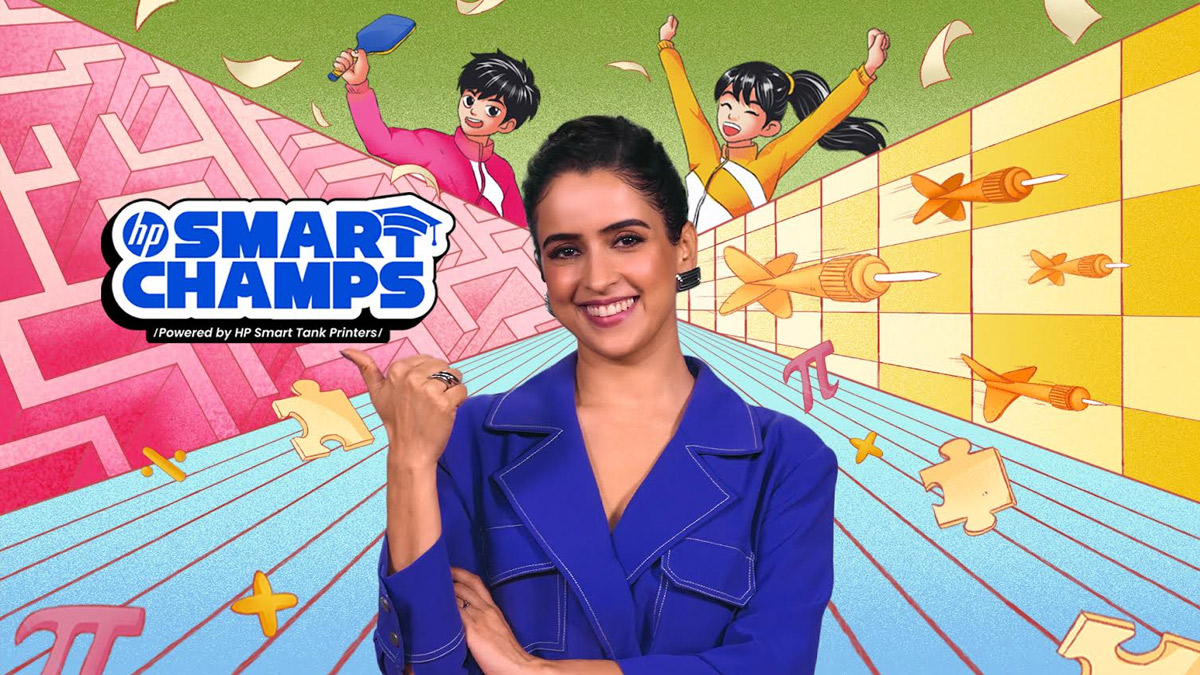
NEW DELHI: HP India has teamed up with JioStar to launch HP Smart Champs, a new learning-based game show designed to make education engaging for school students across the country.
Hosted by Sanya Malhotra, the 10-episode series brings together students from Grades 5 to 9, who compete in teams through quiz and puzzle-based challenges that test knowledge, logic and teamwork. The show will begin streaming on JioHotstar from April 11 and will premiere on Nick on April 18, with weekend episodes airing at 7 PM.
Powered by HP Smart Tank printers, the format integrates print-based learning into the gameplay, using worksheets, clues and visual problem-solving tools to encourage hands-on participation. The idea is to move students beyond rote memorisation and towards more applied, curiosity-led learning.
The competition promises high stakes, with winners set to receive a cash prize of Rs 10 lakh, while runners-up will take home Rs 5 lakh. Additional rewards include HP AI laptops, Smart Tank printers and accessories, while the winning school will be awarded an HP Smart Tech Lab.
Speaking about the initiative, HP India managing director Ipsita Dasgupta said, “At HP, we believe nurturing India’s youth is key to the country’s progress, and technology plays a foundational role in enabling this. With HP Smart Champs, we wanted to create something beyond traditional learning, a fun-filled platform where curiosity, creativity and critical thinking take centre stage.”
On the show’s reach, JioStar head entertainment sales Mahesh Shetty said, “HP Smart Champs reflects how children today learn through exploration and experience. With Nick and JioHotstar, we are creating a multi-screen approach that is both engaging and meaningful.”
Highlighting the role of print, HP India senior director print Satish Kumar said, “The show brings print-based learning to life in an engaging format, helping students develop deeper understanding through hands-on experiences.”
The journey to the finale began with participation from over 1,000 schools across 26 cities, narrowing down to 34 finalists who will compete in a studio showdown in Mumbai.
With its blend of entertainment, education and technology, HP Smart Champs is positioning itself as more than just a quiz show. It is a nationwide push to make learning interactive, accessible and, above all, a lot more fun.







