MAM
Loyalty marketing growing in India

MUMBAI: India‘s continued economic growth has fueled an emerging opportunity for brands and retailers to engage consumers, according to the new 2011 Colloquy Cross-Cultural Loyalty Study.
This research was carried out in collaboration with multichannel marketing services firm Epsilon International and LoyaltyOne, a provider of loyalty marketing services that recently entered the Indian consumer market.
Among the key findings for India is the importance of word-of-mouth (WoM) as compared to other countries surveyed. WOM conversations are rated at 7-8 on a 10 point scale, where 10 signifies that WOM conversations are “extremely important”, approximately, 15 – 25 per cent higher than developed countries. This is of great significance for brands looking to create early adopters and loyal ambassadors.

India also offers a significant socially accessible and connected consumer audience with a hundred million internet users more than half of whom (55 per cent) read product reviews online and only make a purchase based on the feedback, according to the Asian Digital Marketing Association (ADMA) report 2011.
LoyaltyOne India CMO Rathin Lahiri said, “The results of the study validate that there‘s never been a better time for brands in India to engage in meaningful relationships with their customers. First generation loyalty programs create a means to get to know customers better. With that knowledge brands can successfully adapt and build the type of lasting relationships that drive sustained growth.”
Other study highlights:
- Consumers in India have an engaged, energised, and enthusiastic attitude about their economic prospects, consumerism, brands and companies, and loyalty rewards programs. Over one-third (34 per cent) of Indians feel strongly that their economic prospects will improve over the next decade.
- While a sizeable 42 per cent of Indians belong to at least one reward programme, it is significantly lower than their American counterparts, 74 per cent of whom are enrolled in such programs.
- 20 to 33 per cent of Indian consumers are “extremely loyal” to their favorite brands across six major categories — clothing retailers, grocery retailers, financial services providers, dining, auto fuel and travel providers
- 56 per cent of Indians believe that most businesses can be trusted. This is significantly higher than all other countries surveyed.
- A high number of Indians (56 per cent) also seem to have inherent trust towards international brands over domestic brands.
- Email and text messages rank number one and two respectively as the preferred means of receiving marketing messages among India‘s middle class consumers, beating television and print advertising.
Epsilon VP sales, Asia Pacific Adrian Hoon said, “The opportunity for marketers in India is clear. The challenge, however, is to convert the Indian consumer‘s growing love affair for the brand into a longer term, sustainable and profitable relationship. As the role of word of mouth grows in an increasingly social environment, the gap between satisfaction and dissatisfaction has never been more pronounced. Brands that invest in understanding customers‘ engagement dynamics and engaging their hearts and minds will win big, in terms of perceived service and loyalty.”
LoyaltyOne president Bryan Pearson will provide additional research-based insights into the best ways for marketers to communicate with increasingly sophisticated Indian consumers when he serves as a featured presenter at the World Brand Congress in Mumbai on 25 November. Pearson‘s presentation is titled, ‘From the Mouth of India‘s Consumers: New Research into Attitudes about Loyalty‘.







Brands
KKR sixes to power EV charger rollout under VIDA campaign
Cricket meets clean mobility as big hits spark India’s charging growth
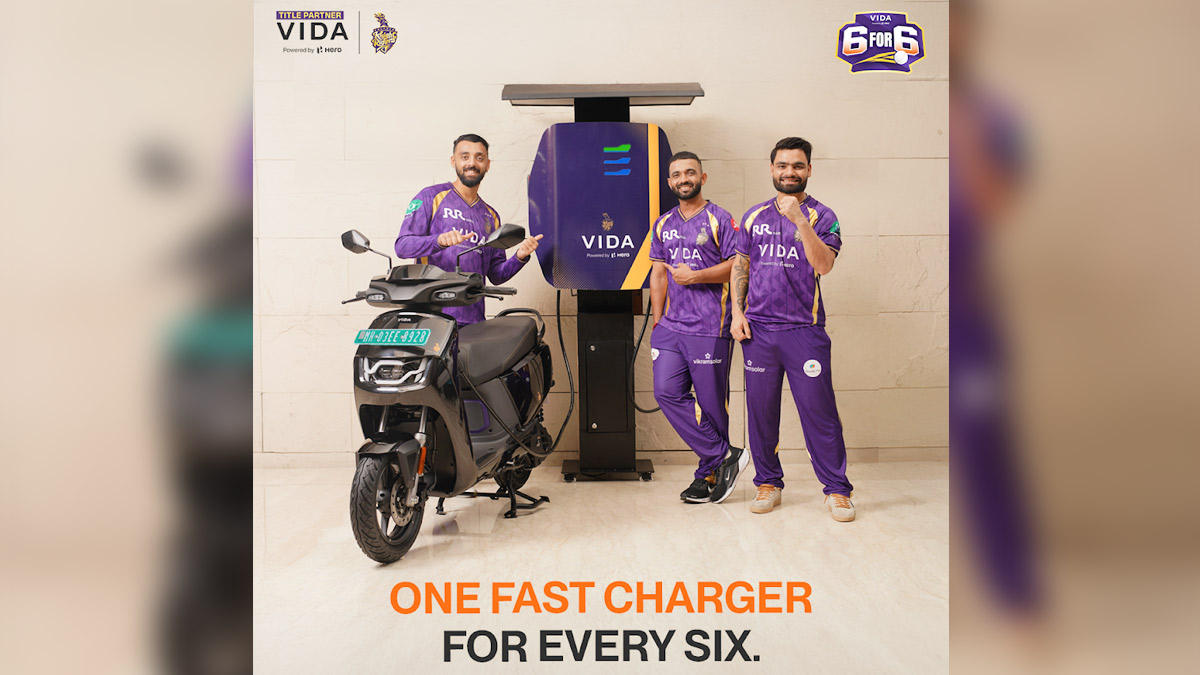
NEW DELHI: VIDA, the electric mobility arm of Hero MotoCorp, has teamed up with Kolkata Knight Riders to launch a campaign that turns cricketing flair into real-world impact.
Titled ‘6 for 6’, the initiative promises to install a 6kW fast EV charger for every six hit by KKR during the ongoing Indian Premier League season. The idea is simple but powerful, as each big hit on the field contributes directly to expanding India’s fast-charging infrastructure.
The campaign builds on VIDA’s growing network, which already spans over 5,300 fast-charging points across more than 430 cities. With EV adoption gaining pace, the brand is using cricket’s mass appeal to accelerate both awareness and infrastructure growth.
Explaining the thinking behind the move, Hero MotoCorp emerging mobility business unit chief business officer Kausalya Nandakumar said, “Cricket has an incredible ability to unite and inspire millions across the country. With the ‘6 for 6’ campaign, we are turning every big hit on the field into a step towards a cleaner and a more accessible mobility future.”
She added that VIDA’s expanding fast-charging network and removable battery technology are designed to make EV ownership more convenient and practical for everyday users.
From the franchise’s side, the campaign is also about giving on-field moments a larger purpose. Kolkata Knight Riders chief executive officer Venky Mysore said, “The ‘6 for 6’ campaign exemplifies the potential of sport as a platform for meaningful, real-world impact. By linking every six to the expansion of EV charging infrastructure, this partnership transforms fan excitement into tangible progress.”
As part of the rollout, VIDA has introduced co-branded charging stations in KKR’s signature colours, with a flagship installation unveiled alongside team players. The chargers are designed for quick top-ups, powering VIDA scooters from zero to 80 percent in about an hour, while also being positioned along key highways to support longer journeys.
The initiative also taps into VIDA’s removable battery system, which allows users to charge using standard household plug points, adding flexibility to the charging ecosystem.
By blending the thrill of cricket with the urgency of clean mobility, VIDA and KKR have found a neat way to make every six count twice, once on the scoreboard and again on India’s road to an electric future.








