Brands
Jio, Sun Direct, Dish TV among top 50 as HDFC retains BrandZ crown


MUMBAI: HDFC Bank has continued to maintain its leadership position in fourth consecutive year, according to the BrandZ Top 50 Most Valuable Indian Brands 2017 report released by WPP and Kantar Millward Brown.
HDFC Bank (24 per cent) is the India’s most valuable brand, almost doubling its brand value since the ranking started in 2014 from $ 9.4bn to $ 18.0bn.
“It has a strong purpose – to improve lives by bringing world class financial services to all sections of India – and demonstrates it through increased access to banking in rural areas, an expanded digital presence and leveraging the latest technology to simplify its offering for customers. BrandZ data shows that consumers perceive the bank as increasingly innovative,” the report stated.

India’s most valuable brands have increased their brand value by 21 per cent to US$ 109.3 billion in the last year. This compares with a two per cent decline in 2016, and is well ahead of the eight per cent value increase of the BrandZ Top 100 Most Valuable Global Brands 2017.
There are seven newcomers in the overall ranking. Telecom provider Jio ranks at number 11 — only months after its launch, having disrupted its category with free-data promotions. The others are newly-listed retailer D-Mart (no.24), appliance brand Whirlpool (no.45), insurance brand Bajaj Allianz (no.49), Canara Bank (no.50) and entertainment brands Sun Direct (no.27) and Dish TV (no.47)
The Store WPP CEO EMEA and Asia David Roth said, “Indian consumers seek authenticity and value for money, and the meaning of those things is being constantly redefined. As consumers become wealthier, they look beyond price to factors such as extra features, innovation and a personalised experience. As reflected in this year’s ranking the most agile Indian brands have recognised the complexity in the market, and achieved just the right balance between aspirational and affordable.”
The automobile category, which also includes tyres, lubricants and motor fuels, grew 23 per cent in value. Brands responded to the changing market with new models that combined smart pricing and functionality with style and power. Royal Enfield, Maruti Suzuki and TVS were among the Top 10 overall fastest risers. Royal Enfield (no.40, 59 per cent) engaged with biker groups on social media, and marketed a range of accessories. Maruti Suzuki (no.7, 56 per cent) extended the brand beyond its traditional appeal to the value segment of the market, while introducing new showrooms called NEXA to reach premium customers.
India’s Top 50 faced successive disruptions in the last year, some global, some created by fast-growing competitors and others strategically imposed by the government – including demonetisation.
The FMCG category, which includes alcohol, food and dairy, personal care and soft drinks, was significantly affected by these challenges but still managed to grow 6 per cent in total value. Some brands achieved impressive value increases by accurately understanding and responding to Indian sensibilities. Noodle brand Maggi (no.32; 66 per cent), the overall second-fastest riser, aligned itself with the trend for nostalgia. This helped it bounce back after a difficult couple of years; its rapid regrowth demonstrating how a strong brand can help a company weather a crisis and recover faster, although it is still some way below its peak brand value of $1.1bn in 2014. Health food brand Saffola (no.36; 24 per cent), meanwhile, introduced oats in new localised flavours and expanded its range of oils into a new super premium sub-segment.
The financial services category increased its value by 26 per cent. The fastest rising banks were Punjab National Bank (no.39; 43 per cent), which is highly customer-focused and more agile than some of its competitors, and Kotak Mahindra Bank (no.6; 36 per cent), which has innovated in areas including digital banking. Both of these brands still have significant catching up to do, however, if they are to reach the top of the leader board.
The BrandZ™ Top 10 Most Valuable Indian Brands 2017
|
Rank 2017 |
Brand |
Category |
Brand value 2017 (US$M) |
Change |
|---|---|---|---|---|
|
1 (-) |
HDFC Bank |
Banks |
17,965 |
+24% |
|
2 (-) |
Airtel |
Telecom providers |
10,233 |
+3% |
|
3 (-) |
State Bank of India |
Banks |
8,334 |
+31% |
|
4 (-) |
Asian Paints |
Paints |
4,717 |
+15% |
|
5 (-) |
ICICI Bank |
Banks |
4,697 |
+19% |
|
6 (+1) |
Kotak Mahindra Bank |
Banks |
4,522 |
+36% |
|
7 (+1) |
Maruti Suzuki |
Automobiles |
4,449 |
+56% |
|
8 (-2) |
Bajaj Auto |
Automobiles |
3,564 |
+5% |
|
9 (-) |
Hero |
Automobiles |
3,295 |
+17% |
|
10 (-) |
Axis Bank |
Banks |
2,428 |
+2% |
Other trends highlighted in this year’s BrandZ Top 50 Most Valuable Indian Brands include: The long-term growth curve of the Top 50 is positive, with the total brand value of the ranking up 57 per cent since the study was first carried out in 2014, when it amounted to $69.6bn
India experienced a resurgence in national pride, while also embracing globalization. This manifested in a desire for products and brands that best reflect Indian heritage, sensibilities and tastes, which benefited local brands and put pressure on multinationals to follow suit. Colgate (no 28; two per cent) launched a toothpaste with Ayurvedic properties to meet this demand.
The top riser is insurance brand ICICI Prudential (no.35; 89%). It benefited from the ‘halo effect’ of other brands’ successful responses to rising consumer affluence, which led to an increase in sales of assets such as cars that need insurance protection
Kantar Millward Brown MD — South Asia Vishikh Talwar said, “There are now ‘multiple Indias’. Consumers continue to love the brands they’ve loved for generations, while equally embracing the brands of the future. Brands must be completely in rhythm with the pulse of the market. Those that can accurately interpret Indian sensibilities, while ensuring smart pricing, are likely to be most successful. This is easier for local brands, but people will relate just as positively to a global brand if it uses insight to understand and meet their needs, and communicate in a way that builds trust.”
For the first time, this year’s BrandZ Top 50 Most Valuable Indian Brands 2017 study incorporates new research from Y&R’s BAV Group into what it takes to build powerful nation brands. According to the 2017 Best Countries report, India stands out for its history, cultural influence, distinction and reputation for entrepreneurship; especially among the world’s business decision-makers.





Brands
ITC Sunfeast Farmlite launches Sugar Free Cookies range
New variants offer guilt-free indulgence for health-conscious snackers.
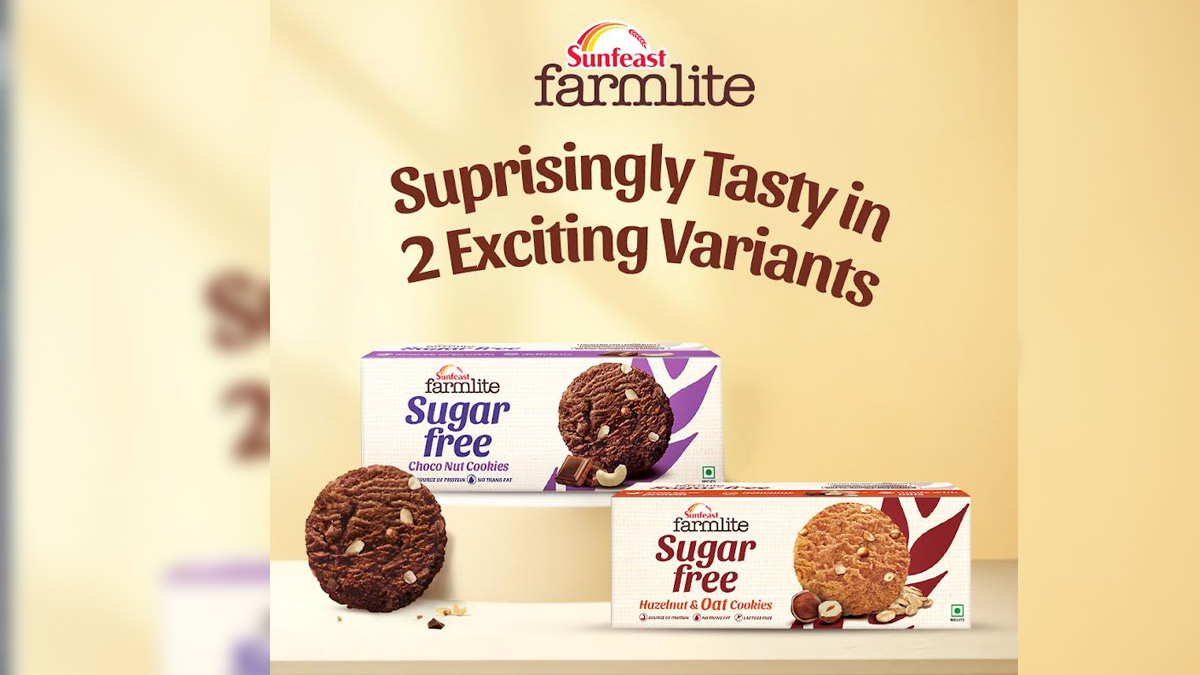
MUMBAI: ITC Sunfeast Farmlite is sweetening the deal for biscuit lovers who want to have their cookie and eat it too without the sugar. The better-for-you biscuits range from ITC Foods has expanded its portfolio with the launch of an all-new Sugar Free Cookies line, aligning with the company’s vision of ‘Help India Eat Better’. The range is designed for consumers who are rethinking sugar in their daily snacking but refuse to compromise on taste and indulgence.
The collection debuts with two tempting variants: Choco Nut Cookies and Hazelnut & Oats Cookies. Both are a source of protein and contain no trans-fat, while the Hazelnut & Oats variant is also lactose-free.
ITC Ltd. vice president (marketing), biscuits, foods division, Suraj Kathuria said, “At Sunfeast Farmlite, we believe mindful snacking should never come at the cost of indulgence. With this launch, we are catering to the growing need for guilt-free snacking while delivering a rich, satisfying cookie experience.”
ITC Ltd. vice president & head of food sciences for foods division Dr Shantanu Das added, “We have applied robust food science to develop cookies that are sugar-free while preserving the taste and texture consumers love.”
Each cookie comes in convenient single-serve packs to maintain texture and freshness. Both variants are available in 100g packs priced at ₹100 and can be found on quick-commerce platforms including Blinkit, Swiggy Instamart, and Zepto.
In a market increasingly leaning towards healthier choices, ITC Sunfeast Farmlite’s new Sugar Free Cookies prove that cutting sugar doesn’t mean cutting joy. For the health-conscious yet indulgent snacker, this could be the perfect bite-sized solution.






