Digital Agencies
ICC Men’s Cricket T20 World Cup garners 55.9 Mn social media mentions

Mumbai: Driven by outstanding player performances, new records, epic turnarounds, and nail-biting moments, the ICC Men’s Cricket T20 World Cup garnered unprecedented social media chatter. Interactive Avenues, a leading full-service digital agency and the digital arm of IPG Mediabrands India, has released “Capturing the Glory: A Social Listening Report on #T20WorldCup”, which sheds light on the digital conversation landscape surrounding the tournament and India’s spectacular victory. The report, based on extensive data gathered from social platforms such as Twitter, Reddit, and popular cricket forums, reveals unique insights on player popularity, most appreciated performances, most talked about matches, top brand partnerships and more.
Commenting on the report, Interactive Avenues COO Shanatanu Sirohi said, “The Cricket T20 World Cup has once again proven the unparalleled ability of cricket to captivate audiences. This tournament has set new benchmarks for player popularity, with stars like Rohit Sharma and Jasprit Bumrah leading the conversations. Our comprehensive social listening report not only highlights the staggering number of mentions and engagements, but also delves into the elements that drove these numbers.”
Key findings of the report:

Social chatter highlights:
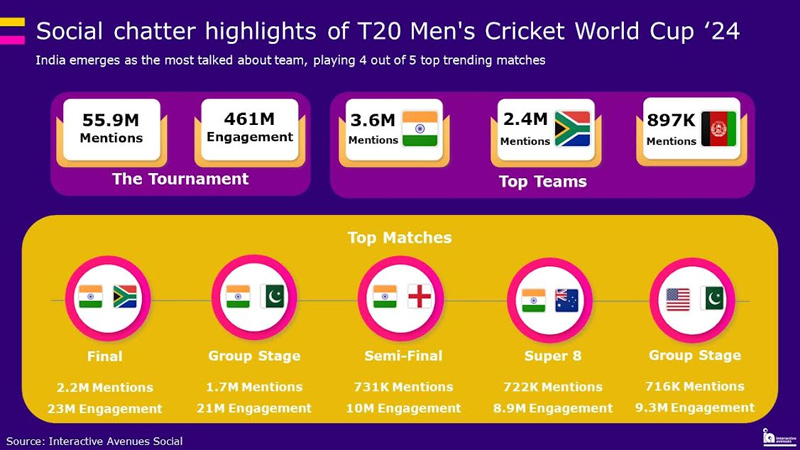
- Overall, the tournament garnered 55.9Mn mentions and drove 461Mn engagements.
- Rohit Sharma emerged as the most talked about player and batsman (5.5Mn mentions). Jasprit Bumrah was the most popular bowler (1.2Mn mentions), and Hardik Pandya was the top all-rounder (1.1Mn mentions).
- The finale between India and South Africa was the most talked about match (2.2Mn mentions), followed by India vs. Pakistan (1.7Mn mentions).
Most thrilling moments:
- Suryakumar Yadav’s stunning catch which clinched the T20 World Cup title for India got 209K mentions.
- Afghanistan beating Bangladesh in a low-scoring thriller to seal their semi-final spot drove 156K mentions
- India’s victory against Pakistan by 6 runs in the low-scoring group stage match garnered 122K mentions.
Most popular players:
- Powered by consistently stellar performances, India’s Rohit Sharma (5.5Mn mentions), Virat Kohli (4.1Mn mentions), Suryakumar Yadav (1.3Mn mentions), Jasprit Bumrah (1.2Mn mentions) and Hardik Pandya (1.1Mn mentions) emerged as the most popular players on social media.
Top emerging players:
- Making their debut in a T20 World Cup, players from USA topped the popularity charts among emerging talent. Saurabh Netravalkar led the roster (163K mentions), followed by Ali Khan (67K mentions), Aaron Jones (49K mentions), and Monank Patel (30K mentions).
Top emotional moments:
- Rohit Sharma and Virat Kohli’s ‘bromance’, including videos of their journey together, resulted in 7.1Mn engagements.
- Rohit Sharma and Virat Kohli announcing their retirement from T20 international matches drove 4.1Mn engagements.
- Rohit Sharma kissing Hardik Pandya in an emotional moment after India won the cup garnered 2.3Mn engagements.
Biggest comeback story:
- After being booed at every match venue during IPL 2024 (92% negative mentions), Hardik Pandya made a spectacular comeback with 88% positive mentions during T20 World Cup 2024.
Top brand partnerships:
- Brands across diverse industries leveraged T20 CWC-based partnerships to drive engagement. Maruti got 258K mentions, Amul garnered 200K mentions, and ICICI Bank got 145K mentions.
- Nandini Milk witnessed a whopping 390% increase in average monthly engagement, while BPCL’s “Snap The AD” contest drove a 191% spike in average monthly engagement.






BENGALURU: For years, creative teams have learned to live with ambiguity. Vague comments, last-minute changes, feedback that arrives without context, clarity, or conviction. It became part of the job – something teams worked around rather than getting it solved.
But as we head into 2026, that tolerance is wearing thin.
Creative work today moves faster, scales wider, and involves more stakeholders than before. Teams are producing more content across more formats, often with distributed collaborators and tighter timelines. In this environment, guesswork is no longer a harmless inconvenience. It’s a cost – to time, to budgets, and to creative mindspace.
The real problem isn’t feedback, it’s how it’s given
Most creative professionals you see today will tell you they’re not against feedback. In fact, they rely on it. Good feedback sharpens ideas, strengthens execution, and pushes work forward. The problem is ‘unclear’ feedback. When someone says “this doesn’t feel right” without context, they aren’t just revising – they’re basically decoding. They’re guessing what the problem might be, trying different directions, and burning time in the process. Multiply that by a few stakeholders and a few rounds, and suddenly days disappear.
In 2026, when teams are expected to deliver faster without compromising quality, interpretation is a luxury most can’t afford.
Scale has changed rverything
Creative projects used to be smaller and simpler. A designer, a manager, maybe one client contact. Feedback loops were short, even if they weren’t perfect.
Today, the same project might involve internal marketing teams, agencies, freelancers, brand reviewers, and regional teams. Everyone has a say. Everyone leaves comments. And often, those comments don’t agree. More people reviewing work means alignment matters more than ever. Clear feedback isn’t just about being nice to creative teams, it’s about keeping projects moving when complexity increases.
Guesswork quietly wears teams down
One of the less talked-about impacts of unclear feedback is what it does to people.
When feedback is vague or contradictory, creatives second-guess their decisions. They hesitate. They overwork. They keep extra time buffers “just in case.” Over time, confidence drops. Ownership fades. Work becomes safer, not stronger. Creative energy gets spent on managing uncertainty instead of pushing ideas forward. And in an industry already grappling with burnout, unclear feedback adds unnecessary mental load.
Actionable feedback is a shared skill
Clear feedback doesn’t mean controlling creative decisions or dictating every detail. It means being specific enough that someone knows what to do next.
Actionable feedback answers three basic questions:
What exactly needs attention?
Why does it matter?
What outcome are we aiming for?
This applies whether you’re reviewing a video frame, a design layout, or a copy draft. The clearer the feedback, the fewer follow-ups it creates. In 2026, teams that treat feedback as a skill and not an afterthought, will move faster with less friction.
Tools shape behaviour (whether we admit it or not)
The way feedback is delivered is often dictated by the tools teams use. Comments buried in long email threads, messages split across chat apps, or notes detached from the actual work all contribute to confusion.
When feedback lives outside the work, context often gets lost. When it’s disconnected from versions and timelines, decisions get questioned. When it’s scattered, accountability disappears. More teams are starting to realise that feedback problems aren’t just communication issues, they’re workflow issues. How work moves between people matters just as much as the work itself.
From Opinions To Alignment
One of the biggest shifts happening in creative teams is a move away from purely opinion-driven feedback. Instead of “I like this” or “I don’t,” teams are asking better questions:
● Does this meet the brief?
● Does this solve the problem?
● Does this align with the goal?
This change reduces unnecessary back-and-forth and helps feedback feel less personal and more productive. It also makes decisions easier to explain and defend. As creative work becomes more strategic, feedback has to support that shift.
2026 Is About Fewer Loops, Not Faster Loops
There’s a misconception that speed means moving through feedback cycles faster. In reality, the most creative teams aren’t just accelerating loops, they’re reducing them. Clear, actionable feedback upfront leads to fewer revisions later. Clear approval stages prevent last-minute surprises. Clear decisions stop work from circling endlessly.
In 2026, efficiency won’t come from working harder or longer. It will come from designing workflows that respect creative time and attention.
Ending guesswork is a mindset change
Ultimately, ending creative guesswork isn’t just about better tools or processes. It’s about mindset. It’s about recognising that clarity is an act of respect – for the work, for the people doing it, for the time invested and for the mindspace used. It’s about moving from “figure it out” to “here’s what we’re aiming for.”
Creative teams that embrace this shift will find themselves not only delivering faster, but also enjoying the process more. And in an industry built on imagination, that might be the most valuable outcome of all.