MAM
IAA Debate: Will mobile take over TV as primary screen three years from now?


MUMBAI: With mobile proliferation in the country and the advent of 4G, the big question remains whether mobile will be the primary screen for news and entertainment in India in three to four years from now?
At Melt 2015, the Indian Advertising Association (IAA) organised a riveting debate on the same with a panel comprising Times Now editor in chief Arnab Goswami and The Hindu MD and CEO Rajiv Lochan, who teamed up to debate against the motion, whereas Madison Media group CEO Vikram Sakhuja and The Quint.com founder and seasoned entrepreneur Raghav Bahl argued for the motion.

ET Now journalist Sonali Krishna moderated the debate. The audience, which comprised the who’s who of the media, advertising and marketing industry, was the ultimate judge of the debate.
All four participating members were given seven minutes to put forth their argument. Sakhuja kick started the debate by basing his argument on the power and features of a smart phone and also the connection that the device has built with consumers in recent years. He was of the opinion that the mobile is something that a person picks up the first thing in the morning and puts down the last at night. The prime connect of Sakhuja’s piece was when he asked people in the audience who had a mobile to raise their hand. Of course, it came as no surprise that the entire hall put their hand up.
However, that aside, his opponents also made sensible rebuttals to portray counter arguments. The prime base of Sakhuja’s argument was the ability of mobile phones and how it enables consumer to consume content while in motion.
Goswami, who in his inimitable style kept putting counter facts and figures in between Sakhuja’s speech initially, took to the floor by basing his piece on the reach and accessibility of television as opposed to the limitations of the mobile phone. Goswami said that the hands that went up when asked if they had a mobile phone, do not represent the entire country and there are people beyond them too who have limited access to smartphones and high speed internet.
Goswami also focused on the affordability quotient and how by paying certain sum of money, an entire house consisting multiple members can enjoy action on television while the investment is way more when it comes to consumption of content on mobile phones, which is less mass and hence gets lesser reach or viewership as compared to television.
Though Goswami’s opponents made numerous attempts to break him by interrupting and putting forth questions, as always he was least deflected and managed to put way more in justifying his stand.
Giving a pass to the mumbo jumbo of statistics, Bahl justified his stand by speaking about consumer behavior and how it can change drastically within a short span of time. He stated the example of mobile phone and the high initial rates associated with it, which in turn placed it as a product for the elite class and totally irrelevant to the middleclass or lower middle class. However, in a short span during 2001 to 2005 everything changed drastically and now a vegetable vendor sits with his cart and sends the vegetable price to consumers over mobile phone using Whatsapp. Many in the audience appreciated Bahl’s arguments and examples as the foundation of his argument was that statistics are derived from past occurrences and hence predicting the duration required to bring a change in consumer behavior on the basis of available statistics cannot be justified.
Not missing the chance even once, Goswami and Lochan interrupted him at numerous occasions. However, one such instance turned into a light banter between Goswami and Bahl, which got the audience on the edge of their seats. Bahl, during his speech, mentioned, “News is consumed in bits and bytes,” to which Goswami countered by saying, “I run a two hour long news show, which cannot be called as bits and bytes and is widely watched.” Bahl immediately launched the direct war by saying, “The show you run is not news but opinion.” Not letting Bahl continue with his point, Goswami retaliated by saying, “Raghav, you launched a news channel, which never managed to get half my ratings.”
However, before things could go out of control, Krishna interjected and called for the debate to go on smoothly.
Adding more substance to the few points already made by Goswami, Lochan also touched upon the qualitative aspect and his major issues were poor available infrastructure, which is in a buffering mode. He also made a point on the basis of health issues and stated mobile phones are a hazard to health and hence there are possibilities of people refraining from using the device.
Once the four speakers had put forth their points, in the concluding statements they acknowledged all the arguments put forward.
A message that Goswami repeatedly tried to convey through his comments, which were directed towards Sakhuja – a media planning and buying representative, was that Sakhuja was standing on the wrong side and should make a shift. The message was not only directed at Sakhuja but was an indirect attempt to convey that television is still the primary screen and advertisers should rate them undisputedly.
After rounds of arguments and counter arguments there was no clear winner that was depicted through audience reaction. However, IAA president Srinivasan Swamy declared Goswami and Lochan as the winners of the debate, which was considered as the official verdict.




Brands
Kingfisher signs three-year IPL partnership
Packaged water brand signs on as ‘good times partner’ for 2026–28 cycle
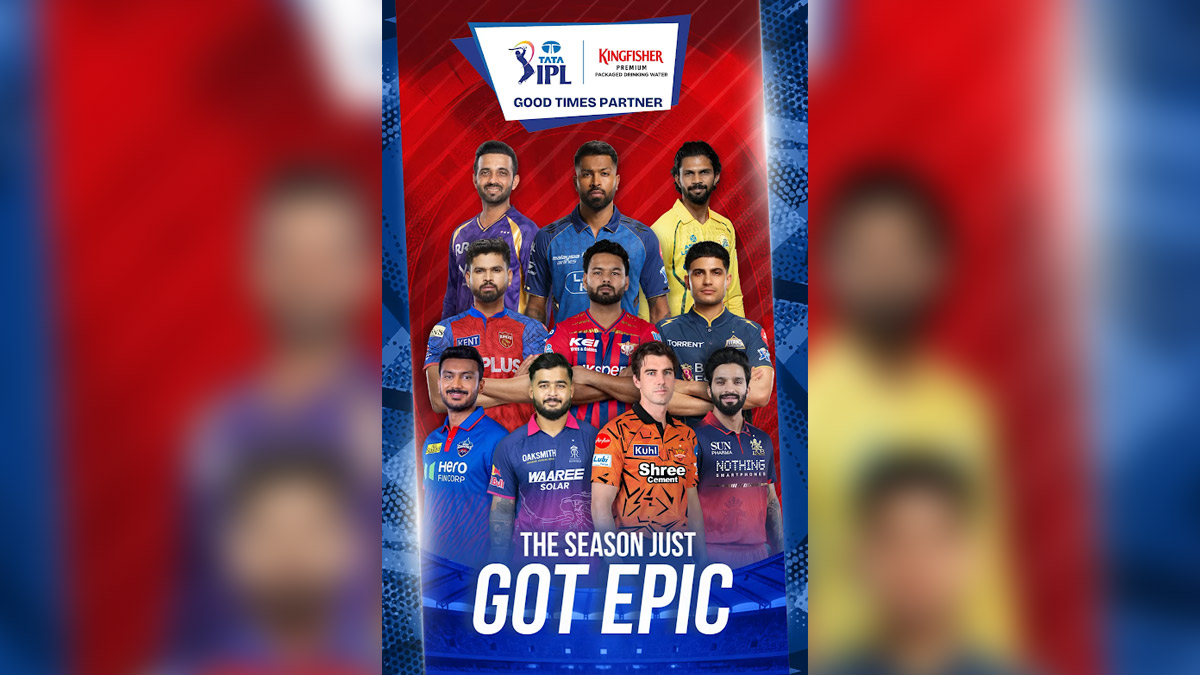
MUMBAI: Kingfisher Premium Packaged Drinking Water is betting big on cricket’s biggest stage, sealing a three-year partnership with the Board of Control for Cricket in India to sharpen fan engagement at the TATA Indian Premier League.
The brand, owned by United Breweries, will serve as the official “good times partner” for the men’s IPL from 2026 to 2028, extending a relationship that began with the Women’s Premier League. The move signals a broader push to embed itself deeper into live sport, with a focus on immersive, consumer-led experiences rather than conventional sponsorship visibility.
At the heart of the tie-up is a suite of fan-first activations spanning broadcast, stadiums and digital channels. These include the “Kingfisher Bird Cam”, offering a branded spider-cam perspective during live matches, and the “Good Times Zone”, an in-stadium entertainment hub during play-offs aimed at amplifying match-day buzz. The brand will also back IPL fan parks, elevate public screening experiences and run digital contests tied to key moments through the season.
Vikram Bahl, chief marketing officer, United Breweries, said cricket in India “is more than a sport, it is a shared cultural moment”, adding that the IPL brings that energy alive at scale. “For Kingfisher Premium Packaged Drinking Water, being present at the heart of these moments, in partnership with the BCCI, is a natural extension of what we stand for. Through this association, we aim to enrich how fans experience the game… making every match more immersive, social and memorable,” Bahl said.
Devajit Saikia, honorary secretary, BCCI, said the IPL “has always been at the forefront of redefining sports entertainment and fan engagement”. He added that the collaboration would fuse cricket fandom with “innovative fan experiences that extend beyond the stadium”, helping create memorable moments for audiences nationwide.
For United Breweries, part of the HEINEKEN group, the play is clear: move from passive branding to active participation in the fan journey—on screens, in stands and across social spaces. With millions tuning in and turning up each season, the IPL remains the country’s most potent marketing theatre. The question now is whether “good times” can translate into lasting brand recall in a market where visibility is easy, but engagement is hard-won.








