MAM
How are inflation-hit FMCG players protecting their bottom lines?

Mumbai: The domestic fast-moving consumer goods (FMCG) industry has been feeling the impact of unprecedented inflation for several quarters now. The unexpected rise in commodity prices, whether in food, chemicals, or packaging, combined with the spike in fuel prices, exacerbated by increased logistics and shipping costs, is putting pressure on FMCG companies, including packaged food companies, while also reducing the share of buyer income available for spending on consumer staples. As the market continues to witness an incremental increase in inflation, it’s not only the consumers who are feeling the pinch, but also the manufacturers, leading to a downgrading of sales across urban and rural areas.
With no respite in near sight, how are the FMCG players dealing with the situation? How are brands resorting to innovative ways to mitigate the rise in input costs and deal with the soaring inflation?
Most of the FMCG companies have increased prices of the products, says Kantar South Asia Insights Division managing director Soumya Mohanty. “So, it’s actually the end consumer who is feeling the pinch most. As a result, they are rationalising spends.”

Findings from the latest Kantar Global Issues Barometer report indicates for 74 per cent of Indians, the increasing cost of living and other issues of concern are having an impact on their big life plans. “Customers are however unwilling to cut their spending on essentials, it’s the large ticket high value items which are most likely to bear the brunt most,” notes Mohanty. “We expect brands to optimise their portfolio to rationalise the cost of production and pass on the benefit to consumers.”
Inflation’s impact can’t be “dealt with,” says White Rivers Media co-founder and CEO Shrenik Gandhi. This is why industry leaders are implementing changes that they hope will mitigate the said impact, he adds, pointing out some cost-saving initiatives that major FMCG players have begun implementing.
Can “shrinkflation” be a solution?
Among these methods is “shrinkflation,” which has been adopted by several major manufacturers, including Hindustan Unilever, Nestle, Dabur, P&G, Coca-Cola, and Pepsico. According to news reports, Haldiram has cut down the size of its aloo bhujia packet to 42 gm from 55 gm.
HUL, Nestlé, Dabur, Marico, ITC, and Britannia have rolled out price increases of between 5 per cent and 20 per cent since October last year. Dabur India has introduced a mix of pricing actions and cost-control measures, even as companies across the board are using recycled aluminium for cans, cutting costs on advertising and marketing spends, and postponing new launches.
According to Gandhi, some innovative ways FMCG brands are mitigating the rise in input costs and dealing with the soaring inflation are by investing in technology and digital initiatives to increase efficiency, introducing “bridge packs” as a strategy that gives slightly more grammage than the lower-priced pack while charging the customer higher, and by resorting to economical packaging and recycled products.
“The Edelweiss report points out that FMCG companies are integrating systems across suppliers, inventory management, and distributor management, which were previously distinct systems in silos,” he noted. “Digital initiatives are being implemented across the board, from supplier onboarding and management to inventory management, distributor management to sales. Even if technology does not directly impact the end product, it will certainly play an increasingly important role in ensuring that it reaches customers faster and generates greater cost savings for these companies.”
Increasing the price is not always an answer
For FMCG and packaged food products, India has always been a very price-sensitive market, and the market volumes were at the lower end of the market, catering to the masses. In the Indian FMCG industry, smaller, single-use SKUs at price points of one rupee, two rupees, five rupees, and ten rupees are important.
Hence, consumer companies are finding ways to increase prices without disturbing the grammage in the sensitive segments, priced less than Rs 10, and also protect margins at the same time. For fear of undermining demand in this category, they are considering launching ‘bridge packs’ at a higher price.
Some manufacturers are using thinner packaging to counter runaway costs in commodities, packaging, and freight. Parle Products is looking at savings from carton configuration—meaning, it is looking at ways to add more packets of biscuits or snacks per carton. Britannia has said the company is bringing in process automation to raise productivity, reducing the distance to market to reduce cost and provide fresh products to consumers, reducing wastage at the factory and in the marketplace, and moving to a target of using up to 60 per cent of renewable energy.
Avalon Consulting partner Santosh Sreedhar agrees that increasing prices is easier said than done in India, which is “a highly price-sensitive” market. However, he adds that beyond a point, this becomes inevitable as commodity pressures increase. “For brands that are operating at these price points, it’s a challenge since the product is sold on price. “In the case of one fruit juice company we are in touch with, the sales dropped as much as 40 per cent when the price of their highest-selling SKU was increased from Rs 10 to Rs 12,” he mentioned.
“In my view, in most products, the opportunity to further reduce pack size is low as the companies have maxed out the potential. So, we may see companies now trying to move up the price point. We have already seen this happen in confectionery and shampoos more than a decade ago when 50p products moved to rupee one. There was a temporary dip in sales for many brands, but eventually, the market settled down at the higher price point,” he added.
He lists out the following options for FMCG companies if they have to retain margins, apart from increasing prices: reduce pack sizes; change product formulation; reduce packaging/packaging reengineering. Changing product formulation is very much a possibility, but may not be applicable in many product categories, says Sreedhar. “We are not expecting at least the top brands to change the composition, but companies can come up with lower priced variants that help them continue to serve customers at lower price points. Many of the shampoo and chocolate brands have done this in the past where the product in the larger SKUs is different from the ones in the smaller SKUs.”
According to Pescafresh founder Sangram Sawant, the quality and freshness of the product, remaining non-negotiable factors, do pose a double challenge for the brand to ensure cost optimisation across functions and efficiency. He said, “Just-in-time inventory, reducing shrinkage, maintaining cold chain across the supply chain links, and introducing technology stacks to reduce the supply chain hurdles have helped us offset a few cost increases.” The brand has currently not decided to hike prices. However, if its procurement costs continue to rise, it will “take a call accordingly.”
The Impact on AdEx?
Will the current scenario warrant a decrease in Advertising spends by brands, as marketing costs are known to one of the first to take a hit in uncertain times?
Sawant says that with the introduction of Pescalive, the seafood e-supplier is innovating across the supply chain and marketing functions to control costs. With regards to ad spends, the brand is in the process of building Pescafresh as an overall foodtech brand and will continue to focus on the same for the fiscal, he adds.
Whenever there is uncertainty, consumers need reassurance, and they fall back to familiar and known options, observes Kantar’s Mohanty. So, it will be key for the brands to stay true to their core purpose and talk to consumers about it. For this to happen, communication is going to be important. So, visibility on different medias- TV, Social media will be important and Ad expenditure is unlikely to get reduced, he believes.
Bombay Shaving Company COO Deepak Gupta is optimistic on the impact on Adex as well. Marketing spends is a function of number of units sold, contribution margin and marketing effectiveness, he notes. “For premium brands on a growth trajectory, current situation provides a unique opportunity as reduced ad expenditure from incumbent brands is leading to higher SOV (Share of voice), and lower CPMs (cost per mille) without increasing absolute ad spends.”
“We are increasing our ad spends on key categories with a channel focus to improve TOMA (top-of-mind awareness) and enter into consideration set of prospective buyers. Overall, we expect higher marketing investment from FMCG brands in second half of the year, considering the onset of festive season and easing of inflationary pressures,” he adds.
While mass FMCG brands are resorting to price increase, volume reduction (or both) and cut in marketing and other discretionary spends, for premium brands the effects have been less pronounced as target consumers for premium grooming products are less price sensitive.
According to Deepak Gupta, the brand has been able to grow by investing in strengthening brand equity and maintain gross margin by reducing discounts, promotions and other discretionary spends.
He takes a more optimistic outlook on the long-term impact of the inflationary trend. “In our view, July-August-September quarter bodes well for FMCG sector as inflation has peaked and festive season is expected to lead to demand revival. Count and intensity of Covid cases have also reduced considerably compared to previous quarters which will lead to incremental growth.” We do not expect any price hike or volume reduction as brands will invest to gain higher share of wallet, Gupta adds.
New-age integrated sales and distribution SaaS platform FieldAssist CEO Paramdeep Singh Anand that connects CPG businesses to the broader value chain too holds on to a positive stance. “According to a recent report, the inflation rate in India is expected to reach five per cent by March 2023, that is a dip of two percentage points. Recently the government has asked FMCG companies to reduce cooking oil prices. Amidst these developments, it is difficult to say if inflation will rise further.”
This is to give some respite to the CPG companies who have been dealing with the trilemma of raising prices, cutting margins or cutting corners, he adds. “It is clear that we have reached the saturation point where companies that have been reducing grams without impacting prices cannot do so anymore for having reached the threshold. A similar statement could be said of companies increasing prices. That leaves many with the option of adopting strategic moves to stay in the race.”
Strategies such as using technology to identify “golden stores”, or the twenty percent stores that sell eighty percent of your products would help in optimising assortment, price, promotions and share of shelf, says Anand. “Another strategy could be optimising advertising costs by targeting new-age platforms to tap audience, for instance gaming sites, or utilising influencer marketing in untraditional ways. This will reduce expenditures and help utilize funds optimally,” he adds.
Apart from reducing price and volume, FMCG brands are looking at each line of P&L to optimise cost. Reducing advertising spends, increased focus on hero SKUs to get scale advantages, premium product innovation, reducing consumer promos and discount, improving sales mix to deliver higher gross margins, allocating higher spends for more capital efficient channels and top customers etc are some of the additional ways that industry stakeholders cite to mitigate input cost pressures, other than supply side measures.






MAM
India’s financial sector spent less on TV ads in 2025 but flooded the internet
Banks, insurers and lenders cut tv ads as digital jumps, LIC and Muthoot lead tv and Axis Bank tops online
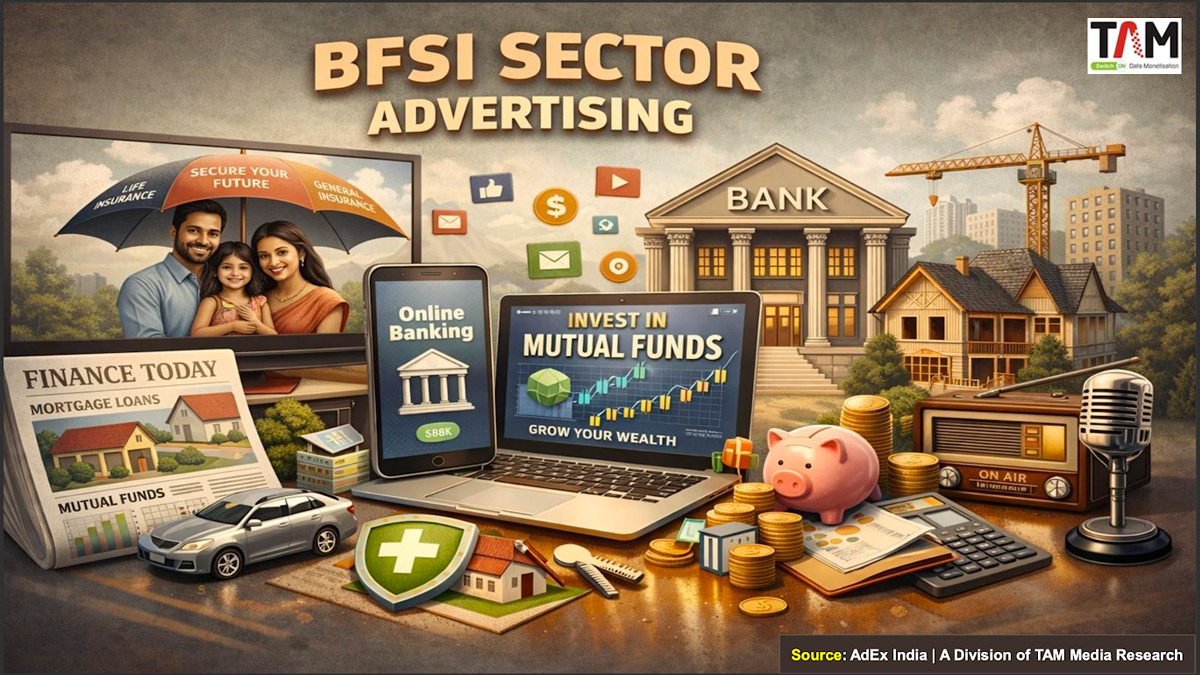
MUMBAI: India’s banking, financial services and insurance sector, one of the most prolific advertisers in the country, delivered a split verdict on media in 2025. It spent less on television, held its nerve in print, turned up the volume on radio and deluged the internet with a ferocity that left every other medium looking pedestrian. The picture that emerges from TAM AdEx’s cross-media report for the BFSI sector is of an industry in transition, still wedded to the news bulletin but increasingly seduced by the algorithm.
Television: a retreat with caveats
TV ad volumes for the BFSI sector fell 16 per cent in 2025 compared with 2024, a sharp reversal after two years of consistent growth that had pushed volumes 16 per cent above 2021 levels by 2023 and a further 7 per cent higher by 2024. Within 2025 itself, the drop was concentrated in the middle of the year: the second and third quarters saw ad volumes slide 35 per cent each against the first quarter, with a partial recovery of 13 per cent in the fourth.
The retreat did not reshuffle the deck. Life insurance retained first place among TV categories with 19 per cent of ad volumes, mortgage loans held second with 16 per cent, and the top ten categories together accounted for 82 per cent of all BFSI television advertising. The dominance of news channels was equally pronounced: news claimed 68 per cent of ad volumes, general entertainment channels a distant 14 per cent and movies 12 per cent. Together, news and GEC captured 82 per cent of the sector’s television spend. News bulletins alone took 48 per cent of programme-genre volumes, with feature films second at 12 per cent. Prime time, between 6pm and 11pm, drew 34 per cent of ad volumes, followed by afternoon at 22 per cent and morning at 20 per cent. A full 82 per cent of all ads ran between 20 and 40 seconds.
Life Insurance Corporation of India was the sector’s biggest TV spender with 11 per cent of ad volumes. Muthoot Financial Enterprises came second with 9 per cent, followed by National Payments Corporation of India at 6 per cent, Tata AIG General Insurance at 5 per cent and State Bank of India at 5 per cent. The top ten advertisers together accounted for 51 per cent of total TV volumes. Three names were new to the top ten in 2025: Tata AIG General Insurance, IIFL Finance and Tata Capital. At brand level, Muthoot Finance Loan Against Gold led with 9 per cent share, Tata AIG Health Insurance entered the top ten for the first time, and the top ten brands together contributed 35 per cent of ad volumes.
Print: the long climb continues
Print told a different story. Ad space for the BFSI sector has grown every year since 2021, rising 16 per cent in 2022, 30 per cent in 2023, 51 per cent in 2024 and 64 per cent in 2025, all measured against a 2021 baseline. Within 2025, ad space was flat in the second quarter but surged 46 per cent in the third and 33 per cent in the fourth compared with the first. Life insurance led print categories with 21 per cent of ad space, followed by mutual funds and banking services and products at 13 per cent each, and corporate financial institutes at 11 per cent. The top ten categories together took 82 per cent of print ad space. LIC led print advertisers with 6 per cent share, and the top ten together covered just 19 per cent of ad space, a reflection of how fragmented print spending remains. Three new entrants joined the top ten in 2025, with Billion Brains Garage Ventures the only exclusive presence not seen in 2024’s list. In the top ten brands, LIC dominated with a 2 per cent share, while Nippon India Mutual Fund rose to third position from fourth in 2024. English accounted for 62 per cent of print ad space, Hindi for 20 per cent. Business and finance publications took 59 per cent of the genre split. The south zone led regional spending with 33 per cent of print ad space, Bangalore topping that zone, while New Delhi and Mumbai were the leading cities nationally.
Radio: louder than ever
Radio ad volumes for the BFSI sector have climbed steadily, rising 12 per cent above 2021 levels in 2023, 36 per cent in 2024 and 45 per cent in 2025. The quarterly pattern within 2025 was volatile: a sharp drop of 43 per cent in the second quarter and 42 per cent in the third, followed by a near-full recovery in the fourth. Life insurance led radio categories with 22 per cent of volumes, banking services and products second at 14 per cent and corporate NBFCs third at 11 per cent. LIC of India held its position as the leading radio advertiser with 20 per cent of ad volumes; the top ten radio advertisers together covered 69 per cent. Muthoot Financial Enterprises led radio brands with 10 per cent share, five of the top ten brands belonged to LIC alone, and SBI Mutual Fund made a remarkable leap to fifth position from 272nd in 2024. Evening and morning time-bands together captured 84 per cent of radio ad volumes, with evenings at 44 per cent and mornings at 40 per cent. Maharashtra was the leading state for radio BFSI advertising with 18 per cent share; Maharashtra, Gujarat and Uttar Pradesh together accounted for 43 per cent.
Digital: the five-times surge
If one number defines the 2025 BFSI advertising story, it is five. Digital ad impressions for the sector multiplied fivefold between 2021 and 2025, having already doubled in 2023 and doubled again in 2024 before the 2025 leap. Within the year, impressions dipped 19 per cent in the second quarter and 12 per cent in the third before recovering 8 per cent above the first quarter by the fourth. Banking services and products led digital categories with 27 per cent of impressions, life insurance and credit cards tied at 19 per cent each, and securities and sharebroking organisations fell from first place in 2024 to fourth in 2025. Axis Bank was the runaway leader among digital advertisers with 12 per cent of impressions, followed by ICICI Bank at 9 per cent, IDFC First Bank at 7 per cent and Kotak Mahindra Bank at 6 per cent. The top ten digital advertisers covered 59 per cent of impressions, and seven of them were new entrants compared with 2024, signalling rapid churn in the digital spending hierarchy. At brand level, Axis Bank led with 9 per cent, ICICI HPCL Super Saver Credit Card vaulted to third place from 921st in 2024, and six of the top ten digital brands were new to the list. Programmatic buying accounted for 91 per cent of all digital BFSI transactions; combined with ad networks, it captured 96 per cent.
The data from TAM AdEx paints the portrait of a sector that still believes in the power of the television news bulletin to sell insurance to the masses, but increasingly knows that the next generation of borrowers, investors and cardholders is scrolling, not watching. The race is now on to reach them before the algorithm serves up someone else’s loan offer first.






