MAM
Hitchki redefines dining and nightlife with a Bollywood twist: Reeti Khowal


Mumbai: In a bustling urban landscape where dining out is as much about the experience as it is about the food, Hitchki has carved a niche for itself by offering a vibrant dining and nightlife experience. Perfect for catching up with friends or enjoying a lively night out, Hitchki’s unique selling proposition (USP) lies in its Bollywood theme and lively atmosphere.
The quirky décor, inspired by iconic Bollywood films and the nostalgic music transport guests back to the golden era of Indian cinema. This Bollywood theme not only sets the stage for a memorable dining experience but also appeals to the cultural nostalgia of a diverse clientele.
The restaurant’s menu is a delightful fusion of traditional Indian flavors and global cuisine. Guests can savor a variety of dishes, from classic Indian delicacies to contemporary international fare, all expertly crafted to please the palate. The impressive selection of drinks, including innovative cocktails and fine spirits, complements the culinary offerings, making every meal at Hitchki a gastronomic adventure.

Adding to the charm of Hitchki is its lively atmosphere. The restaurant regularly hosts live music performances, DJ nights, and themed events, ensuring that there is always something exciting happening. These vibrant events not only draw crowds but also create a dynamic and engaging environment that keeps guests coming back for more.
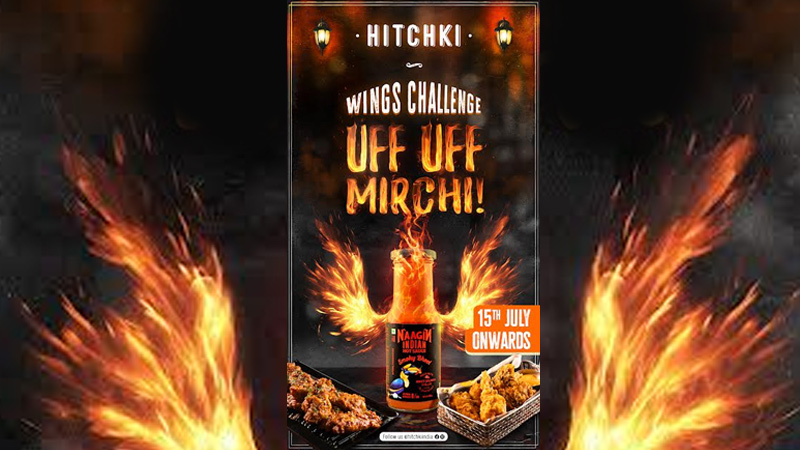
The restaurant has also announced its exciting collaboration with Naagin Sauce. From 15 July to 30 July, all Hitchki outlets in India will host the ‘Uff Uff Mirchi Wings Challenge.’ The challenge will showcase a variety of hot wings, each more tempting than the last, all prepared with Naagin’s special sauces. Participants who successfully finish the chicken wings challenge within the time limit will triumph and secure a place on the leaderboard, along with exciting rewards from Hitchki and Naagin Sauce. At the end of the 15-day contest, the participant with the fastest completion time will be crowned the ultimate winner and receive an exciting prize.
The restaurant industry is in a constant state of flux, shaped by shifting consumer preferences and global trends. In 2024, new trends are transforming how restaurants operate and market themselves. As the industry moves towards personalised and experiential strategies, establishments are finding innovative ways to engage with their customers.
To gain deeper insights into Hitchki, Indiantelevision.com reached out to Mirah Hospitality DGM – Marketing Reeti Khowal. She shared valuable perspectives on what makes Hitchki a leader in the industry.
Khowal highlighted how Hitchki’s distinctive atmosphere transports guests back in time, celebrating the golden era of Bollywood hence redefining dining and nightlife with a Bollywood twist. This nostalgic element creates an emotional connection with guests, making their dining experience truly unique. Their menu blends traditional Indian flavors with contemporary twists and due to this fusion, it appeals to diverse palates and keeps the menu exciting and fresh.
On the growing trend of themed restaurants, she discussed how Hitchki effectively capitalizes on this trend. By staying true to its Bollywood theme, they attract a wide audience looking for an immersive dining experience. Khowal also elaborated on how Hitchki utilises personalised and marketing strategies to connect with its audience. From targeted promotions to engaging social media campaigns, they highly ensure that the marketing efforts resonate with its customers.
Finally, she spoke about how Hitchki maintains its competitive edge by continuously innovating and adapting to changing market trends and customer preferences. This approach allows Hitchki to stay ahead of the curve and consistently deliver a high-quality dining experience.




MAM
Brands push beyond compliance as trust takes centre stage
ASCI AdTrust Summit 2026 spotlights shift from legal checks to credibility.
MUMBAI: In a world where a disclaimer can be legally sound yet socially suspect, brands are learning that compliance may tick boxes but trust wins markets. At the inaugural ASCI AdTrust Summit 2026, a panel on “Beyond Compliance: The New Currency of Trust” unpacked a growing industry reality: the gap between what the law permits and what consumers accept is widening and fast.
Moderated by Meenakshi Ramkumar of National Law School of India University, the discussion brought together leaders across law, marketing and academia to examine how brands must evolve in a digital ecosystem increasingly shaped by scrutiny, scepticism and speed.
Ramkumar set the tone by highlighting a critical shift, advertising today operates in the same digital space that fuels misinformation, scams and fake news, making credibility harder to establish. “The challenge is not just about what brands do, but the broader context of low institutional trust,” she noted, adding that when violations go unchecked, trust erodes not just in brands but in the regulatory system itself.
This vacuum, she said, has given rise to consumer activism from boycotts to social media backlash as a parallel accountability mechanism.
For Amit Bhasin, Chief Legal Officer at Marico, the distinction was clear, legal compliance is non negotiable, but insufficient. “Compliance is the minimum threshold. The real challenge is staying aligned with changing consumer expectations,” he said.
He pointed to how advertising narratives have evolved from traditional depictions of gender roles to more shared responsibilities reflecting a broader societal shift. “Earlier, it was fine to show one person doing the household work. Today, that may not land well. Consumers expect brands to reflect reality,” Bhasin observed.
He also highlighted internal debates where campaigns that may be legally permissible are still rejected for being culturally insensitive, noting that responsible advertising often requires asking uncomfortable questions before the public does.
If compliance is the baseline, reputation is the battlefield.
Bhasin noted that reputational risk has become a far greater concern than legal exposure, particularly in an era where campaigns can be dissected within hours online. “Earlier, a controversial ad might invite a newspaper editorial. Today, within hours, you’re at the centre of a storm,” he said.
Brands, he added, now evaluate campaigns through a dual lens legal viability and reputational vulnerability with the latter often proving more decisive.
From a healthcare perspective, Satish Sahoo of Cipla Health underscored the complexity of operating within fragmented yet stringent regulatory frameworks, spanning drugs, food, cosmetics and Ayush. “Anything under a drug licence is the most tightly regulated,” he said, adding that this necessitates proactive, not reactive, compliance.
He shared an example from the oral rehydration salts (ORS) category, where Cipla resisted the temptation to position products aggressively despite competitive pressure. “Our product is WHO compliant, and our communication reflects that. We chose not to blur the lines, even if others did,” he noted.
The long term payoff, he suggested, lies in credibility built over consistency, not quick wins.
Yet, as Harsha N of National Law School of India University pointed out, even perfect compliance does not guarantee trust. Drawing from historical and modern examples from exaggerated product claims in the 1800s to contemporary environmental and health advertising, he argued that legal frameworks often lag behind consumer expectations. “A brand can be fully compliant and still be perceived as misleading,” he said, citing instances where fine print disclosures fail to reach or convince the average consumer. He added that larger companies carry a disproportionate responsibility to set ethical benchmarks, even in areas where the law remains silent.
The conversation also turned to digital advertising, where the challenge extends beyond content to how ads are experienced. From algorithmic targeting to personalised messaging, brands now operate in an environment where regulation struggles to keep pace with technology.
Sahoo noted that social media has amplified awareness, with influencers and consumers increasingly scrutinising product claims and calling out inconsistencies. “Awareness has gone up dramatically. People are questioning what goes into products and what brands are saying,” he said.
The role of self regulatory bodies such as Advertising Standards Council of India also came under the spotlight.
Harsha acknowledged that while SROs play a crucial role, they are not immune to criticism, particularly around perceived conflicts of interest and enforcement gaps. “SROs have a higher threshold of responsibility not just to interpret the law, but to anticipate societal expectations,” he said.
He added that failures in self regulation often push the burden back onto government intervention, underscoring the need for stronger, more proactive oversight.
One of the more nuanced debates centred on whether building trust comes at a cost. While Sahoo acknowledged that quality and compliance can increase costs, he argued that companies must absorb them as part of their long term strategy.
Bhasin, however, framed the challenge differently not as cost, but as competitiveness in a market where not all players play by the same rules. “The real tension is when others cut corners and you choose not to,” he said.
The panel concluded with a call to embed trust into business metrics.
Sahoo suggested that organisations must go beyond revenue targets to include consumer equity and trust based KPIs, ensuring that ethical considerations are not sidelined in the pursuit of growth. “Trust sounds abstract, but it can translate into measurable consumer equity,” he said.
As the discussion wrapped up, one message stood out: the rules of advertising are being rewritten not just by regulators, but by consumers themselves. In an ecosystem where attention is fleeting and scepticism is high, brands that merely comply may survive, but those that build trust are the ones that endure.







