MAM
Gender disparity & males’ preponderance at top level in media cos: Study

MUMBAI: Population First, the communication and advocacy initiative working towards gender sensitivity, has conducted a study on ‘Media: How Gender Sensitive, How Inclusive’ in collaboration with Gender Issues Cell of K.C. College, Mumbai. The report of this research was released at an event in on 28 July at KC College, Churchgate (Mumbai).
The report covers 36 media organizations from 87 respondents which saw Mapping of Gender Distribution, recruitment & promotion, Equity Policies, Proactive Measures, Sexual Harassment.
The findings of the study were shared in a panel discussion with eminent media and advertising leaders – Kalpana Sharma (Former deputy Editor, The Hindu), K V Sridhar (Founder, Hyper Collective), and Devleena Majumdar (President HR, Culture Machine).

A L Sharada, Director, Population First shared, “The study was conducted with funding support from UNFPA. The project was restricted to media organizations within Mumbai Metropolitan Region and covered a total of 87 respondents drawn from 36 media organizations across languages.
“Data on gender distribution at different levels within media houses have clearly reflected gender disparity. Board members, Founder members, CEO etc are predominantly men. Women are found in large numbers as HR personnel across print and advertising but are less in number in broadcast. The presence of women camerapersons, photographers in technical sections is dismal across all media. The study also throws light on beats being highly gendered, awareness of Prevention of Sexual Harassment of Women at Workplace, demands of work and family life came out as a major hindrance for women professionals in media and more,” she said.
Conclusion and Recommendations: This was a comprehensive study, carried out across print, television and advertising media to find out how gender sensitive and inclusive media is with regards to policies, gender distribution and pro-active measures in place, to provide a gender friendly working environment. The project was restricted to media organisations within Mumbai Metropolitan Region and covered a total of 87 respondents drawn from 36 media organizations across languages. The data collection exercise was carried out by a group of 15 students who received an intensive training in the intricacies of data collection and research methodology for two weeks prior to going to the field.
Conclusions, thus, are derived from the rich data gathered from interviews with media personnel and from review of previous research studies and existing literature on the subject. However it is important to bear in mind that media personnel do not constitute a homogenous community. They expressed a diversity of opinions on a range of subjects. What we present here are broad conclusions:
• Data on gender distribution at different levels within media houses clearly reflect gender disparity. While there are more number of women in lower and middle level positions, there is a preponderance of males at the top levels. Board members, Founder members, CEO etc are predominantly men. Women are found in large numbers as HR personnel across print and advertising but are less in number in broadcast. The presence of women camerapersons, photographers in technical sections is dismal across all media. Marketing and client services in the language press have more women employees. However the marketing section in English dailies is largely male oriented. However there are some exceptions like Indian Express which has an all women editorial team.
• Beats are highly gendered even though media houses would have us believe that gender is irrelevant when it comes to assignment of beats. Culture, education, consumer news, fashion, lifestyle are primarily assigned to women and crime, business and political reporting is generally done by men with some exceptions. This was attributed to a women’s preference for the so called feminine beats and that it was unsafe for women to do crime reporting or that she was physically weak to handle heavy technical equipment.
• Some of the respondents were so critical of the use of a gender lens in the questions that it seemed as though gender is on its way out and that gender did not matter in media organisations. That women and men are distinguished more by their professionalism than masculinity and femininity. However a deeper probe revealed the misogyny floating around.
• A masculine culture pervades media organizations and determines everything, the work ethics, news content, that the gender of a person is unimportant, that we are all professionals. There was the preponderance of a ‘Boys’ Club” and a masculine culture which includes working till late hours or playing political mind games. Women respondents said that they got their promotional opportunities depending upon whether they played by these power games or refused to do so. Women respondents also felt that they were constantly being judged and had to prove that they were “as good as a man”. However if women were aggressive it was perceived as arrogance, whereas the same was overlooked in a man.
• The lack of awareness among media personnel about their rights with respect to various policies is appalling to say the least, and among those who are aware of institutional mechanisms and procedures, the reluctance to use them is disheartening. While the number of women in media is definitely on the rise, it has still not translated into organizations having structured programmes for creating awareness of sensitive issues like sexual harassment.
• Only 33% of the respondents reported to there being any orientation/training/workshop organized at periodic intervals for employees so as to generate an awareness of Prevention of Sexual Harassment of Women at Workplace Act, 2013. There were exceptions in which seniors from certain organizations did say that they conducted such programmes at their own initiative for their juniors.
• Again, this lack of awareness translates into respondents not knowing the procedure regarding filing of sexual harassment complaints within their organization. At least 26% female respondents and 10% male respondents said that they had no idea about the procedure for filing complaints. Amongst the others who knew about the procedure, many felt hesitant about filing such a complaint if the situation should ever arise, because they were not confident about their organizations supporting them.
• While the number of women in different forms of media have been increasing, the feminization of media does not necessarily translate into less sexism in media content or an increasing feminist consciousness since organizational content, socialization of reporters, journalistic routines play an important part in imbalances in gender portrayal in media content.
• Gendered assumptions and stereotypes are deeply embedded within media organisations but are more pronounced in the regional language press. Men play ‘big brotherly or avuncular roles’ (Joseph, 2005,p) patronising and protectionist.
• Reconciling the demands of work and family life came out as a major hindrance for women professionals in media. Women seek not only gender sensitive workplaces but also understanding families. The socialisation process is not wired to train girls in goal setting and negotiating skills or for facing the challenges of work life
• When it comes to gender policies very few organisations have little to offer other than the legally mandated policies like maternity leave for instance. Even here there are disparities with some offering fully paid three months maternity leave and others six months. Paternity leave of course is a mere token ranging from one week and fifteen days to one month. There seemed to an unwritten code in some media houses about losing out on career benefits like promotion and other incentives following maternity leave.
• However all is not bleak. There are some media organisations which stand out for their progressive gender policies that reflect their sensitivities to structural inequities within the system. These policies seek to provide a gender enabling environment and mitigate the gendered consequences of their work life. These include organisations like SapientNitro, FCB Interface and Hypercollective in the advertising media, Star Sports, NDTV in broadcast and BBC in print.
• Lack of transparency within media organizations is a bit startling. They seemed reluctant to share information on policies and programmes and when the gaze turns towards them, they refuse to introspect.




MAM
India’s financial sector spent less on TV ads in 2025 but flooded the internet
Banks, insurers and lenders cut tv ads as digital jumps, LIC and Muthoot lead tv and Axis Bank tops online
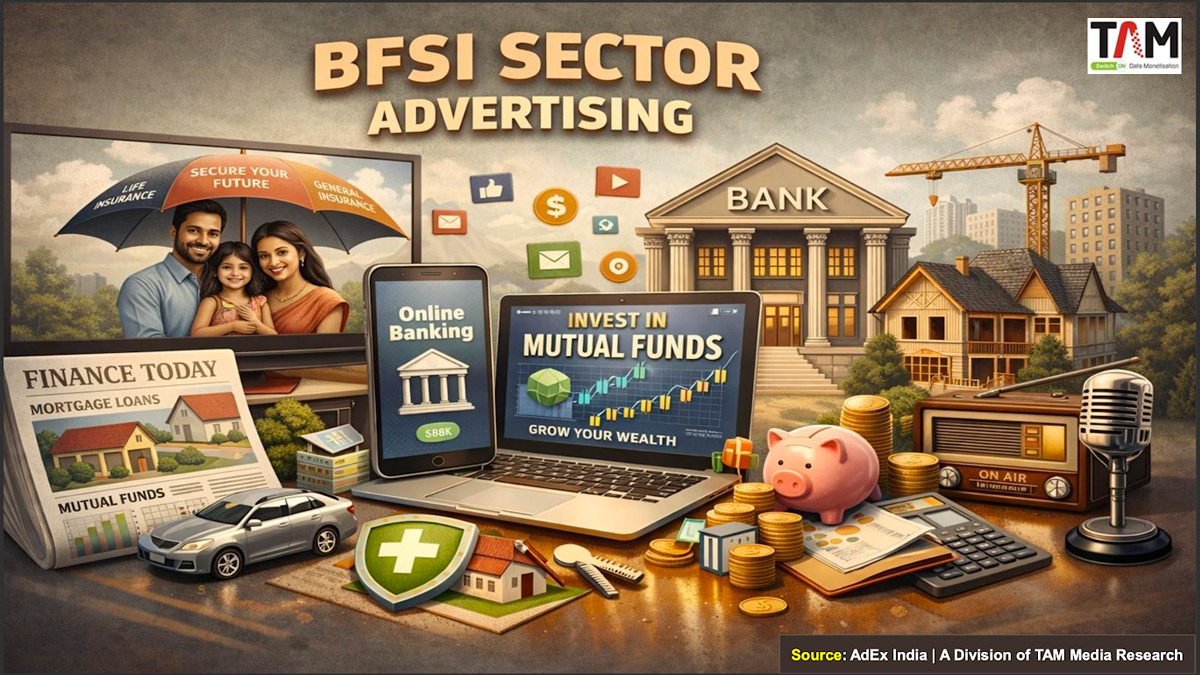
MUMBAI: India’s banking, financial services and insurance sector, one of the most prolific advertisers in the country, delivered a split verdict on media in 2025. It spent less on television, held its nerve in print, turned up the volume on radio and deluged the internet with a ferocity that left every other medium looking pedestrian. The picture that emerges from TAM AdEx’s cross-media report for the BFSI sector is of an industry in transition, still wedded to the news bulletin but increasingly seduced by the algorithm.
Television: a retreat with caveats
TV ad volumes for the BFSI sector fell 16 per cent in 2025 compared with 2024, a sharp reversal after two years of consistent growth that had pushed volumes 16 per cent above 2021 levels by 2023 and a further 7 per cent higher by 2024. Within 2025 itself, the drop was concentrated in the middle of the year: the second and third quarters saw ad volumes slide 35 per cent each against the first quarter, with a partial recovery of 13 per cent in the fourth.
The retreat did not reshuffle the deck. Life insurance retained first place among TV categories with 19 per cent of ad volumes, mortgage loans held second with 16 per cent, and the top ten categories together accounted for 82 per cent of all BFSI television advertising. The dominance of news channels was equally pronounced: news claimed 68 per cent of ad volumes, general entertainment channels a distant 14 per cent and movies 12 per cent. Together, news and GEC captured 82 per cent of the sector’s television spend. News bulletins alone took 48 per cent of programme-genre volumes, with feature films second at 12 per cent. Prime time, between 6pm and 11pm, drew 34 per cent of ad volumes, followed by afternoon at 22 per cent and morning at 20 per cent. A full 82 per cent of all ads ran between 20 and 40 seconds.
Life Insurance Corporation of India was the sector’s biggest TV spender with 11 per cent of ad volumes. Muthoot Financial Enterprises came second with 9 per cent, followed by National Payments Corporation of India at 6 per cent, Tata AIG General Insurance at 5 per cent and State Bank of India at 5 per cent. The top ten advertisers together accounted for 51 per cent of total TV volumes. Three names were new to the top ten in 2025: Tata AIG General Insurance, IIFL Finance and Tata Capital. At brand level, Muthoot Finance Loan Against Gold led with 9 per cent share, Tata AIG Health Insurance entered the top ten for the first time, and the top ten brands together contributed 35 per cent of ad volumes.
Print: the long climb continues
Print told a different story. Ad space for the BFSI sector has grown every year since 2021, rising 16 per cent in 2022, 30 per cent in 2023, 51 per cent in 2024 and 64 per cent in 2025, all measured against a 2021 baseline. Within 2025, ad space was flat in the second quarter but surged 46 per cent in the third and 33 per cent in the fourth compared with the first. Life insurance led print categories with 21 per cent of ad space, followed by mutual funds and banking services and products at 13 per cent each, and corporate financial institutes at 11 per cent. The top ten categories together took 82 per cent of print ad space. LIC led print advertisers with 6 per cent share, and the top ten together covered just 19 per cent of ad space, a reflection of how fragmented print spending remains. Three new entrants joined the top ten in 2025, with Billion Brains Garage Ventures the only exclusive presence not seen in 2024’s list. In the top ten brands, LIC dominated with a 2 per cent share, while Nippon India Mutual Fund rose to third position from fourth in 2024. English accounted for 62 per cent of print ad space, Hindi for 20 per cent. Business and finance publications took 59 per cent of the genre split. The south zone led regional spending with 33 per cent of print ad space, Bangalore topping that zone, while New Delhi and Mumbai were the leading cities nationally.
Radio: louder than ever
Radio ad volumes for the BFSI sector have climbed steadily, rising 12 per cent above 2021 levels in 2023, 36 per cent in 2024 and 45 per cent in 2025. The quarterly pattern within 2025 was volatile: a sharp drop of 43 per cent in the second quarter and 42 per cent in the third, followed by a near-full recovery in the fourth. Life insurance led radio categories with 22 per cent of volumes, banking services and products second at 14 per cent and corporate NBFCs third at 11 per cent. LIC of India held its position as the leading radio advertiser with 20 per cent of ad volumes; the top ten radio advertisers together covered 69 per cent. Muthoot Financial Enterprises led radio brands with 10 per cent share, five of the top ten brands belonged to LIC alone, and SBI Mutual Fund made a remarkable leap to fifth position from 272nd in 2024. Evening and morning time-bands together captured 84 per cent of radio ad volumes, with evenings at 44 per cent and mornings at 40 per cent. Maharashtra was the leading state for radio BFSI advertising with 18 per cent share; Maharashtra, Gujarat and Uttar Pradesh together accounted for 43 per cent.
Digital: the five-times surge
If one number defines the 2025 BFSI advertising story, it is five. Digital ad impressions for the sector multiplied fivefold between 2021 and 2025, having already doubled in 2023 and doubled again in 2024 before the 2025 leap. Within the year, impressions dipped 19 per cent in the second quarter and 12 per cent in the third before recovering 8 per cent above the first quarter by the fourth. Banking services and products led digital categories with 27 per cent of impressions, life insurance and credit cards tied at 19 per cent each, and securities and sharebroking organisations fell from first place in 2024 to fourth in 2025. Axis Bank was the runaway leader among digital advertisers with 12 per cent of impressions, followed by ICICI Bank at 9 per cent, IDFC First Bank at 7 per cent and Kotak Mahindra Bank at 6 per cent. The top ten digital advertisers covered 59 per cent of impressions, and seven of them were new entrants compared with 2024, signalling rapid churn in the digital spending hierarchy. At brand level, Axis Bank led with 9 per cent, ICICI HPCL Super Saver Credit Card vaulted to third place from 921st in 2024, and six of the top ten digital brands were new to the list. Programmatic buying accounted for 91 per cent of all digital BFSI transactions; combined with ad networks, it captured 96 per cent.
The data from TAM AdEx paints the portrait of a sector that still believes in the power of the television news bulletin to sell insurance to the masses, but increasingly knows that the next generation of borrowers, investors and cardholders is scrolling, not watching. The race is now on to reach them before the algorithm serves up someone else’s loan offer first.






