MAM
From watching TV, swiping the mobile screen – to reading books


MUMBAI: The covid-prompted lockdown turned every parent into a jailer. Trapped indoors with nowhere to run, children reached for the nearest dopamine hit, usually a glowing rectangle promising infinite scroll and zero effort. Kranti Gada, a media entrepreneur and mother of two, watched the same zombie-eyed transformation unfold in her Mumbai home. The dinner table conversations died. The bedtime stories vanished. Imagination, that most precious childhood commodity, seemed to flatline somewhere between Instagram and Youtube.
Then she noticed something curious bubbling up in her school Whatsapp group. Some 200 desperate parents were frantically swapping books like contraband, passing dog-eared copies of Harry Potter and Geronimo Stilton from flat to flat, anything to prise their children’s fingers away from the screen. The informal lending library worked. Kids were reading again.
“If this tiny circle could share resources so effectively,” Gada thought, “why not scale it for millions of mothers across India?”

The result is neOwn, a subscription platform that has become Netflix for the printed page. Children aged 0 to 15 can binge-read from a catalogue of over 9,000 titles delivered straight to their doorstep anywhere in the country. Pick five books a month for Rs 1,299, keep them for 30 days, swap them for fresh ones. Repeat until literate. A single copy of Diary of a Wimpy Kid costs Rs 699 in bookshops; neOwn lets young readers devour up to 15 books a month for roughly double that price.
The business model is deliciously simple: rent, read, repeat. But the execution requires military precision. Every book undergoes rigorous quality checks and sanitisation before it leaves the warehouse, no one wants sticky fingerprints or mysterious stains from the last borrower. The collection now spans 50,000 physical copies across adventure, mystery, fiction, general knowledge, fantasy and graphic novels, plus a growing selection of regional-language titles. Each book is reviewed by experts before making the cut. This isn’t just bulk-buying from publishers; it’s careful curation designed to hook reluctant readers and challenge voracious ones.
The neOwn app does the heavy lifting that frazzled parents cannot. It offers personalised recommendations based on age, reading level and genre preferences. Reading progression trackers show how a child evolves from picture books to chapter books to young adult fiction. A waitlist function solves the perennial library problem: if that coveted title is currently out, you simply add it to your wish list. As soon as someone returns it, parents get a Whatsapp alert and an app notification. The book gets reserved for three days. Confirm your interest and it’s blocked exclusively for you, no one else can nick it, ready for your next delivery.
Reading challenges gamify the experience in ways that would make a Silicon Valley product manager weep with envy. Children log their reading minutes, earn badges, compete (gently) with friends, and build consistent habits. Suddenly, books aren’t homework or vegetables to be endured. They’re addictive. They’re social currency. They’re something to boast about in the school playground.
The numbers suggest Gada has tapped into something real and urgent. Over 10,000 active readers now scroll through the app. Some 8,500 subscribers are scattered across 350 cities, half of them outside the usual metropolitan suspects of Mumbai, Delhi and Bengaluru. Geography is no barrier; neOwn ships everywhere from tier-1 metros to tier-3 towns, proof that the hunger for stories transcends postcodes and privilege.
But logistics remain a challenge. Children in Delhi and Bengaluru currently wait five to six days for books couriered from Mumbai, a delay that can dampen enthusiasm when attention spans are measured in seconds. Gada’s solution is simple: decentralise. New warehouses in Bengaluru are coming first, followed by the national capital region. Local distribution means faster deliveries, lower shipping costs, and happier parents. Nearly 10 per cent of neOwn’s subscribers are based in Bengaluru alone, a market too valuable to serve slowly.
Gada’s background explains why neOwn feels less like a scrappy startup and more like a well-oiled machine. As chief operating officer at Shemaroo, the entertainment giant, she spent years transforming a traditional business-to-business enterprise into a consumer-facing brand. She launched broadcast channels, built OTT platforms, and dragged the company into the digital-first age. An MBA from NMIMS and an alumna of IIM Bangalore, she made Business World’s Disrupt 40 Under 40 list and currently sits on the management committee of the International Advertisers Association’s India chapter.
“Everything I know I learned there,” she says of Shemaroo. “It’s like my alma mater.”
That institutional knowledge, how to scale, how to market, how to build infrastructure, now powers neOwn’s rapid expansion.
But neOwn isn’t just clever logistics wrapped in an app. Gada understands that reading is a social act, not a solitary one. The platform regularly hosts online storytelling sessions, sometimes led by professional narrators who bring characters to vivid life, other times by authors themselves who chat with children about plot twists and character motivations. Young readers ask questions. Authors answer. The distance between creator and consumer collapses. It’s part book club, part fan convention, part interactive theatre. Authors promote neOwn to their followers; neOwn promotes authors to its subscribers. Everyone wins, especially the children who discover that writers are real people with interesting things to say.
Her “Million Readers Pledge” aims to mobilise an entire country into a reading insurgency. Parents, teachers, corporates, Rotary Clubs, even people without children, everyone is invited to take small, weekly actions that promote literacy. “Gift a book instead of a toy,” Gada urges. “When everyone does a little, together we create a massive impact.” It’s grassroots activism dressed up as consumer behaviour.

When she appeared on the television show Ideabaaz, which showcases promising business ideas, Liberty Shoes owner Anupam Bansal immediately pledged his support. “We should encourage her,” he told the cameras. The reaction is typical wherever Gada pitches neOwn: people grasp the mission instantly and instinctively. There’s no need to convince anyone that children spend too much time on screens. The problem is obvious. What’s rare is a solution that’s both practical and scalable.

Subscriptions currently range from Rs 4,000 for book-only plans to around Rs 8,400 for bundles that include educational toys, yes, neOwn has expanded beyond books into a full ecosystem of learning and play. Parents don’t subscribe once and vanish; they stick around because the value proposition is undeniable.
The ambition, however, is enormous. Gada wants to scale from 10,000 readers today to 100,000 in the near term, then to one million active readers annually. With an average spend of Rs 8,000 to Rs 10,000 per customer, that translates to Rs 1,000 crore in revenue, a thousand-crore brand built on the radical notion that children might prefer stories to screens if given half a chance. It’s a bold target, but not an insane one. The infrastructure is proven. The engagement metrics are solid. The book quality is high. What’s needed now is reach, and that’s what the new warehouses and the Million Readers Pledge are designed to deliver.
For Gada it’s like going back to her roots. Shemaroo, was a book lending library (it’s still operational), it moved forward into circulating videos, when her uncles – the Maroo family – ran it in the seventies and eighties. Today, it runs channels galore and offers several video services to the media and entertainment industry.
In an age when algorithms curate childhood and attention is the scarcest resource, Gada has sparked a kranti, a revolution, by offering something delightfully analogue. The crackle of a new page. The weight of a hardback. The shared wonder of a story told well, discussed over breakfast, argued about with siblings, remembered for life. She’s betting that beneath all the screen addiction lies something older and more powerful: humanity’s ancient love affair with narrative. Give children access to great stories, remove the barriers of cost and clutter, make reading social and rewarding, and they’ll choose books over Instagram.
Turns out the greatest gift you can give a child isn’t a screen. It’s a plot and a twist and a turn. And nowhere can you find as many of them as in a book.







MAM
Dettol launches new emotional campaign for Antiseptic Liquid
Heartfelt film celebrates mother’s instinct with the tagline “Nothing protects like Mom & Dettol.”
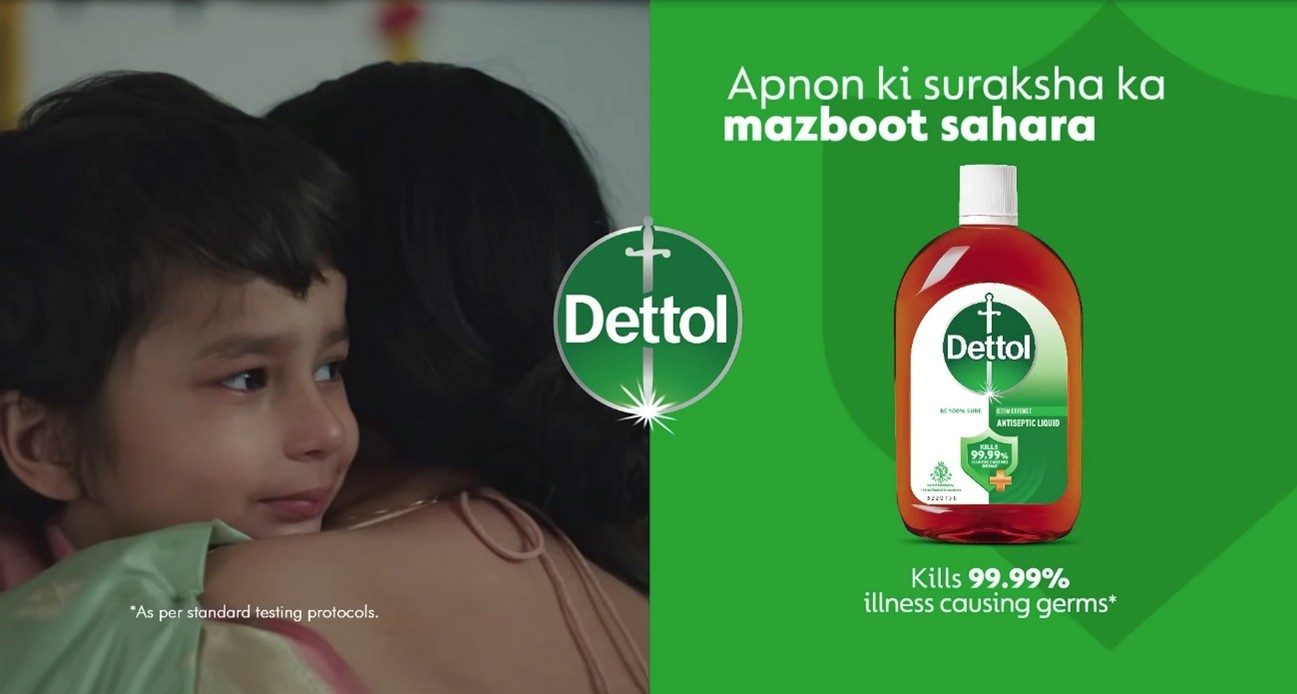
MUMBAI: Dettol has found the perfect formula for its latest campaign, a generous mix of maternal love and antiseptic care that’s sure to tug at every Indian heartstring. The iconic germ protection brand has rolled out a touching new campaign for Dettol Antiseptic Liquid built around the universal truth of a mother’s instinctive care. The film brings to life the simple yet powerful idea: “Nothing protects like Mom & Dettol.”
Set against the lively chaos of a shaadi ka ghar, the story follows a young boy who hurts himself but puts on a brave face to hide his pain. The moment he reaches his mother, she instinctively senses something is wrong. As she gently tends to his wound with Dettol Antiseptic Liquid, his guard drops, leading to a tender role reversal where the child ends up comforting his mother. The film ends with the poignant line, “Apnon ki suraksha ka mazboot sahara.”
The campaign reinforces Dettol’s timeless place in Indian homes as a reassuring companion in moments of vulnerability. It was conceptualised and written by Prasoon Joshi
, with an original track composed by Vishal Khurana K, sung by Javed Ali, and lyrics by Prasoon Joshi. Amit Sharma directed the film.
Reckitt EVP regional director for South Asia Gaurav Jain said the campaign captures the deep emotional bond between a mother’s instinct and Dettol’s protection. “This campaign encapsulates that delicate, human truth, a mother senses hurt even before it is spoken, and Dettol strengthens her ability to respond with care and confidence,” he noted.
Prasoon Joshi added, “When a child is hurt, the first instinct is to reach for their mother, their ultimate safe space. And in that moment, the mother turns to Dettol, something she trusts to protect what matters most.”
As the flagship product in the Dettol portfolio, the Antiseptic Liquid continues to offer unmatched protection for cuts and wounds, standing shoulder to shoulder with mothers through life’s small scrapes and bigger worries.
In a world full of flashy advertisements, Dettol has quietly reminded us once again that the strongest protection often comes wrapped in the simplest, most heartfelt moments, the kind only a mother and a trusted bottle of Dettol can provide.






