Brands
Flair Writing Industries posts 20 per cent revenue growth in December quarter

MUMBAI: It seems Flair Writing Industries has no intention of running out of ink just yet, as their latest financial results prove they are still writing their own success story with remarkable precision. The Mumbai-based stationery powerhouse has released its unaudited consolidated results for the quarter ended 31 December 2025, revealing a performance that is, quite literally, one for the books.
For the quarter ending December 2025, the group reported a robust revenue from operations of Rs 31,769.85 lakhs, a significant climb from the Rs 26,454.77 lakhs recorded in the same period the previous year. Total income for the quarter stood at Rs 32,081.90 lakhs, comfortably outpacing the Rs 27,107.19 lakhs seen in the 2024 December quarter.
The nine-month trajectory is equally sharp; the company’s revenue from operations hit Rs 92,715.63 lakhs compared to Rs 78,181.52 lakhs in the prior year’s corresponding period. This steady ascent suggests that while the digital age might be upon us, the world still has a massive appetite for a reliable ballpoint.
Despite a slight dip in profit after tax compared to the preceding quarter (September 2025), the company still posted a solid profit of Rs 3,314.04 lakhs for the December quarter, up from Rs 2,926.88 lakhs in December 2024. Basic earnings per share (EPS) for the quarter were recorded at Rs 3.11.

In a move that will likely keep investors’ spirits high, the Board of Directors has declared an interim dividend of Rs 0.50 per equity share (10% of the Rs 5 face value). Shareholders should mark their calendars for 4 February 2026, which has been fixed as the record date for this payout.
Flair isn’t just sitting on its laurels; it’s putting its IPO proceeds to work. Of the Rs 27,303.72 lakhs raised through its fresh issue, the company has already utilised Rs 25,388.49 lakhs.
New valsad unit: Rs 3,684.07 lakhs has been spent on setting up the new facility, with Rs 1,915.23 lakhs still unutilised and temporarily parked in fixed deposits.
Capital expenditure: The company and its subsidiary, Flair Writing Equipments Private Limited, have fully utilised the allocated Rs8,674.80 lakhs for capital expenditure.
Working capital & debt: A further Rs 7,700.00 lakhs was funneled into working capital, while Rs 4,300.00 lakhs was used to repay or prepay borrowings.
The company also noted the implementation of the new unified labour codes effective from 21 November 2025. While the Ministry of Labour & Employment has published draft rules, Flair’s current assessment suggests the financial impact is “not material” and has not been recognised in these results. However, they remain on standby to evaluate any future impact once the final State and Central rules are fully notified.
With five decades of “excellence” behind them, Flair continues to prove that in the world of writing instruments, they are still the ones holding the pen.






Brands
Google secures AP discom licence to power $15bn Vizag AI hub
First-of-its-kind move gives tech giant grid control for massive 1GW campus
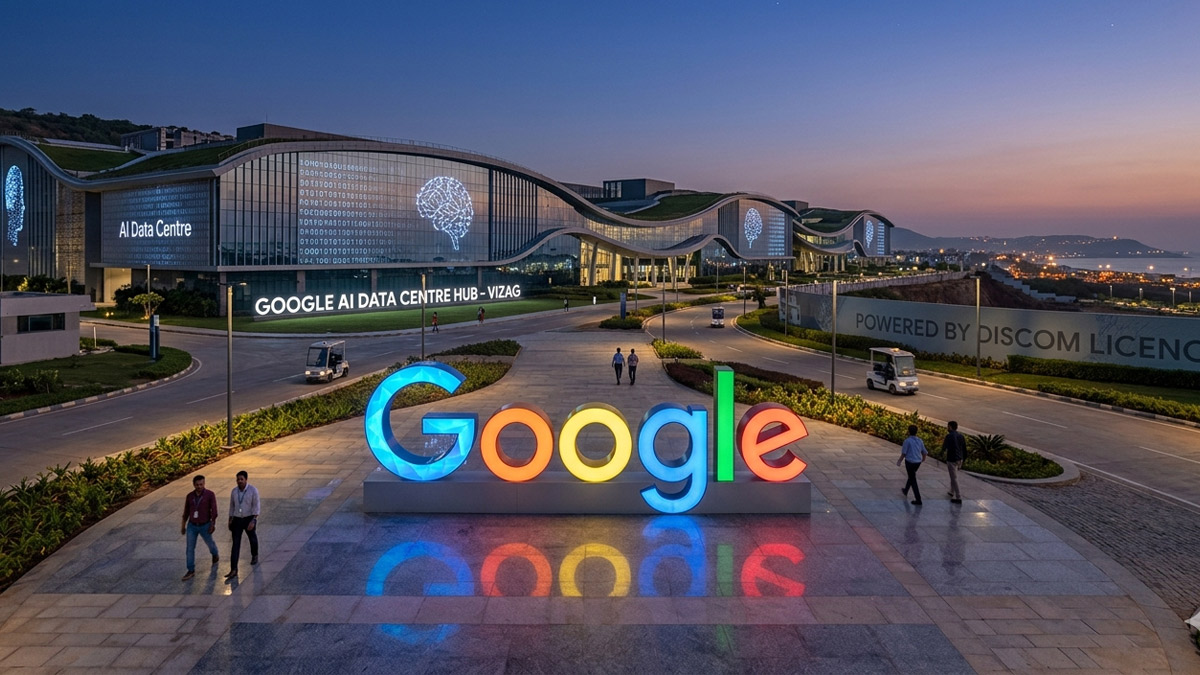
VISAKHAPATNAM: Google has secured a rare electricity distribution company licence in Andhra Pradesh, marking a decisive shift from being just a power consumer to becoming a power distributor for its upcoming mega data centre hub in Visakhapatnam.
The move effectively rewrites the rulebook for hyperscalers in India. Instead of relying on state utilities, Google will be able to procure electricity directly from generators, including its own renewable sources. This not only cuts out intermediaries but also gives the company tighter control over supply, reliability and long-term costs.
For a business where electricity can account for up to 60 per cent of operating expenses, the economics are hard to ignore. Even more critical is uptime. Data centres demand near-perfect reliability, and owning the distribution layer allows Google to manage outages and load balancing with far greater precision.
At the heart of the plan is a sprawling 1-gigawatt data centre ecosystem spread across more than 600 acres in three locations near Vizag. With an estimated investment of $15 billion over five years, the project is set to become India’s largest single foreign direct investment and Google’s biggest AI-focused facility outside the United States.
The campus is being designed with artificial intelligence workloads in mind, housing the company’s custom tensor processing units to power services such as Gemini, Search and Google Cloud. In scale, the planned capacity is comparable to powering a small city.
Google is not building alone. It has partnered with Adani Infrastructure to develop the physical campuses, while Bharti Airtel will set up an international subsea cable landing station. This connectivity backbone is expected to link the hub directly to a dozen countries, ensuring low latency for global data traffic.
Vizag’s coastal location plays a key role in that strategy. It enables direct access to subsea cables and provides the large volumes of water needed for cooling data centre operations. Equally important is policy backing from the Government of Andhra Pradesh, which fast-tracked approvals and granted the uncommon discom licence to anchor the investment.
Groundbreaking is scheduled for April 28, 2026, with phased commissioning expected to begin by July 2028.
The broader signal is clear. As AI workloads surge, hyperscalers are no longer content plugging into existing infrastructure. They are beginning to build and control it. In Vizag, Google is not just setting up a data centre, it is wiring up its own future.







