Brands
Expert-speak on implications of penalising celebs in misleading ads


MUMBAI: In India, a general tendency is to shoot the messenger instead of going to the root of a problem and then finding a solution. A Parliamentary panel proposal — it’s still that only — to penalise celebrity endorsers for misleading advertisements could be one such instance, though industry experts differ on the merit of such a move.
One thing the Indian advertising world has learnt from the Maggi fiasco in India is when a brand’s authenticity is questioned; fingers are quick to point at celebrities endorsing it instead of going into finer details. Some adverse government lab findings hit Nestle, owners of Maggi brand of noodles and soups, so hard that it’s still recovering from the brand and revenue battering it took over few months earlier this year.
While celeb endorsers of Maggi, including people like film stars Madhuri Dixit, Amitabh Bachchan and Preity Zinta, only felt the wrath of social media, if the Parliamentary panel suggestions are enacted into a law, going forward, celebrities may face legal action against them for featuring in misleading advertisements.

In a recent meeting to discuss the Consumer Protection Bill 2015, a Parliamentary Standing Committee on Consumer Affairs mooted that a celebrity may be fined upwards of Rs 1 crore (Rs 10 million) as an exemplary penalty. A jail time up to five years was also brought up in a prior meeting but was later reconsidered.
Though not yet a law, but it is easy to gauge the general direction the conversation on celebrity endorsement is headed in India, which, along with Japan, has in recent times shown an increased use of celebrities to push products and services.
As things stand today, the obvious questions are: (i) should celebrity endorsers alone be held responsible for saving consumers from false advertisements and claims and not the company owning the product and the ad agency designing the creatives and (ii) what are the implications on the advertising business in India if the Bill actually becomes a law?
Indiantelevision.com reached out to stakeholders in the industry for their take on the issue and to understand how such a proposal would affect them.
Celebrities are not godmen or god-women
A Euromonitor study in 2014 on `Celebrity Power and Its Influence on Global Consumer Behaviour’ stated: “As long as the celebrity is authentic, he or she can help to lend credibility to a brand and influence the way it is perceived as many consumers believe that if a product is good enough for a star, it is good enough for them.”
In spite of acknowledging the fact that celebrities are strong influencers, Advertising Club of India President Raj Nayak finds it silly to penalise celebrities over misleading advertisements.
“It is unfair to put the onus on celebs unless they are endorsing brands like beedi (hand rolled tobacco leaves), cigarettes , alcohol, gutka (chewing tobacco), fairness cream or any such product that is injurious to health or has a negative impact on society. Even in such a case there should be an advisory cautioning them from endorsing such products,” Nayak opined, adding the onus of a misleading ad, however, must rest with the company that is advertising and selling the product.
According to Nayak, the industry in India already has a self-regulatory body, Advertising Standards Council of India (ASCI), and consumers have the option of complaining or raising an issue regarding an ad, but it’s “absolutely silly to penalise celebrities.”
Though it has been seen that the global trend of using celebrities to push products does have a roller-coaster ride, Vizeum India MD Shripad Kulkarni does not totally agree that celebrities alone can change and shape opinions.
“Holding the celebrity responsible is akin to shooting the messenger. A celebrity is an individual without any public authority. Assuming that a misleading ad is the sole responsibility of the celebrity, can somebody please explain to me how an individual can ever figure out if the claim in an ad on any product category is true or not?” Kulkarni asked, explaining that a celebrity who can check the veracity or authenticity of all the products or services (being endorsed by him or her), ranging from a financial instrument rating, vest comfort or oils helping maintain long hair, etc, “might as well get into the most lucrative business in India — become a godman” or god-woman as the case may be.
Echoing sentiments similar to Kulkarni was RK Swamy Hansa BBDO Chairman Srinivasan K Swamy. “Celebrities don’t have the means to clarify each and every claim made by a brand. They may have sort of a check, but that doesn’t make it a foolproof one. I think a brand communication is ultimately an advertiser’s responsibility,” he averred.
Vague term or definition
The 2014 Eurominitor study at another place stated that the level of celebrity influence is “difficult to gauge” but it is estimated that while as many as one in four advertisements feature celebrities in the US, the percentage is much lower in Europe. In Germany, for example, the rate is around 16 per cent. The celebrity culture is widespread in Asia and though the phenomenon is newer in China and India, it has gained momentum in a relatively short space of time.
So, who is this celebrity that the government plans to penalise? An actor? A cricketer? Someone plain famous? A Bharat Ratna, which is India’s highest civilian award? A scion of an erstwhile royal family? A politician or a Member of Parliament (yes, in India even such people widely endorse products and services) ? A professional model? Or the common man who oscillates between fame and oblivion?
The Advertising Agencies Association of India (AAAI) chairman Nakul Chopra expresses serious concerns over the ambiguity of the word ‘celebrity’, especially with regards to a would-be law.
“You can’t enact a law with the term ‘celebrity’ in it without defining what it means precisely. Basically, any model lending his or her face, voice or image to a product can be charged with these penalties. Tomorrow, someone lending his or her face to a cause or a brand, may be not a known personality, will also be liable under this law. I don’t think you can apply one rule to all,” Chopra said.
For Chopra, it’s not fair that an endorser of a product or a service, celebrity or not, is made liable for the product that they endorse because it is a “difficult liability to administer.”
More caution need of the hour?
There’s an age old saying that more things change, more they remain the same. And, this proposal, experts feel, is a case highlighting the adage.
Madison Communications Mates CEO Darshana Bhalla, who deals with talent management and facilitates top notch endorsement deals, felt these proposals were just cosmetic changes wherein except for a more judicious verification process everything else will remain the same.
“Advertising is a like a wheel and every cog in the wheel is responsible for its movement, be it the celebrity, the brand, the media, the creative agencies or agencies like us. Therefore, I believe, we shouldn’t take away responsibilities from each other or over impose them either,” Bhalla said.
Pointing out that there is nothing wrong in doing the due diligences when it comes to celebrity endorsements, whosoever is the stakeholder, Bhalla did feel that if the proposal was actually enacted into a law, it would bring more caution in the processes, which is only fair.
According to him, “Anyway most of the A-listers have been very cautious about what they endorse. Ultimately consumerism is not going to get affected by this, will it? When it comes to us talent management agencies, we get our celebrities to endorse brands that are cognizant of the guidelines of proper brand communication.”
In line with the same thoughts Swamy added, “This Bill, if it comes in effect, will simply add a few more layers of self-regulation. I don’t think the advertising or endorsement market will feel any major impact from it.”
Factoring in fines in contracts
Several advertising gurus predicted that if the fine or penalty became an actuality, a fine-inclusive contract will become the norm in the endorsement world.
“Celebrities are basically echoing a brand communication for a product or a service. If the fines (and other penalties) come into being, they will be simply included into a contract as a clause. From the beginning itself the celebrities will not face the burden of paying the fines because no celebrity will sign a contract that will expose him or her to a possible financial damage,” SK Swamy Hansa BBDO’s Srinivasan Swamy pointed out.
Interestingly, Swamy also opined that if the law required to hauling up of celebrities on monetary grounds, they will have” no qualms to stand by brands”. Chopra too felt that a fine will lead to celebrities seeking indemnity from the advertisers for the liability placed on them.
More teeth to ASCI
Whether or not a law to penalize celebrity endorsers for misleading adverts becomes a reality, what is clearly emerging is that the industry would need more of self-regulation and for that to be more effective, ASCI’s role as a body gains importance.
In its report on the Consumer Protection Bill, which was introduced in Parliament last year in August, the Parliamentary Standing Committee on Consumer Affairs said the penalties could be in the form of compelling the misleading advertiser to either issue corrective advertisement (an expensive proposition in itself), apart from proposing other stringent measures.
This could be done by adding clauses to the Consumer Protection Bill to ensure that the advertising code being followed by ASCI got added legal teeth. Punitive measures need to be incorporated in the Advertising Code to cater to consumer interests, the panel opined. This was based on a suggestion by the Consumer Education and Research Centre of Ahmedabad.
During the study of the Bill, the parliamentary committee had met several stakeholders as well as officials of government organizations and execs from advertising companies.
Welcoming suggestions by the Committee, ASCI secretary told the panel members , “ASCI had the chance to present our work from the last few years before the committee and the current self-regulatory system was backed by other industry stakeholders as well. We are very happy that the committee has recommended more teeth to ASCI, though we have yet to see how it is worded in the final legal document.”
(With inputs from BB Nagpal in New Delhi)





Brands
Samsung certifies 1,000 Maharashtra students in AI and coding
The South Korean electronics giant marks its first large-scale skilling push in the state, with women making up nearly half the national programme’s enrolment
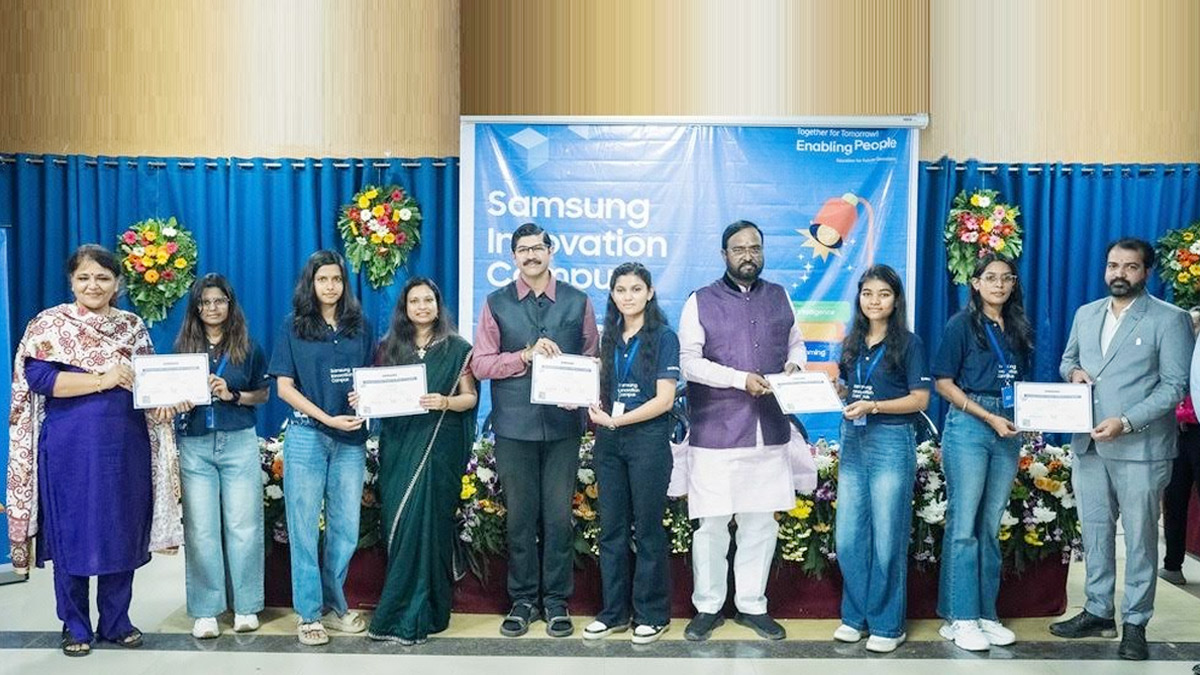
PUNE: Samsung has put 1,000 students in Maharashtra through a certified training programme in artificial intelligence and coding, the largest such drive the South Korean electronics company has run in the state and a signal that corporate India’s skilling ambitions are moving well beyond the boardroom brochure.
The certifications were awarded under Samsung Innovation Campus (SIC), the company’s flagship corporate social responsibility programme, which launched in India in 2022 with the stated aim of democratising access to future-technology education. The 1,000 graduates were drawn from four institutions: 127 from Savitribai Phule Pune University, 373 from Pimpri Chinchwad University, 250 from D.Y. Patil University’s Ramrao Adik Institute of Technology and 250 from Anjuman-I-Islam’s Kalsekar Technical Campus. All completed training in either AI or coding and programming, the two disciplines Samsung has identified as the critical pillars of the digital economy.
The programme does not stop at technical training. Soft-skills development and career-readiness modules are baked into the curriculum, a deliberate attempt to close the gap between what universities teach and what employers actually want.
“India’s digital growth story will ultimately be shaped by the quality of its talent pipeline,” said Shubham Mukherjee, head of CSR and corporate communications at Samsung Southwest Asia. “As technologies like AI move from the periphery to the core of industries, skilling must evolve from basic training to building real-world capability. This milestone in Maharashtra reflects how industry and academia can come together to create a future-ready workforce that is both globally competitive and locally relevant.”
The Maharashtra drive sits within a rapidly scaling national effort. Samsung Innovation Campus trained 20,000 young people across India in 2025, hitting its stated target for the year. Women account for 48 per cent of national enrolments, a figure the company cites as evidence of its push for an inclusive technology ecosystem. The programme is implemented in partnership with the Electronics Sector Skills Council of India and the Telecom Sector Skill Council.
Samsung, which is marking 30 years in India this year, runs SIC alongside two other initiatives, Samsung Solve for Tomorrow and Samsung DOST, as part of a broader effort to build what it calls a generation of innovators with both the technical depth and the problem-solving mindset to thrive in a fast-moving digital world.
A thousand certified students is a tidy headline. Whether they find jobs that match their new skills is the harder question, and the one that will ultimately determine whether corporate skilling programmes like this one are genuine pipelines or well-photographed gestures.






