MAM
Exclusive: IPL franchise Punjab Kings revenues to grow by 20-25 per cent this season

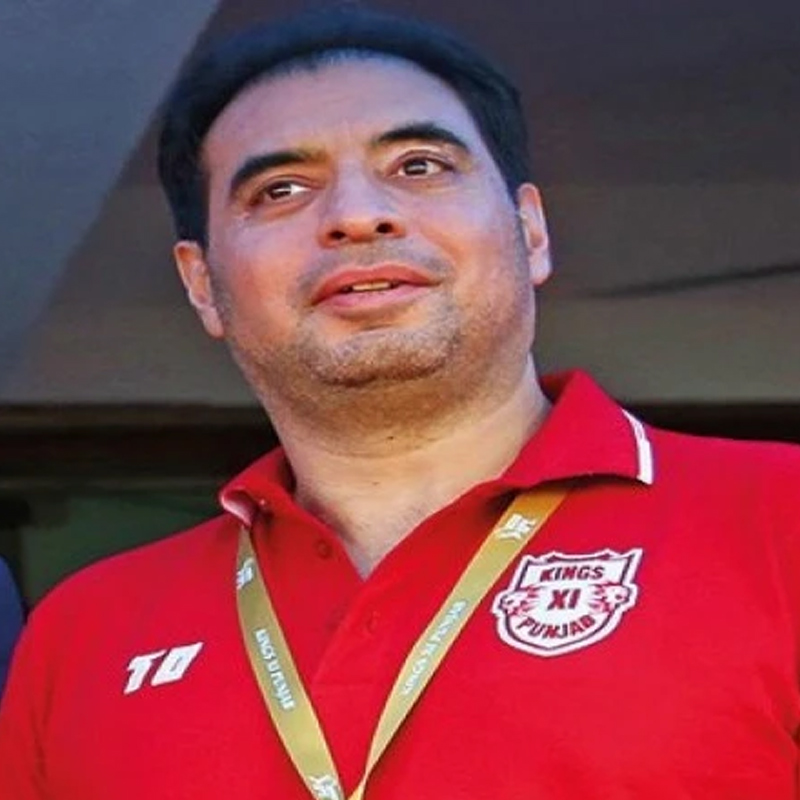
Mumbai: This season, the Indian Premier League (IPL) franchise Punjab Kings revenue will grow by 20-25 per cent. This will be a mix of central revenue and local revenue. Speaking to IndianTelevision.com Punjab Kings co-owner Mohit Burman says that revenues are up by 25 per cent and quite a bit of this jump is from local sponsorship revenue on the jersey and centrally one or two sponsors have been added.
“Licensing and merchandising and ticketing will not impact the P&L. The BCCI running ticketing centrally. Licensing and merchandising has never given money because you do not have the regulation to curtail spurious jerseys that are made in your name and sold outside stadiums. You will never end up making big money from this area. It will only be a small amount of money,” he tells.
Only two sponsorship deals open up on the jersey next year. So the franchise will have to wait two years to do new sponsorship deals. Non-jersey sponsorship deals can be done in the digital space but the value is much less. While the franchise has reached just one IPL final back in 2014, he maintains that it has not made a difference in terms of sponsorship revenue of more than 15 per cent.

Sponsors look for brand visibility at the end of the day and also doing activation with the franchise’s players. “It is all measured back to what the viewership is, the number of games and so and so forth,” Burman says, adding that, “The two new franchises that came in Lucknow and Gujarat benefitted when they did sponsorship deals because there was not enough inventory in the market. The other franchises he explains were riding out Covid and so earlier did long-term deals. It is a question of demand and supply. The two new teams commanded a premium rate maybe of 50 per cent. This has nothing to do about whether a team has won or not.”
He further says that this year the franchises sponsors have focused more on digital activation. There have not been many commercial shots by Punjab King’s sponsors. “They are doing digital activities which both the players and consumers love.”
He also notes the growing trend of sponsors like Jio, Amul, Boat doing deals across franchises. The advantage he says is that the brand gets constant exposure regardless of who is playing.
He says that earlier in a normal situation the franchise did not make as much from ticketing compared to other franchises like Mumbai. That is because Punjab is a very price-sensitive market and it was hard to sell more than 20,000 tickets for a match through the stadium capacity might have been 25-28,000.
Most of the franchise’s revenue comes from the central pool and Burman hesitates when asked to what extent central revenue’s contribution could rise with the media rights auction next month. But he does say that the BCCI splitting the media rights into broadcast and digital was needed to fully exploit the potential rights value.
When asked about the fall in TV viewership he says that a lot of it has gone to digital through mobiles but this is not being measured properly because there is no single currency yet to measure digital. “Digital is not officially measured. So you do not get the real numbers. There is no body controlling digital measurement. The fact though remains that there is a huge shift where people are viewing IPL matches on the mobile. People sometimes mirror the IPL on their TV. The digital value and cost of streaming the IPL will both go up,” he shares.
In terms of future sources of revenue, he points out digital streams like NFTs, metaverse. “It is early days in terms of NFTs. Crypto has to get regulated but it is big money. We also have a $3 million offer sitting on the table regarding the digital rights of our players. From this content can be created. The BCCI has to approve of it,” he tells.
In the pure cricketing space academies is something being pursued big time. In terms of academies, he says that it will be in catchments areas which is Punjab, Kashmir, Haryana. A central Academy will be set up in Punjab, to begin with. The concept is to then set up Academies in other parts of the country. “We have a huge catchment area in North America and the UK which we will possibly explore. We will do scouting and find potential boys who can be funneled into the system. We will use the help of the local federation.”
When asked about the franchise changing its name to Punjab Kings he said that the aim was to use the name Punjab first which is what other franchises do apart from Bangalore. “People must immediately attach the franchise to the market. We wanted to attribute ourselves to the State we come from.” He adds that operating in a Covid environment has been difficult but it was a bigger challenge for the BCCI. “The fact is that we have pulled off all three seasons quite well. The challenge for us was staying in the bubble and keeping everyone on their toes and happy.”
He also explains that costs did not go up due to Covid. That is because matches were played only in one or two venues. So air travel and hotel costs were saved. “This season we are playing in Mumbai. Otherwise we would have been travelling to different cities and spending money on transport and logistics. Things have evened out.” Beyond the IPL Burman owns the St. Lucia franchise in the Caribbean Premier League (CPL) in West Indies. He is happy about how the ownership has turned out and says that the franchise was profitable from the first year.
“We got the franchise at the right price and we did central deals even before we picked up the franchise. We will probably make money on the jersey also. The local government supports our team and we also have a big sponsor. Our revenue split between central and local revenue is almost equitable.” He is also interested in the upcoming league from Cricket South Africa (CSA) but notes that it is in its formative stage.. Right now the Big Bash League in Australia does not allow for outsiders to own a franchise. “Otherwise we would definitely explore it due to viewership and there is a lot of interest in India on the Big Bash League.”
He adds that he is not interested in non-cricket leagues. Years ago Burman had exited the now-defunct Hockey India League because the math was not adding up. “We have to be sure that we will get a return on investment. We do not get into any league if we know that there is no money to make. Ideally, we would like to make money in the first year itself which is what we did in the CPL. We look at leagues where the cricket board is involved as there will be accountability,” he concludes.






MAM
India’s financial sector spent less on TV ads in 2025 but flooded the internet
Banks, insurers and lenders cut tv ads as digital jumps, LIC and Muthoot lead tv and Axis Bank tops online
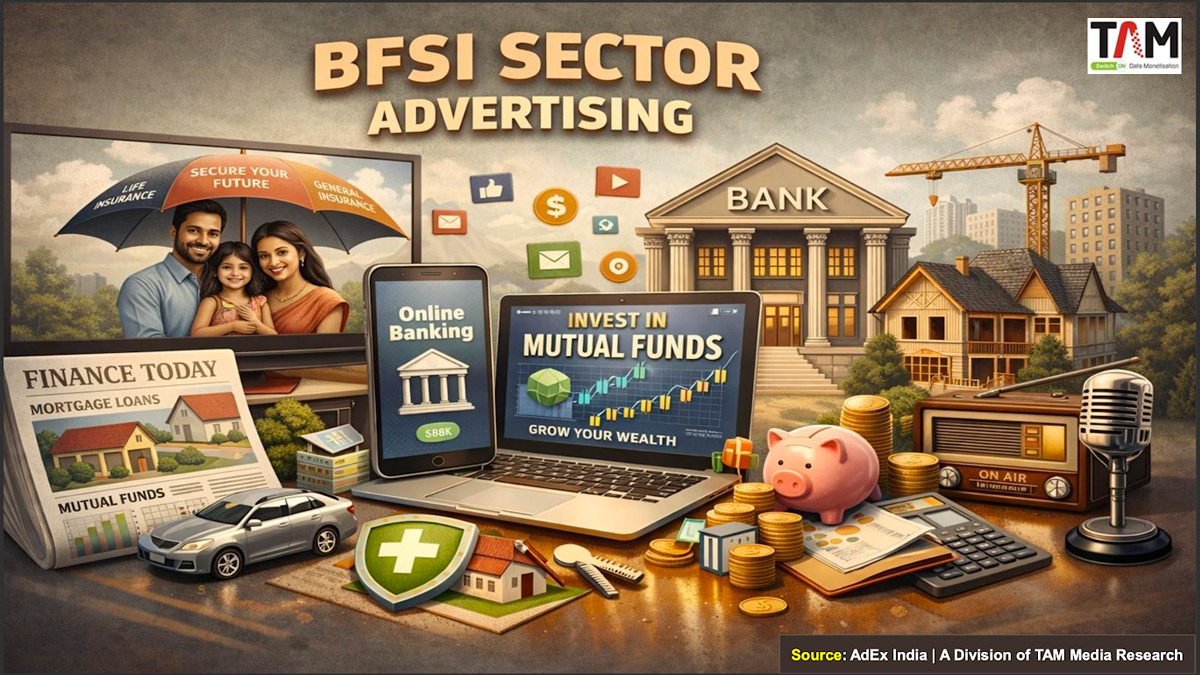
MUMBAI: India’s banking, financial services and insurance sector, one of the most prolific advertisers in the country, delivered a split verdict on media in 2025. It spent less on television, held its nerve in print, turned up the volume on radio and deluged the internet with a ferocity that left every other medium looking pedestrian. The picture that emerges from TAM AdEx’s cross-media report for the BFSI sector is of an industry in transition, still wedded to the news bulletin but increasingly seduced by the algorithm.
Television: a retreat with caveats
TV ad volumes for the BFSI sector fell 16 per cent in 2025 compared with 2024, a sharp reversal after two years of consistent growth that had pushed volumes 16 per cent above 2021 levels by 2023 and a further 7 per cent higher by 2024. Within 2025 itself, the drop was concentrated in the middle of the year: the second and third quarters saw ad volumes slide 35 per cent each against the first quarter, with a partial recovery of 13 per cent in the fourth.
The retreat did not reshuffle the deck. Life insurance retained first place among TV categories with 19 per cent of ad volumes, mortgage loans held second with 16 per cent, and the top ten categories together accounted for 82 per cent of all BFSI television advertising. The dominance of news channels was equally pronounced: news claimed 68 per cent of ad volumes, general entertainment channels a distant 14 per cent and movies 12 per cent. Together, news and GEC captured 82 per cent of the sector’s television spend. News bulletins alone took 48 per cent of programme-genre volumes, with feature films second at 12 per cent. Prime time, between 6pm and 11pm, drew 34 per cent of ad volumes, followed by afternoon at 22 per cent and morning at 20 per cent. A full 82 per cent of all ads ran between 20 and 40 seconds.
Life Insurance Corporation of India was the sector’s biggest TV spender with 11 per cent of ad volumes. Muthoot Financial Enterprises came second with 9 per cent, followed by National Payments Corporation of India at 6 per cent, Tata AIG General Insurance at 5 per cent and State Bank of India at 5 per cent. The top ten advertisers together accounted for 51 per cent of total TV volumes. Three names were new to the top ten in 2025: Tata AIG General Insurance, IIFL Finance and Tata Capital. At brand level, Muthoot Finance Loan Against Gold led with 9 per cent share, Tata AIG Health Insurance entered the top ten for the first time, and the top ten brands together contributed 35 per cent of ad volumes.
Print: the long climb continues
Print told a different story. Ad space for the BFSI sector has grown every year since 2021, rising 16 per cent in 2022, 30 per cent in 2023, 51 per cent in 2024 and 64 per cent in 2025, all measured against a 2021 baseline. Within 2025, ad space was flat in the second quarter but surged 46 per cent in the third and 33 per cent in the fourth compared with the first. Life insurance led print categories with 21 per cent of ad space, followed by mutual funds and banking services and products at 13 per cent each, and corporate financial institutes at 11 per cent. The top ten categories together took 82 per cent of print ad space. LIC led print advertisers with 6 per cent share, and the top ten together covered just 19 per cent of ad space, a reflection of how fragmented print spending remains. Three new entrants joined the top ten in 2025, with Billion Brains Garage Ventures the only exclusive presence not seen in 2024’s list. In the top ten brands, LIC dominated with a 2 per cent share, while Nippon India Mutual Fund rose to third position from fourth in 2024. English accounted for 62 per cent of print ad space, Hindi for 20 per cent. Business and finance publications took 59 per cent of the genre split. The south zone led regional spending with 33 per cent of print ad space, Bangalore topping that zone, while New Delhi and Mumbai were the leading cities nationally.
Radio: louder than ever
Radio ad volumes for the BFSI sector have climbed steadily, rising 12 per cent above 2021 levels in 2023, 36 per cent in 2024 and 45 per cent in 2025. The quarterly pattern within 2025 was volatile: a sharp drop of 43 per cent in the second quarter and 42 per cent in the third, followed by a near-full recovery in the fourth. Life insurance led radio categories with 22 per cent of volumes, banking services and products second at 14 per cent and corporate NBFCs third at 11 per cent. LIC of India held its position as the leading radio advertiser with 20 per cent of ad volumes; the top ten radio advertisers together covered 69 per cent. Muthoot Financial Enterprises led radio brands with 10 per cent share, five of the top ten brands belonged to LIC alone, and SBI Mutual Fund made a remarkable leap to fifth position from 272nd in 2024. Evening and morning time-bands together captured 84 per cent of radio ad volumes, with evenings at 44 per cent and mornings at 40 per cent. Maharashtra was the leading state for radio BFSI advertising with 18 per cent share; Maharashtra, Gujarat and Uttar Pradesh together accounted for 43 per cent.
Digital: the five-times surge
If one number defines the 2025 BFSI advertising story, it is five. Digital ad impressions for the sector multiplied fivefold between 2021 and 2025, having already doubled in 2023 and doubled again in 2024 before the 2025 leap. Within the year, impressions dipped 19 per cent in the second quarter and 12 per cent in the third before recovering 8 per cent above the first quarter by the fourth. Banking services and products led digital categories with 27 per cent of impressions, life insurance and credit cards tied at 19 per cent each, and securities and sharebroking organisations fell from first place in 2024 to fourth in 2025. Axis Bank was the runaway leader among digital advertisers with 12 per cent of impressions, followed by ICICI Bank at 9 per cent, IDFC First Bank at 7 per cent and Kotak Mahindra Bank at 6 per cent. The top ten digital advertisers covered 59 per cent of impressions, and seven of them were new entrants compared with 2024, signalling rapid churn in the digital spending hierarchy. At brand level, Axis Bank led with 9 per cent, ICICI HPCL Super Saver Credit Card vaulted to third place from 921st in 2024, and six of the top ten digital brands were new to the list. Programmatic buying accounted for 91 per cent of all digital BFSI transactions; combined with ad networks, it captured 96 per cent.
The data from TAM AdEx paints the portrait of a sector that still believes in the power of the television news bulletin to sell insurance to the masses, but increasingly knows that the next generation of borrowers, investors and cardholders is scrolling, not watching. The race is now on to reach them before the algorithm serves up someone else’s loan offer first.






