MAM
Euro RSCG Worldwide honoured at 2003 Clio Awards

NEW YORK: A few days ago leading integrated marketing communications agency Euro RSCG Worldwide won three statues at the 44th annual Clio Awards in Miami Beach, Florida. The agency garnered two Gold and one Bronze from offices across Europe and South America.
An official release informs that the Clio Awards provide the international advertising and design industry with the world’s best-judged creative competition, and in doing so, honour advertising and design excellence worldwide. The citations were received in the television/cinema category. Euro RSCG Mezzano Costantini Mignani in Milan won a Gold for the Peugeot 206 spot The Sculptor; Paris-based BETC Euro RSCG was awarded a Gold in for the Visigoths and Black Bands spots for Canal Plus; and CraveroLanis Euro RSCG in Buenos Aires received a Bronze for the Alarm Clock spot for Philips Batteries.
Euro RSCG Worldwide chairman and CEO Bob Schmetterer has been quoted in the release saying: “These spots are prime examples of what we at Euro RSCG Worldwide call Creative Business Ideas — breakthrough ideas that combine creativity and strategy in new ways, and transform the way we look at business. And receiving these prestigious awards acknowledges the vast creative expertise of Euro RSCG across languages and continents.”

Euro RSCG Worldwide comprises of 233 offices located in 75 countries throughout Europe, North America, Latin America, and Asia Pacific. Euro RSCG provides advertising, marketing services, corporate communications, and interactive solutions to global, regional, and local clients. The agency’s client roster includes Air France, BNP Paribas, Intel, Volvo, MCI, and Yahoo! The New York headquartered Euro RSCG Worldwide is the largest unit of Havas, the world’s sixth-largest communications group.







MAM
Lego brings Messi, Ronaldo, Mbappé, Vinicius together
Campaign clocks 314 million views ahead of FIFA World Cup 2026 buzz.
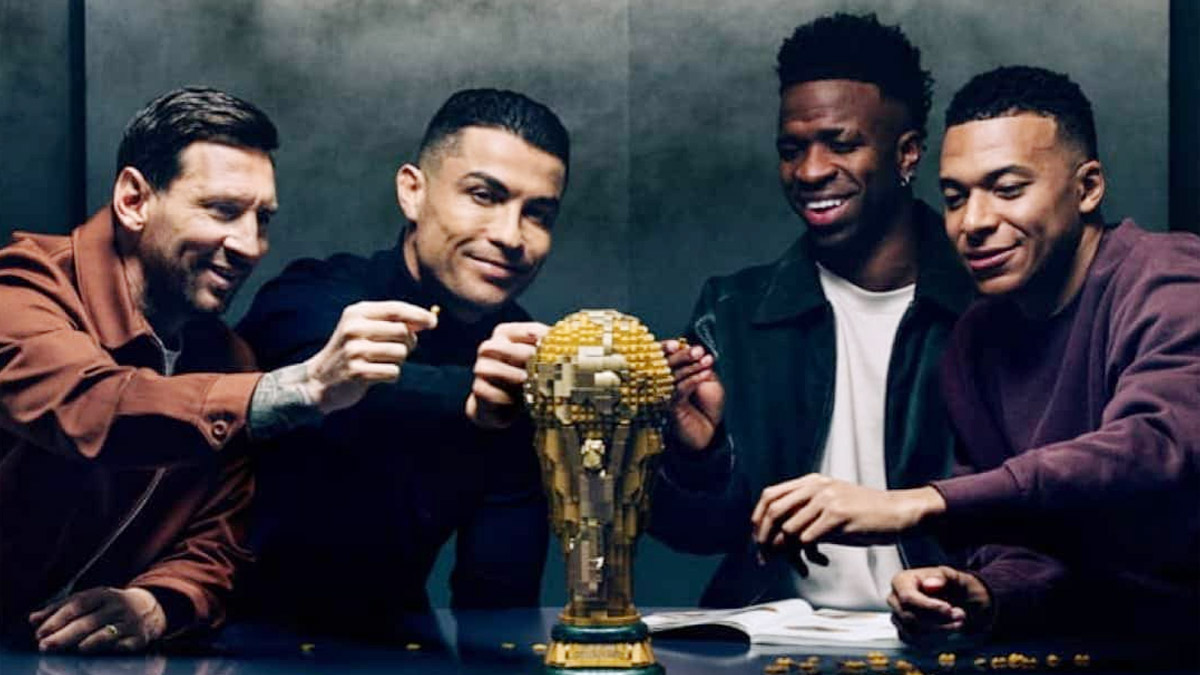
MUMBAI: Four legends, one frame and not a single tackle in sight. Lego has pulled off a crossover few thought possible, uniting Lionel Messi, Cristiano Ronaldo, Kylian Mbappé and Vinícius Júnior in a single campaign ahead of the FIFA World Cup 2026 only this time, they’re building dreams brick by brick.
Titled “Everyone wants a piece”, the campaign features the quartet assembling a Lego version of the World Cup trophy, before placing miniature versions of themselves atop it, a playful nod to football’s ultimate prize. Shared widely across social media, the ad carries a pointed disclaimer: it is not AI-generated, a subtle but telling signal in an era where even reality is often questioned.
The numbers tell their own story. The campaign has already crossed 314 million views on Instagram across the players’ accounts, with fans hailing it as a rare, almost nostalgic moment particularly for the reunion of Messi and Ronaldo, whose last shared campaign ahead of the 2022 World Cup became one of the platform’s most-liked posts.
Beyond the film, Lego is extending the play with exclusive, player-themed sets tied to each of the four stars, part of a broader football-led programme designed to ride the global momentum building towards 2026. The idea, as echoed by the players themselves, leans into the parallels between football and play experimentation, creativity, failure, and triumph.
Messi described the sets as a way to bring on-pitch moments into an imaginative, hands-on world, while Ronaldo called the transformation into a Lego figure a rare honour, blending sport with storytelling. Vinícius, meanwhile, struck a more personal note, recalling childhood moments of building with Lego and framing creativity as a universal language that transcends borders.
The timing is no accident. With the 2026 World Cup set to run from June 11 to July 19 across the United States, Canada and Mexico, and featuring an expanded 48-team format, global anticipation is already building. Argentina, led by Messi, will enter as defending champions, adding another layer of intrigue.
For Lego, the campaign does more than celebrate football, it taps into its mythology. Because when icons become figurines and rivalries turn into play, the beautiful game finds a new kind of pitch. one built, quite literally, by hand.






