Digital
Ethical AI must benefit society, not dominate it, says WFEB chief Sanjay Pradhan at IAA event
At Mumbai event, ethics expert urges businesses and governments to shape AI responsibly

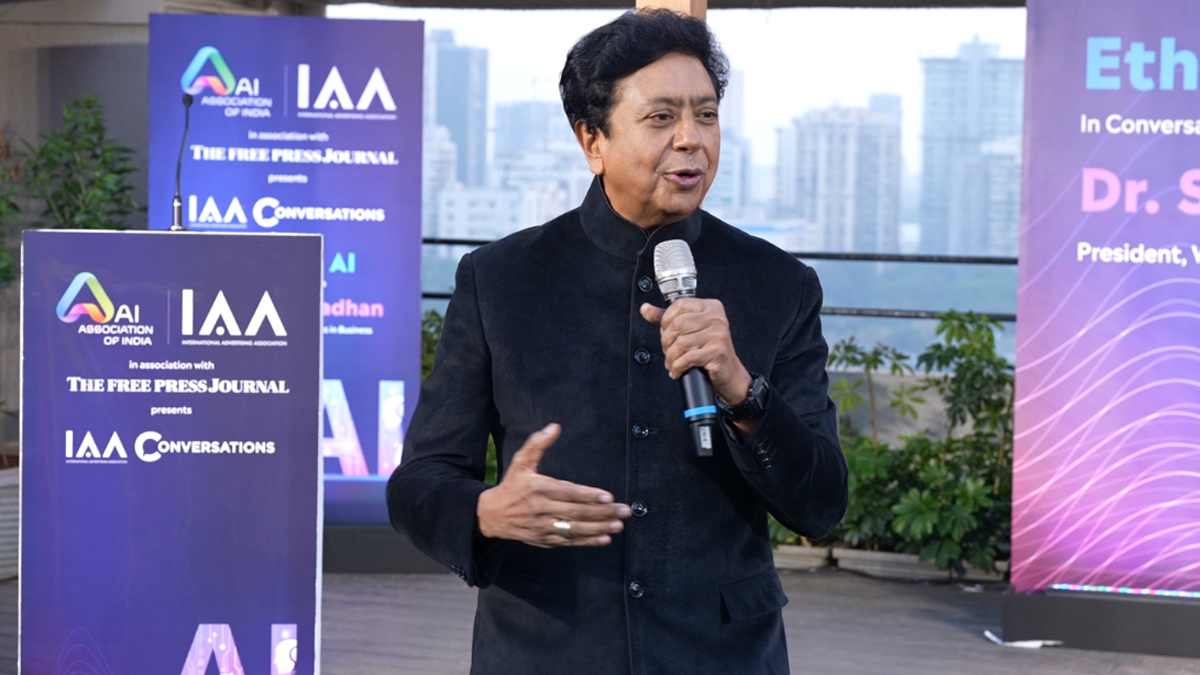
MUMBAI: Artificial intelligence may be racing ahead at lightning speed, but its direction must still be guided by human conscience. That was the central message delivered by Sanjay Pradhan, president of the World Forum for Ethics in Business (WFEB), during the latest edition of IAA Conversations held in Mumbai.
The session was organised by the International Advertising Association (IAA) and the Artificial Intelligence Association of India (AIAI) in association with The Free Press Journal at the Free Press House on 7 March. Addressing a packed audience, Pradhan called for stronger ethical leadership to ensure AI remains a tool that benefits humanity rather than one that governs it.
“Artificial intelligence has rapidly become one of the most powerful technologies humanity has created,” Pradhan said. “It is unlocking breakthroughs in medicine, science and creativity at a pace unimaginable just a few years ago.”

But he warned that the same technology carries serious risks. AI, he noted, can amplify disinformation faster than facts can travel, compromise privacy, deepen discrimination and disrupt millions of livelihoods. Referencing concerns raised by AI pioneers such as Geoffrey Hinton, often called the godfather of AI, Pradhan stressed that the real challenge is not whether AI will shape the world, but whether humans will shape it with ethics and wisdom.
Structuring his talk around four guiding questions, why, what, how and who, Pradhan introduced the audience to WFEB’s emerging AI Ethics Partnership, a global platform aimed at advancing responsible artificial intelligence. He outlined four priority concerns that demand urgent attention: disinformation, bias and discrimination, data privacy and job security.
To make the idea of ethical AI easier to grasp, Pradhan offered a simple metaphor. Ethical AI, he said, is like a three layered cake. The outer layer represents the visible value ethical AI creates for businesses and society. The middle layer is organisational culture that moves ethics from written codes to everyday practice. The innermost layer, however, is the most crucial, the conscience of individual leaders.
Drawing from Indian philosophical thought through WFEB co-founder Ravi Shankar, Pradhan noted that while artificial intelligence can reproduce stored knowledge, true intelligence is boundless and rooted in conscience, creativity and compassion. Practices such as breathwork and meditation, he suggested, can help leaders develop the calm clarity needed for ethical decision making.
The event also featured a discussion with Maninder Adityaraj Singh, chief of staff and head of innovation at Rediffusion Brand Solutions Pvt Ltd, and Yash Johri, lawyer, Supreme Court of India.
Opening the session, IAA India chapter president Abhishek Karnani, highlighted the need for industries to understand and engage with AI responsibly.
“AI has to be befriended and understood,” added Rediffusion managing director and AIAI national convenor Sandeep Goyal. “Its ethical use will determine whether it becomes a friend or a foe.”
As AI continues to reshape industries and societies, Pradhan ended with a simple but powerful call to action. Businesses, governments and individuals must work together to ensure that the algorithms shaping the future reflect human values rather than just cold logic.




Digital
Truecaller opens Business Chat platform to global partners and enterprises
Expansion aims to replace SMS with trusted, rich and conversational messaging

MUMBAI: Truecaller has expanded access to its Business Chat platform, opening it up to global channel partners and enterprise solution providers as it looks to reshape how businesses connect with customers.
The move allows partners worldwide to offer the platform to enterprise clients, enabling a shift away from traditional SMS towards a more interactive, verified and media-rich communication experience. The company is positioning this as a higher-trust alternative in an increasingly cluttered digital landscape.
With over 500 million active users globally, Truecaller is betting on its scale and daily engagement to give brands a more direct and credible way to reach consumers. The platform supports contextual conversations, real-time insights and engagement metrics, allowing businesses to fine-tune communication across the customer journey.
“The definition of success for modern enterprises has evolved. It’s no longer just about delivery but about earning attention and driving meaningful engagement,” said Truecaller global head, GTM Priyam Bose. He added that opening the platform to partners creates a gateway for brands to connect with users in a more trusted and action-oriented environment.
The expansion is already underway, with partners such as Gupshup and OneXtel live in India, while Globe Teleservices, Cloudcom and Sling Africa are driving adoption in international markets.
By equipping partners with data-driven tools and a conversational interface, Truecaller aims to help businesses cut through noise and build stronger customer relationships. The platform also promises a cleaner, more secure interaction layer, addressing long-standing concerns around spam and trust in business messaging.
As enterprises rethink customer engagement in a post-SMS world, Truecaller’s latest push signals a clear ambition to become a central player in conversational commerce.






