MAM
Digital ad-spend to be 37.6% Vs TV’s 35.9% by ’18: DAN

MUMBAI: The world media is reaching a tipping point in ad spend now as digital overtakes television, mobile overtakes desktop and paid search overtakes print. Dentsu Aegis Network’s forecasts suggest that, in 2018, digital will be the top media in terms of global share of spend, taking over television for the first time. Digital’s share of total media spend is predicted to reach a 37.6% share in 2018 (up from 34.8% in 2017), versus 35.9% for television (down from 37.1% in 2017), amounting to a total value of US$ 215.8 billion.
Based on data received from 59 markets across the Americas, Asia-Pacific, Europe, Middle East and Africa, Dentsu Aegis Network’s Ad Spend Forecasts – June 2017 point to a more cautious economic outlook in 2017 than the previous year, with global ad spend growth falling from 4.8% to 3.8% (see Figure 1). However, conditions are set to improve in 2018 with forecast growth in ad spend of 4.3%. Events will play a key role in 2018, with events such as the Winter Olympics & Paralympics in South Korea, the FIFA World Cup in Russia and the US Congressional elections all expected to stimulate ad spend growth.
· New ad spend growth forecasts show caution in 2017 but improved outlook for 2018.

Global ad spend to hit $563.4 billion in 2017 with digital driving growth.
Global ad spend growth holds at 3.8% amid cautious near-term outlook
· Globally, mobile ad spend is set to overtake desktop in 2017, with digital overtaking TV in 2018
· Innovation in digital advertising (video, social, programmatic) powers spend growth
Despite concerns about the economic impact of Britain’s decision to leave the European Union, UK ad spend growth held up better than expected in 2016 at 6.1%. While there are signs of caution in 2017, with growth dipping to 4%, 2018 is forecast to see growth bounce back to 5.9%. A similar picture unfolds in the United States, where a slowdown to 3.6% is forecast for 2017, followed by a slight improvement in 2018 to 4.0%. The United States also remains the largest market in the world, accounting for 37.7% of global advertising spend in 2017. Advertising spend in emerging markets continues to outpace developed economies. For example, ad spend growth in India is forecast to grow at 13% in 2017, while China is the second largest market in the world by share of advertising spend—remaining the only emerging economy to feature in the top five largest ad markets.
Mobile and digital become the new default settings: Our forecasts show how digital technology continues to disrupt and drive innovation in the way brands connect with their consumers. In 2017, we forecast that advertising spend on mobile will overtake desktop, reaching 56% in terms of share of global Digital advertising spend. In 2018, mobile ad spend will grow further to account for a total of US$116.1 billion. With smartphone subscriptions set to reach 4 billion by 2025 and about a third of consumers reporting that their smartphone is their primary source of entertainment, we can expect to see this trend continue to strengthen.
Furthermore, our forecasts suggest that in 2018 digital will be the top media in terms of global share of spend, taking over television for the first time. Digital’s share of total media spend is predicted to reach a 37.6% share in 2018 (up from 34.8% in 2017), versus 35.9% for television (down from 37.1% in 2017), amounting to a total value of US$215.8 billion. Reflecting the continued disruption by digital technology of the print media industry, Paid Search (advertising within the sponsored listings of a search engine) is forecast to overtake traditional print media (newspapers and magazines) in 2018. Print media has been on a downward trajectory for some years now, but will likely fall to a 13.8% share of total spend in 2018 (down from 15.1% in 2017) while paid search is forecast to grow to 14.6%, up from 13.6% in 2017.
Video, social and programmatic power innovation and growth: While digital ad spend is growing rapidly and set to overtake television, within digital there are a number of new sources of growth that point to the future of advertising. For example, in 2017, online video is set to grow by 32.4%; social by 28.9%; and programmatic (i.e. automated ad buying) by 25.4%. Looking ahead, brands will need to embrace the potential of disruptive technologies such as virtual reality, artificial intelligence and voice activation. However, research suggests that only 8%of brands currently intend to use virtual reality for advertising purposes.
Commenting on the latest ad spend forecasts, Dentsu Aegis Network CEO Jerry Buhlmann said, “We are reaching a tipping point in ad spend now as digital overtakes television, mobile overtakes desktop and paid search overtakes print. Digital and data must now be the default settings for advertisers. Evolving to people-based marketing rather than audience-based marketing and using data to increase addressability is essential for brands to manage tighter conditions in 2017 while positioning themselves for future growth.”
“At the same time, the challenge for brands is to ensure that they are ready to embrace the potential of new innovation. As technologies such as virtual reality and voice activation become more prominent, brands must ensure that they remain relevant by creating new value for their consumers.”
Carat India MD Kartik Iyer commented, “India continues to be amongst the few countries seeing growth rates in double digits. While this may be slightly lower than past expectations owing to various market drivers like demonetization and GST, the growth is clearly expected to continue. Driving this growth is Digital with a growth rate of over 35% which is far in excess of that seen by other more traditional media. And with digital quickly progressing on its path of becoming the Go To media for entertainment, this trend is also expected to continue. Other media like TV and cinema are expected to grow at around 12% while Radio and OOH should see a growth of 10% and Newspapers around 8%.”
“Another medium that is driving growth is that of ambient (at over 15% growth rates). Considering the changing retail environment, the medium, in tandem with digital is becoming pivotal for delivering quality engagement with consumers.”



Brands
Samsung certifies 1,000 Maharashtra students in AI and coding
The South Korean electronics giant marks its first large-scale skilling push in the state, with women making up nearly half the national programme’s enrolment
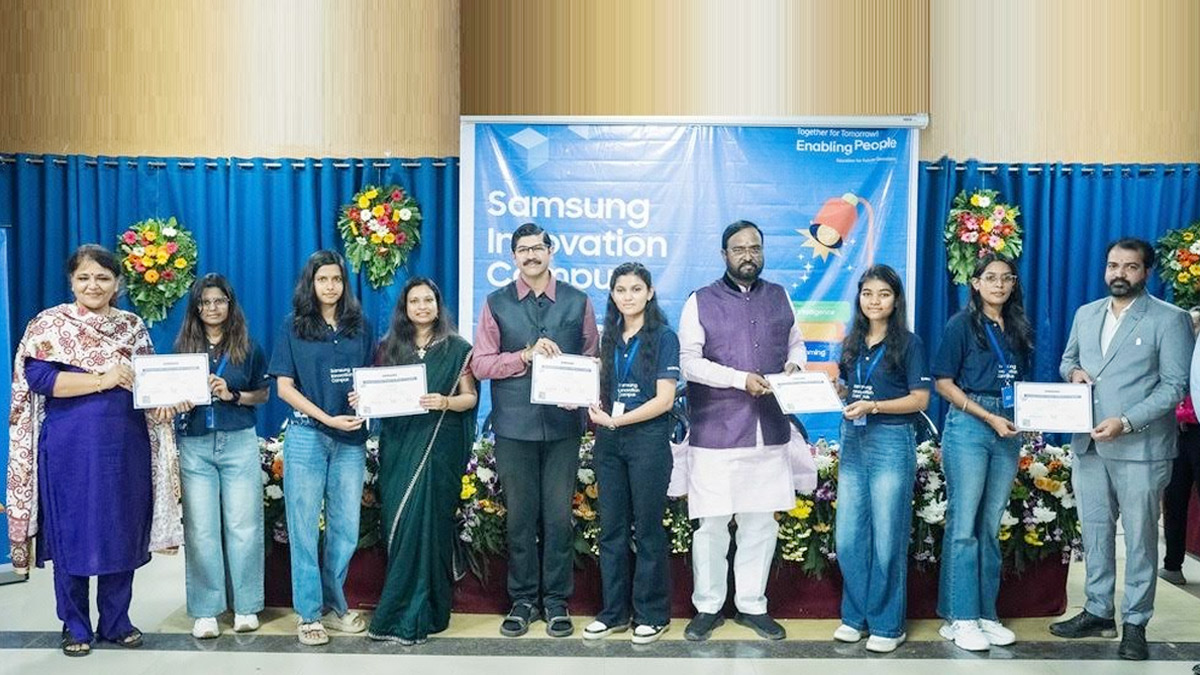
PUNE: Samsung has put 1,000 students in Maharashtra through a certified training programme in artificial intelligence and coding, the largest such drive the South Korean electronics company has run in the state and a signal that corporate India’s skilling ambitions are moving well beyond the boardroom brochure.
The certifications were awarded under Samsung Innovation Campus (SIC), the company’s flagship corporate social responsibility programme, which launched in India in 2022 with the stated aim of democratising access to future-technology education. The 1,000 graduates were drawn from four institutions: 127 from Savitribai Phule Pune University, 373 from Pimpri Chinchwad University, 250 from D.Y. Patil University’s Ramrao Adik Institute of Technology and 250 from Anjuman-I-Islam’s Kalsekar Technical Campus. All completed training in either AI or coding and programming, the two disciplines Samsung has identified as the critical pillars of the digital economy.
The programme does not stop at technical training. Soft-skills development and career-readiness modules are baked into the curriculum, a deliberate attempt to close the gap between what universities teach and what employers actually want.
“India’s digital growth story will ultimately be shaped by the quality of its talent pipeline,” said Shubham Mukherjee, head of CSR and corporate communications at Samsung Southwest Asia. “As technologies like AI move from the periphery to the core of industries, skilling must evolve from basic training to building real-world capability. This milestone in Maharashtra reflects how industry and academia can come together to create a future-ready workforce that is both globally competitive and locally relevant.”
The Maharashtra drive sits within a rapidly scaling national effort. Samsung Innovation Campus trained 20,000 young people across India in 2025, hitting its stated target for the year. Women account for 48 per cent of national enrolments, a figure the company cites as evidence of its push for an inclusive technology ecosystem. The programme is implemented in partnership with the Electronics Sector Skills Council of India and the Telecom Sector Skill Council.
Samsung, which is marking 30 years in India this year, runs SIC alongside two other initiatives, Samsung Solve for Tomorrow and Samsung DOST, as part of a broader effort to build what it calls a generation of innovators with both the technical depth and the problem-solving mindset to thrive in a fast-moving digital world.
A thousand certified students is a tidy headline. Whether they find jobs that match their new skills is the harder question, and the one that will ultimately determine whether corporate skilling programmes like this one are genuine pipelines or well-photographed gestures.






