AD Agencies
Dentsu reveals 2025 media trends report


Mumbai : dentsu releases its 2025 media trends report, titled The Year of Impact. This edition, crafted by specialists across Carat, dentsu X, and iProspect, explores the profound changes driven by algorithms, artificial intelligence, and the new dimensions of consumer engagement, expected to shape the media landscape in the upcoming year.
The report details how 2025 will drive toward a fully addressable, shoppable, and accountable media ecosystem, marking a shift into what dentsu defines as the “Algorithmic Era of Media.” With over 40 pages of in-depth insights, the report outlines how brands can harness this new media environment to drive tangible impact and growth.
dentsu Media APAC, chief client officer & practice president Prerna Mehrotra commented: “At dentsu, we’re truly excited about what we call the Algorithmic Era – where generative AI and personalization are set to drive unprecedented change in how brands engage with consumers, creating new ways for brands to capture consumer attention and build relationships. We see media becoming 100% addressable, shoppable and accountable, highlighting the need for marketers to think about media in a whole new way. Brands must build Media ++ strategies to create more memorable, personalised moments tapping into the creator economy and building connected ecosystems to identify new spaces for growth. In our latest edition of the dentsu Media Trends report, we deep-dive into 10 trends and provide strategic considerations for brands to deliver impact in this new era.”

“The rapid integration of AI across the media value chain has transformed how brands interact with consumers, marking the beginning of The Algorithmic Era, where real-world value creation moves beyond experimentation,” says dentsu Media global practice president, Will Swayne. “The 2025 report is a toolkit for brands seeking to thrive in this new era, offering strategic guidance on leveraging niche communities, connected television, and next-level retail media.”
According to the 2025 Media Trends report, the key themes poised to drive the industry forward include:
1. AI moves from potential to actual impact: AI has evolved from a nascent trend to a transformative force, embedding itself in daily life and revolutionizing media planning, content creation, and consumer interaction. AI-generated micro-moments and the rise of dynamic personalization are opening new doors for brands to build deep, meaningful connections with consumers.
2. Storytelling breaks through the algorithmic bubble: Niche interests and deep fandoms are becoming invaluable assets for brands looking to stand out. Storytelling will be the primary tool for brands to navigate the increasingly algorithm-driven media space, creating impactful narratives across connected television and digital platforms.
3. Retail reshapes media: Retail media continues to grow at a double-digit rate, offering advertisers access to unparalleled shopper data. With key players like Amazon, Walmart, and even the finance industry expanding their ad capabilities, the retail-media fusion is set to become a cornerstone of media strategies.
4. The quest for quality: As media investments increase, so does the demand for higher-quality engagement. Brands must prioritize strategic partnerships and premium content to cut through the noise, ensuring their media dollars drive both immediate results and long-term brand equity.
5. Unevenly distributed future: As technology and media consumption habits evolve unevenly across regions, brands will need to adopt hyper-localized strategies. Regulatory, economic, and technological divides are reshaping the global media landscape, and brands must be prepared to navigate these complexities.







AD Agencies
Kevin Vaz opens FICCI-EY report with a declaration: India’s M&E industry set to breach Rs 3 trillion mark by 2027
In a keynote address at the FICCI-EY report launch, Kevin Vaz says sport, AI and the connected TV boom are driving a multi-screen revolution with no signs of slowing
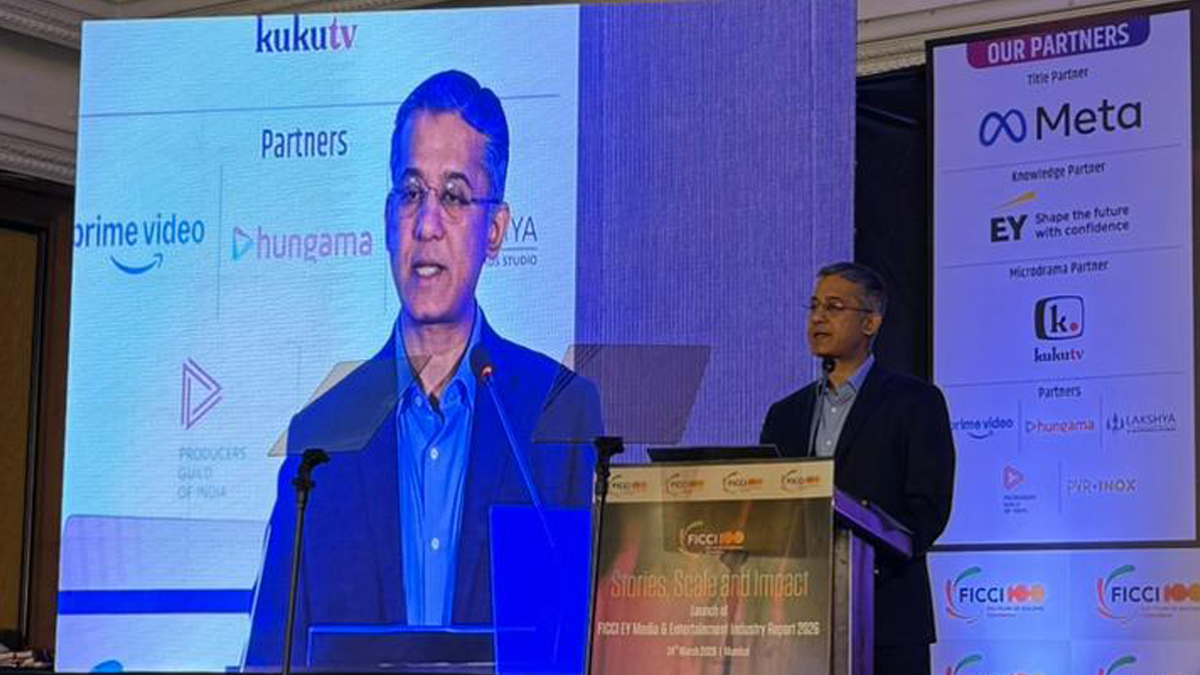
MUMBAI: India’s media and entertainment industry is growing faster than the economy, reshaping global benchmarks and is on course to blow past Rs 3 trillion by 2027. That was the headline message from Kevin Vaz, chairman of the FICCI Media and Entertainment Committee and chief executive of entertainment at JioStar, who delivered the opening keynote at the launch of the FICCI-EY Media and Entertainment Report 2026 in Mumbai on Monday. He did not waste much time on caveats.
The industry hit Rs 2.78 trillion in 2025, outpacing GDP per capita growth and surpassing even last year’s bullish forecasts. Vaz described the year in three words: scale, convergence, transformation. The numbers, he suggested, were only half the story. The other half was how that growth was happening.
Digital has become the industry’s largest segment, driven by advertising, subscriptions and commerce. But Vaz was quick to puncture the familiar narrative of digital killing everything else. India, he argued, is not an either-or market. It is an AND market. Connected TV is surging. Linear television, mobile, films and print are all still expanding. AVGC, the animation, visual effects, gaming and comics sector, is emerging as a serious growth engine, opening new storytelling formats and new global revenue streams. Nothing, he said, is replacing anything. Everything is reinforcing everything else.
Nowhere is that more vivid than in sport. In an on-demand world where audiences can watch anything, anytime, Indians still show up live. “Sports don’t fragment audiences,” Vaz said. “They unite them, just on different screens.” The ICC Men’s T20 World Cup 2026 made the point emphatically. During the final, JioHotstar delivered 72.5 million concurrent streams, a global record. Group chats exploded. Families renegotiated control of the television. Advertisers, Vaz noted with undisguised relish, stopped asking where audiences were and started asking how fast they could get in.
Cinema had its own landmark year. More than 1,900 films were released, with several crossing the Rs 1 billion mark. Dhurandhar was singled out as proof that Indian audiences will still turn up in large numbers for content that grips them. Live experiences, too, are getting bigger and more immersive, though Vaz suggested the surface has barely been scratched.
Then there is artificial intelligence, which he described as quietly, and sometimes not so quietly, reshaping everything. AI is enabling personalisation, efficiency and scale, but Vaz argued its deeper significance lies in what it is doing to creativity itself. He pointed to Mahabharat: Ek Dharmayudh, billed as the world’s first AI-produced show, as evidence that the technology can amplify creative ambition rather than hollow it out. He also used the platform to call on Indian policymakers to engage seriously with the creative industry on AI and copyright, ensuring that creators are fairly compensated as the technology spreads.
The picture that emerges from the report, and from Vaz’s keynote, is of an industry that has stopped thinking of itself as a fast-growing emerging market and started thinking of itself as a global template. Scale, diversity and innovation, he said, are no longer in tension in India. They are coexisting, and the rest of the world is taking notes.
The Rs 3 trillion milestone is two years away. As the man who chairs the committee that shapes the industry’s policy agenda and runs the country’s most powerful entertainment platform, Vaz set the tone for the day with characteristic directness: India’s media business is not just chasing growth. It is deciding what the country talks about at dinner. That is a different kind of power altogether.








