Brands
Decathlon’s next frontier

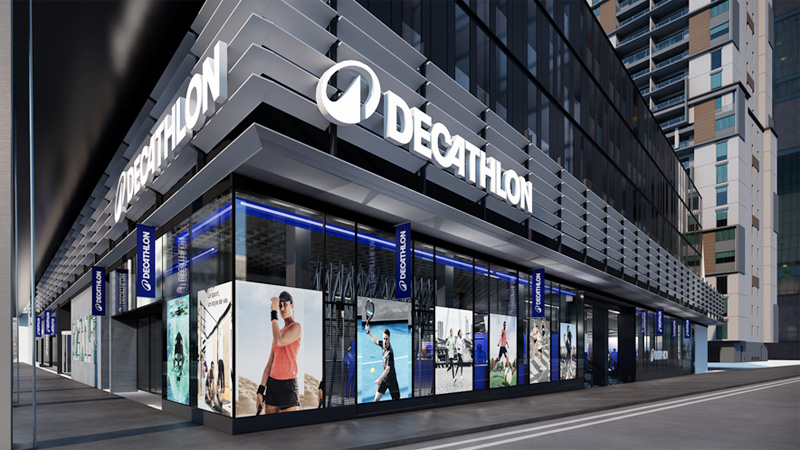
Mumbai: Decathlon, a multi-specialist sports brand, is revealing its new purpose, to “Move People Through the Wonders of Sport,” and the strategy behind this bold new ambition to bring innovative and sustainable sport to everyone. As part of this evolution, Decathlon is unveiling its new brand, which includes a dynamic and forward-looking identity and the new “orbit” logo.
Since the beginning of its journey in 1976, Decathlon has always believed in sports’ vital role in helping societies to be healthier and happier. And today, people need sport more than ever.
At the beginning of this transformation journey, Decathlon wrote its “North Star”, a long-term ambition to accelerate its mission for the good of societies and the planet. Guided by the North Star, a new purpose was born: Move People Through the Wonders of Sport.

Anchored to this purpose, Decathlon is adopting an ambitious global strategy, which encompasses an enhanced customer experience, a strong commitment to sustainability and an overall modernisation of the company. Core to the customer experience is an evolved brand introduced today.
Barbara Martin-Coppola, Decathlon’s Global Chief Executive Officer: “Today marks a very special moment in both the history and future of Decathlon. Now more than ever, the world needs sport. It has a unifying power and can improve both physical and mental health. At Decathlon, we want to have a greater positive impact on humans, society and the planet by Moving People Through the Wonders of Sport. I am proud to be working towards the North Star – our guiding light and ambition – with our teammates. It’s been incredible to see our diverse community come together to celebrate what makes us special: enabling everyone to practise sport on their own terms. I am confident that our ambitious strategy, evolving our way of doing business, will ensure Decathlon leads the sector as a unique and trusted sports brand.”
A New Brand Identity and Portfolio
Decathlon’s striking new brand identity reflects the brand’s ambition while celebrating its past. Along with a dynamic blue, it now welcomes a new brand icon – “the Orbit” – expressing movement, the ambition to reach new heights, and circularity, at the heart of Decathlon’s sustainable business model.
Decathlon is unleashing the full potential of the brand to bring sport to everyone through a new and simplified brand portfolio with 9 category specialists: Quechua (mountain), Tribord (water and wind), Rockrider (outdoor cycling), Domyos (fitness), Kuikma (racket), Kipsta (team sports), Caperlan (wildlife), Btwin (urban gliding and mobility) and Inesis (target), and 4 expert brands: Van Rysel, Simond, Kiprun and Solognac.
A Business Model Based on Sustainability
All the good that sports can do for people’s lives and societies cannot be at the expense of the planet.
Decathlon aims to be a driving force and has committed to becoming Net Zero by 2050.
DECATHLON’s decarbonization targets are (scopes 1, 2 & 3):
. 20 per cent reduction in absolute CO2 emissions in 2026.
. 42 per cent reduction in absolute CO2 emissions in 2030 and net zero by 2050.
Strongly engaged in reaching its ambition, Decathlon has, for the second year in a row in 2023, decoupled its growth and its CO2 emissions.
Decathlon is working hand in hand with suppliers and partners to unlock sustainability all across the supply chain. With this collaborative approach, Decathlon has been working with suppliers to decarbonise processes and pave the way for new business models based on circularity and increased product life cycles.
This also means that across the product range, Decathlon is increasing product lifespans and enabling customers to reuse, repair and recycle their products.
A New Customer Experience Shaped by a Digital-First Mindset
Decathlon is harnessing the power of digital with a global revamp of the e-commerce website to provide a seamless shopping experience for customers anytime, anywhere.
Decathlon’s digital supply chain has been rethought with best-in-class tools and AI algorithms to enable accurate forecasting, assortment planning and stock parameters. This has already led to significant reductions in stock levels and many improvements, including decreasing transportation costs, carbon footprint and delivery time.
Decathlon is also breaking ground with new ways to embark its customers on an immersive experience, including its 3D Shopping App on Apple Vision Pro in the U.S.
In the coming months, more than 1,700 stores around the world will be refurbished with a whole new setup, offering customers intuitive navigation, increased product visibility, engaging physical and digital displays, and an aesthetically pleasing atmosphere.
Innovation at the Heart of a Multi-Specialist Sports Brand
Every day, over 850 engineers and 400 designers at Decathlon relentlessly invent, create, design, and try and test new materials and products. The result is a set of groundbreaking sporting solutions, underpinned by 900 patents.
Decathlon’s organisation is shaped by this culture and includes expert teams such as Booster Innovation – supporting local teams, Sports Lab – dedicated to the study of sports and dynamics of the human body, AddLab- a 3D prototyping centre and Advanced Design – designing the sports and experiences of the future.
Looking to the Future as One
Decathlon aims to become one of the most Inclusive organisations in the world.
In 2023, Decathlon’s Executive team reached parity for the first time in its history, and the company has made unprecedented commitments for 2026, including measuring representation, inclusion and belonging, acting on it, and setting global standards and best-in-class performance in DEI.
Decathlon is building and strengthening communities such as women in leadership and associated programmes, forging external partnerships with DEI experts. In 2023, Decathlon received several industry recognitions including tenth place in Forbes’ Retail & Wholesale category for the world’s “Best employer for Women”.



Brands
Maharashtra panel orders Lodha to refund Rs 5 crore to homebuyers
Consumer court flags unfair practices in long-running property dispute case

MUMBAI: In a sharp rebuke to one of India’s biggest real estate players, the Maharashtra State Consumer Disputes Redressal Commission has directed Macrotech Developers to refund nearly Rs 5 crore to a senior citizen couple, Uttam and Anindita Chatterjee. The ruling, delivered on March 13, 2026, calls out the developer for “deficiency in service” and “unfair trade practices”, bringing closure to a dispute that has stretched over a decade.
The case traces back to 2015, when the couple booked a 3-BHK flat at World Towers in Lower Parel for Rs 12.22 crore, with possession promised within a year. What followed was a series of changes that complicated matters. After deciding to exit the project, they were persuaded to shift to a 4-BHK in another development priced at Rs 8 crore, with delivery scheduled for 2018. However, within months, the price was allegedly increased to Rs 10 crore. After demonetisation reshaped the market, similar flats were reportedly being offered at lower prices, but the couple were not given the benefit.
Despite paying over Rs 2.83 crore, the couple neither received possession nor clarity. Instead, in 2018, the developer unilaterally cancelled the booking, retained part of the amount as earnest money, and argued that the buyers were investors rather than consumers. The commission rejected this claim, observing that casual references to “investment” do not take away consumer rights when the purchase intent is residential.
The bench also held that the developer could not penalise buyers for payment delays while failing to meet its own delivery commitments. It noted the lack of formal documentation for revised terms and termed the prolonged retention of funds without delivering a home as exploitative.
As part of its order, the commission directed the developer to refund Rs 2.83 crore paid by the couple, along with interest at 10 per cent per annum, amounting to around Rs 2.12 crore. In addition, Rs 1 lakh has been awarded for mental agony and Rs 50,000 towards litigation costs, taking the total payout to over Rs 5 crore. The developer has been asked to comply within two months.
For now, the ruling serves as a reminder that in real estate, shifting terms and delayed promises can carry a significant cost.