MAM
Dead men walking!

The prologue to an agency review – an agency review is ideally an open minded exercise that is meant to evaluate the performance of the advertising agency over the past year, in as fair and unbiased manner, as is humanly possible. However, since this is about as achievable as having an advertising awards show without at least one self respecting agency deciding to boycott on ‘philosophical’ grounds, what it’s very announcement leads to is unmitigated stress, panic and confusion all round.
“News of an impending review always fuels the need for warm brew.” The hushed oriental accent, the slight flutter of mach speed induced turbulence and Chai-La (the mystical Chinese canteen tea boy) had delivered the customary tea cup and opening barb to Ram Shankar. It was Monday morning and Ram had not yet got his bits and bytes together when Vikas (his boss) beckoned him, in a manner that meant business.
“Mr Bose has told me this morning that we are going to have an agency review,” started Vikas, adjusting his tie in his reflection in Ram’s glasses.

“Do you think the account is in danger?” asked Vikas in a hushed tone.
“I wouldn’t know,” began Ram and was cut in mid sentence by PP (the creative director of the exaggerated mustache fame) bursting into Vikas’s chambers like Ronaldo in the penalty box.
“Why are we having an agency review man? Are we going to lose the account?” boomed PP in his customary high decibel style, causing weak hearted account executives to instantly sign up for medical insurance policies.
“Relax PP, its nothing new,” replied Vikas, in his most soothing tone, trying to function for once like the head on the business, but after he remembered that it was the first time that this was happening in five years, his morale fell faster than the credibility of ‘breaking news’ after the last pest control visit of the BMC had been aired live.
“This hasn’t happened with us in a very long time,” echoed Planimus, the media head, in his routinely philosophically platonic tone, “I smell trouble brewing.”
Almost on cue Dharti, the ravishingly radiant account planner walked in, “Hey the security guard told me that the account was up for review, what’s happening guys?”
“Lets just meet in the conference room, we need to figure out a strategy,” suggested Vikas, and for once all the necessary evils were in agreement.
The scene shifted to the conference room. Vikas, following his perfunctorily servicing impulse of staying on top of things, walked purposefully to the board, marker pen in hand straight from the ‘have whiteboard will scribble’ school of thought.
“Let’s see what we have here,” furiously constructing geometric shapes, like he had a personal vendetta against parabolas (he didn’t draw any, just in case you assumed).
He finished with three circles – client, agency and external forces and had somehow managed to link all three with arrows that looked like having directional issues.
“What does all this mean?” asked an irritated PP. “Why must you complicate simple things? I bet that’s why the review is happening.”
“If you had shown more interest in the account after finishing with the film, maybe we wouldn’t be here, client’s dislike creative who just do the glamorous jobs.”
“It’s not my job to write calendars, I am never good with dates,” retorted PP.
“Given the numerous angry women waiting in the reception for you daily, for once I would agree,” replied Vikas, relishing the opportunity to kick the old foe in the more delicate, unmentionable parts.
Before PP could venture into his nuclear explosion, Dharti patted a firm hand on his shoulder, fortified with a smile that spoke waist downwards.
“Must we be fighting like this? Let’s try and figure this out,” she purred, instantly sending goose pimples down Ram’s spine.
However years of crunching and rounding figures had made Planimus oblivious to the wiles of women, and he still had some ax to grind.
“Madam, you knocked us all out the last time we discussed strategy, I think the client is still nursing the bump on his head from your last interaction. In my time strategy used to be simple, over and done with in ten minutes.” He finished with a sardonic smile.
“This isn’t your time Planimus,” cooed back Dharti, in an interesting tone that bordered between spite and contempt.
“To lose the war, put four generals together in a room and ask them to arrive at a decision-Old Chinese army saying.” Chai-La popped in and out of Ram’s subconscious mind, leaving behind the sacred brew nestled in his fingers.
Ram waited for the mayhem to subside before deciding to make his point. A valuable tip he had picked from Planimus, about advertising when clutter was low for more impact.
“Could it just be that given the new personnel at the clients end, they want to look at everything in a fair and unbiased manner? You know like bringing a newer perspective to the table so that the communication that we create could actually get better and more focused? Are we making too much of our fear of losing the account?”
All the participants in the room starred at Ram in rapt silence, like people would have when Moses was reciting the commandments. Then the conference room erupted with laughter.
“Fair and unbiased,” choked Vikas, as he hung onto PP’s shoulder for support in a rare ‘Kodak moment of camaraderie’.
“Should we be scared of losing the business?” stuttered Planimus as he kept banging the table in an almost tribal ritual.
Dharti sat composed, dignified and silent through it all.
Ram felt he had at least one supporter. All the others turned to look at her.
“Bringing a new perspective so that we can create better communication,” she said and burst out into laughter, further fuelling the mirth factor in the room.
Ten minutes later all attention was back to the whiteboard, though not strictly at the seismographic visuals Vikas had crafted earlier.
“We need to figure this one out. You know how the boss panics when he hears these things, we will end up creating 42 campaigns for everything,” mulled Vikas.
“Why 42?” Dharti queried innocently.
“That’s because the boss is a Douglass Adam fan and you know the bit about 42 being the answer to life, the universe and everything. The chief applies it everywhere.”
“Well I don’t mind writing a 42 slide presentation,” cooed Dharti.
“What about the creative trying to churn out 42 campaigns, are we going mad?”
“Well statistically 42 is an interesting number,” started Planimus and was instantly rebooted by the chilling glares that were shot in his direction.
“Why don’t we just call Bose, maybe he will help us,” asked Dharti.
“After the way I keep taking his case in meetings,” said PP, “I think he is having this because he wants to settle scores with me. I expect to be the target.”
“Tchah!” interjected Vikas, “He hates it that I’m not involved on a day to day basis,” not wanting PP to steal the limelight even in such issues.
“Why don’t we just call him?” implored Dharti
“Who should?”
Furtive glances were exchanged across the room.
“He hates me.”
“He is intimidated by me.”
“I can’t stand the creep.”
All eyes rested on Ram Shankar.
“Call him chief,” chirped Vikas, relieved that the onus of this ‘stress call’ was off him. “Make it seem natural, start like you were just inquiring when it is.”
All the others offered encouraging glances by way of support.
Ram’s hand was trembling as he began dialing the number, somewhere deep down he felt that he was a bit too junior to be making that call, but Vikas’s quick fingers zipped across the number pad and the phone was buzzing at the other end before Ram could even think of formulating an escape plan.
“Mr Bose, I was just calling to inquire when the review meeting would be?” he began in his most earnest voice, all eyes in the room transfixed on him.
There was silence as Bose’s voice cackled its usual cacophonic tone for a bit. Ram put down the phone, his hand still shaking. “He says it was just a misunderstanding. The Chairman had told his assistant, ‘Get the agency to Hotel Sea-View to meet me.’ That fellow apparently has a hearing problem and so he spread the word about the agency review.”
“I knew it!”
“How can they dislike our work?”
“Or our planning.”
“Or strategy.”
And before he knew it the other four had cleared the room and zipped off for a lavish lunch, the voucher of which Ram would have to clear later (with much explaining).
“Tale of the review woe is useful to keep agency on toe,” the ancient Chinese rhyme (for better or verse), the express delivery of the tea cup and Chai-La had vanished into one of the circles on the whiteboard.





MAM
India’s financial sector spent less on TV ads in 2025 but flooded the internet
Banks, insurers and lenders cut tv ads as digital jumps, LIC and Muthoot lead tv and Axis Bank tops online
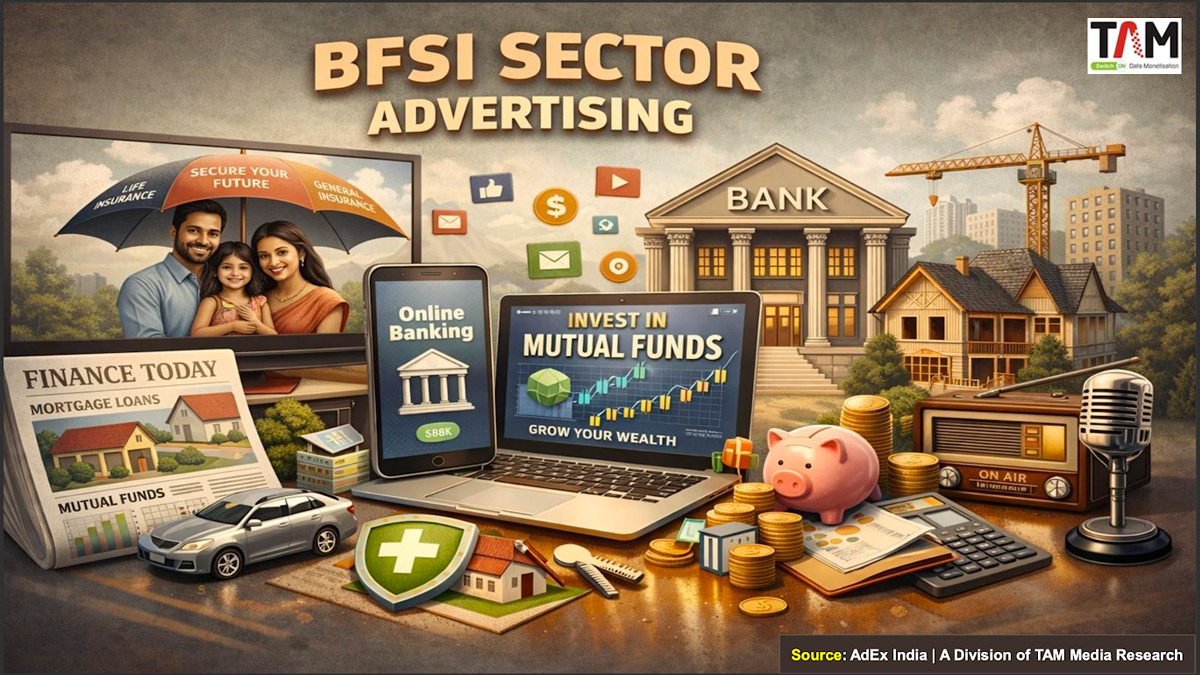
MUMBAI: India’s banking, financial services and insurance sector, one of the most prolific advertisers in the country, delivered a split verdict on media in 2025. It spent less on television, held its nerve in print, turned up the volume on radio and deluged the internet with a ferocity that left every other medium looking pedestrian. The picture that emerges from TAM AdEx’s cross-media report for the BFSI sector is of an industry in transition, still wedded to the news bulletin but increasingly seduced by the algorithm.
Television: a retreat with caveats
TV ad volumes for the BFSI sector fell 16 per cent in 2025 compared with 2024, a sharp reversal after two years of consistent growth that had pushed volumes 16 per cent above 2021 levels by 2023 and a further 7 per cent higher by 2024. Within 2025 itself, the drop was concentrated in the middle of the year: the second and third quarters saw ad volumes slide 35 per cent each against the first quarter, with a partial recovery of 13 per cent in the fourth.
The retreat did not reshuffle the deck. Life insurance retained first place among TV categories with 19 per cent of ad volumes, mortgage loans held second with 16 per cent, and the top ten categories together accounted for 82 per cent of all BFSI television advertising. The dominance of news channels was equally pronounced: news claimed 68 per cent of ad volumes, general entertainment channels a distant 14 per cent and movies 12 per cent. Together, news and GEC captured 82 per cent of the sector’s television spend. News bulletins alone took 48 per cent of programme-genre volumes, with feature films second at 12 per cent. Prime time, between 6pm and 11pm, drew 34 per cent of ad volumes, followed by afternoon at 22 per cent and morning at 20 per cent. A full 82 per cent of all ads ran between 20 and 40 seconds.
Life Insurance Corporation of India was the sector’s biggest TV spender with 11 per cent of ad volumes. Muthoot Financial Enterprises came second with 9 per cent, followed by National Payments Corporation of India at 6 per cent, Tata AIG General Insurance at 5 per cent and State Bank of India at 5 per cent. The top ten advertisers together accounted for 51 per cent of total TV volumes. Three names were new to the top ten in 2025: Tata AIG General Insurance, IIFL Finance and Tata Capital. At brand level, Muthoot Finance Loan Against Gold led with 9 per cent share, Tata AIG Health Insurance entered the top ten for the first time, and the top ten brands together contributed 35 per cent of ad volumes.
Print: the long climb continues
Print told a different story. Ad space for the BFSI sector has grown every year since 2021, rising 16 per cent in 2022, 30 per cent in 2023, 51 per cent in 2024 and 64 per cent in 2025, all measured against a 2021 baseline. Within 2025, ad space was flat in the second quarter but surged 46 per cent in the third and 33 per cent in the fourth compared with the first. Life insurance led print categories with 21 per cent of ad space, followed by mutual funds and banking services and products at 13 per cent each, and corporate financial institutes at 11 per cent. The top ten categories together took 82 per cent of print ad space. LIC led print advertisers with 6 per cent share, and the top ten together covered just 19 per cent of ad space, a reflection of how fragmented print spending remains. Three new entrants joined the top ten in 2025, with Billion Brains Garage Ventures the only exclusive presence not seen in 2024’s list. In the top ten brands, LIC dominated with a 2 per cent share, while Nippon India Mutual Fund rose to third position from fourth in 2024. English accounted for 62 per cent of print ad space, Hindi for 20 per cent. Business and finance publications took 59 per cent of the genre split. The south zone led regional spending with 33 per cent of print ad space, Bangalore topping that zone, while New Delhi and Mumbai were the leading cities nationally.
Radio: louder than ever
Radio ad volumes for the BFSI sector have climbed steadily, rising 12 per cent above 2021 levels in 2023, 36 per cent in 2024 and 45 per cent in 2025. The quarterly pattern within 2025 was volatile: a sharp drop of 43 per cent in the second quarter and 42 per cent in the third, followed by a near-full recovery in the fourth. Life insurance led radio categories with 22 per cent of volumes, banking services and products second at 14 per cent and corporate NBFCs third at 11 per cent. LIC of India held its position as the leading radio advertiser with 20 per cent of ad volumes; the top ten radio advertisers together covered 69 per cent. Muthoot Financial Enterprises led radio brands with 10 per cent share, five of the top ten brands belonged to LIC alone, and SBI Mutual Fund made a remarkable leap to fifth position from 272nd in 2024. Evening and morning time-bands together captured 84 per cent of radio ad volumes, with evenings at 44 per cent and mornings at 40 per cent. Maharashtra was the leading state for radio BFSI advertising with 18 per cent share; Maharashtra, Gujarat and Uttar Pradesh together accounted for 43 per cent.
Digital: the five-times surge
If one number defines the 2025 BFSI advertising story, it is five. Digital ad impressions for the sector multiplied fivefold between 2021 and 2025, having already doubled in 2023 and doubled again in 2024 before the 2025 leap. Within the year, impressions dipped 19 per cent in the second quarter and 12 per cent in the third before recovering 8 per cent above the first quarter by the fourth. Banking services and products led digital categories with 27 per cent of impressions, life insurance and credit cards tied at 19 per cent each, and securities and sharebroking organisations fell from first place in 2024 to fourth in 2025. Axis Bank was the runaway leader among digital advertisers with 12 per cent of impressions, followed by ICICI Bank at 9 per cent, IDFC First Bank at 7 per cent and Kotak Mahindra Bank at 6 per cent. The top ten digital advertisers covered 59 per cent of impressions, and seven of them were new entrants compared with 2024, signalling rapid churn in the digital spending hierarchy. At brand level, Axis Bank led with 9 per cent, ICICI HPCL Super Saver Credit Card vaulted to third place from 921st in 2024, and six of the top ten digital brands were new to the list. Programmatic buying accounted for 91 per cent of all digital BFSI transactions; combined with ad networks, it captured 96 per cent.
The data from TAM AdEx paints the portrait of a sector that still believes in the power of the television news bulletin to sell insurance to the masses, but increasingly knows that the next generation of borrowers, investors and cardholders is scrolling, not watching. The race is now on to reach them before the algorithm serves up someone else’s loan offer first.






