Brands
Coolberg brews ‘jugaaro’ with Prime Video’s ‘Do You Wanna Partner’

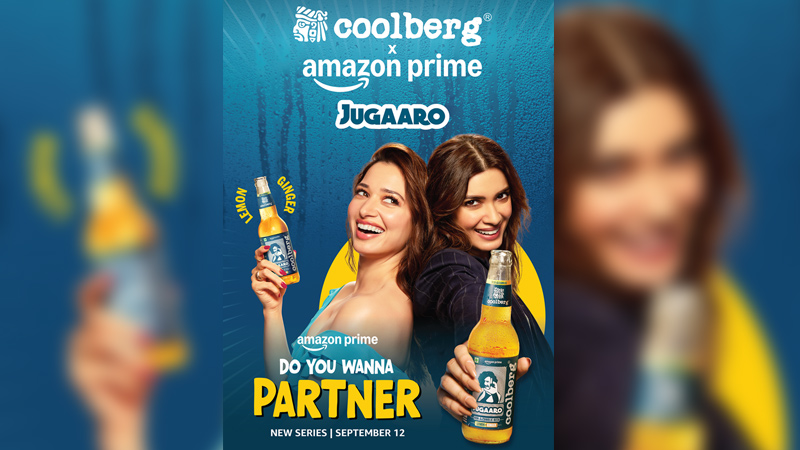
MUMBAI: When life gives you lemons, Coolberg adds ginger and calls it jugaaro! Prime Video and Coolberg have teamed up for a first-of-its-kind collaboration, bringing fiction off the screen and into people’s hands with a limited-edition drink inspired by Amazon Original series Do You Wanna Partner. Ahead of the show’s launch on 12 September, the duo unveiled the Coolberg ‘jugaaro’ lemon-ginger non-alcoholic malt beverage, designed to bottle up the show’s quirky, entrepreneurial spirit.
The parallel is uncanny. Just as the series follows two women who hustle their way through the male-dominated world of craft beer, Coolberg itself is led by three trailblazing women: Ghodawat Consumer Limited, ceo, Salloni Ghodawat, co-founder Yashika Keswani, and brand lead Ritika Agrawal. Together, they have carved out Coolberg as India’s number one non-alcoholic beer brand and a flag-bearer for mindful drinking among Gen Z and millennials.

“This collaboration isn’t just about a product, it is about a story,” said Ghodawat. “Coolberg’s journey mirrors the series about breaking barriers, challenging conventions, and showing that the future of FMCG belongs to diverse voices and fearless ideas.”
The special-edition Jugaaro will be stocked across 3,500 plus general trade stores, 50 modern trade outlets including Nature’s Basket and Walmart, 800 plus Horeca destinations like Absolute BBQ and Wow Momo, and leading quick commerce apps including Blinkit, Zepto and Swiggy.
Produced by Dharmatic Entertainment, Do You Wanna Partner stars Tamannaah Bhatia and Diana Penty as best friends chasing their dream of a beer start-up, alongside Jaaved Jaafery, Nakuul Mehta, Shweta Tiwari and Rannvijay Singha. The series promises a fizzy mix of comedy, heart, and jugaad, while Coolberg Jugaaro serves as the perfect real-world chaser.







Brands
Dunkin’ Donuts to exit India as Jubilant FoodWorks ends 15-year franchise deal
The quick service restaurant giant is ending a 15-year franchise partnership with the American doughnut chain, even as it renews its Domino’s agreement for another 15 years
NOIDA: Dunkin’ is done in India. Jubilant FoodWorks Ltd, the country’s leading quick service restaurant operator, has decided not to renew its franchise agreement with the American coffee and doughnut chain, and will wind down its Indian stores in a phased manner before December 31, 2026, bringing a 15-year partnership to a quiet, loss-laden close.
The decision, approved by JFL’s board on March 30, 2026, ends a relationship that began with a Multiple Unit Development Franchise Agreement signed on February 24, 2011. JFL will now evaluate and undertake what it described in a regulatory filing as the “rationalisation and/or cessation of certain operations and/or sale, transfer or disposal of assets and/or assignment or transfer of franchise rights,” all in consultation with Dunkin’s brand owners and strictly within the terms of the original agreement.
The numbers tell the story bluntly. In the financial year 2024-25, Dunkin’ India posted a revenue of Rs 37 crore against a loss of Rs 19 crore — a haemorrhage that was always going to test the patience of a parent company recording revenues of Rs 6,104 crore and a profit of Rs 194 crore in the same period. Doughnuts, it turns out, were never going to move the needle.
The contrast with JFL’s handling of its other marquee franchise could hardly be sharper. Even as it walks away from Dunkin’, the company has just doubled down on Domino’s, signing a fresh Master Franchise Agreement on March 31, 2026, granting it exclusive rights to develop and operate Domino’s Pizza stores in India for 15 years, with an option to renew for a further 10.
JFL, incorporated in 1995 and promoted by the Bharatia family, operates a network of more than 3,500 stores across six markets — India, Turkey, Bangladesh, Sri Lanka, Azerbaijan and Georgia. Its portfolio includes Domino’s and Popeyes on the global side, and two home-grown brands: Hong’s Kitchen and COFFY, a café brand in Turkey.
For Dunkin’, India was always a stretch. The brand never quite cracked the cultural code in a market where filter coffee and chai command fierce loyalty and where the doughnut remains, at best, an occasional indulgence rather than a daily habit. Fifteen years, mounting losses and a parent with better things to spend its capital on was always going to be a difficult equation to solve.
The doughnut has had its last day. The pizza, however, is staying.






