MAM
Convergence India opens on Digital India theme with 434 exhibitors from 29 countries


NEW DELHI: India has emerged as one of the most promising markets for IT and Telecommunications companies with government initiatives such as Digital India and Make in India propelling growth and encouraging major tech companies like Facebook, Microsoft and Google, who are preparing to serve the Indian rural market.
This was the general view of speakers at the inauguration of the 24th Convergence India Expo, which opened in the capital today with 434 exhibitors from 29 countries.

Speakers said India is in the midst of a digital revolution, and the government has unveiled new policies and regulations to accelerate the adoption of ICT in key economic and strategic sectors to increase India’s competitiveness and productivity.
Bharti Enterprises vice chairman Akhil Gupta said, “The Indian ICT sector has entered an exciting growth phase led by the proliferation of digital media and technologies. With over one billion mobile connections, the country’s transformation into a digital economy will be driven by mobile broadband, which will help hundreds of millions of Indians benefit by connecting to the internet. The industry remains committed to the Government’s Digital India vision.”
CII National Committee on Telecom & Broadband chairman Kiran Karnik, who was moderating the inaugural conference session on Digital India, added, “The panellists comprised eminent names who bought a unique and different perspective on the various issues involved. The result was an excellent session, which provided many insights and useful suggestions.”
Keynote speaker at the Convergence India forum, former Secretary in the Government and former Telecom Regulatory Authority of India (TRAI) chairman Pradip Baijal said, “Today’s India and Indians want to be informed and connected 24×7, hence mobile broadband. India has very poor fixed-line tele-density and fixed broadband density. Of seven billion mobiles in the world, 3.5 billion have been converted to mobile broadband. In India, less than 10 per cent of mobiles have been converted to mobile broadband. This needs correction, and I hope the conference will deliberate on this.”
Exhibitions India Group chairman Prem Behl, who conceived the Convergence India Expo, said, “Our endeavour is to bring to the forefront an extraordinary platform, which is informative, thought provoking and empowers both government and industry stakeholders to meet the challenges of the future.”
Participating exhibitors include: Appear TV, Cisco Systems, Elemental Technologies, Ericsson, NAGRA, RiverSilica, SanDisk India and Telenor, among others, who are using the Convergence India platform to showcase cutting-edge technologies and innovations.
Apart from the exhibition arena, concurrent conference sessions are being held in two separate halls with prominent government officials, industry leaders, technocrats, academia, media, etc.
Eminent speakers included TRAI chairman R S Sharma; Kiran Karnik; Broadcom India MD Rajiv Kapur; Cisco India and SAARC managing director – service provider business Sanjay Kaul; Telenor India CEO Sharad Mehrotra; ICA National president Pankaj Mohindroo; Bharti Infratel MD and CEO Devender Singh Rawat; and Viom Networks CEO Syed Safawi, amongst others.
Organised by the Exhibitions India Group, the Expo is supported by the Department of Electronics and Information Technology, Ministry of Communications & Information Technology and Ministry of Information and Broadcasting.







Brands
KKR sixes to power EV charger rollout under VIDA campaign
Cricket meets clean mobility as big hits spark India’s charging growth
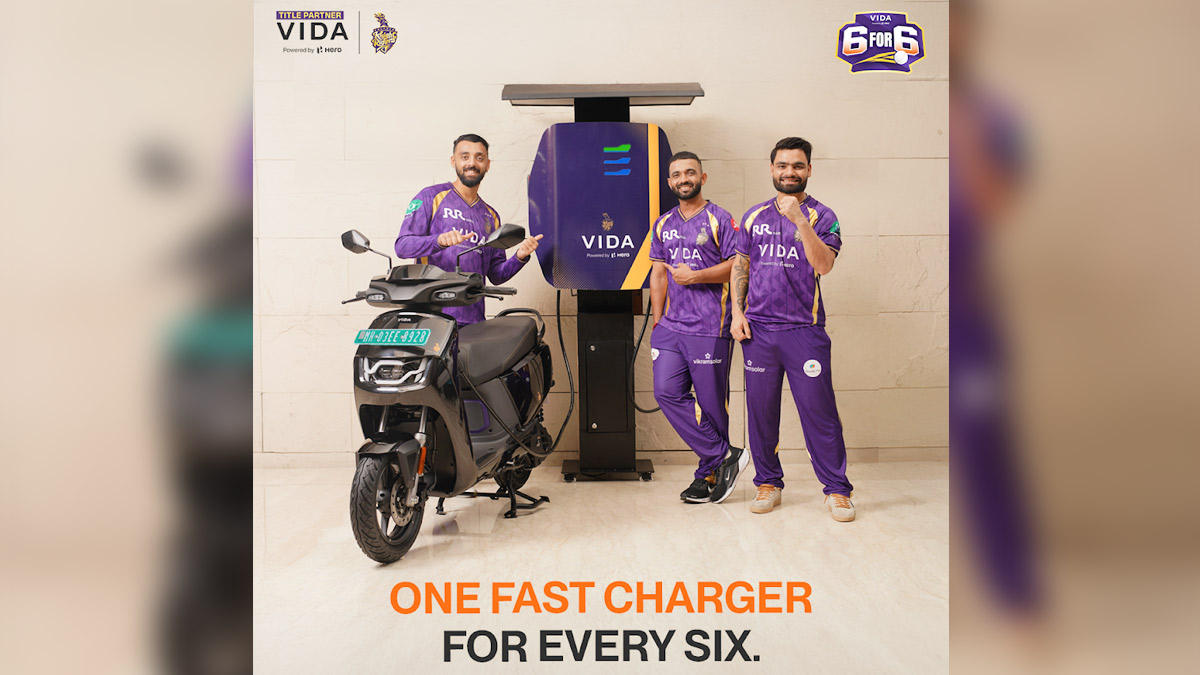
NEW DELHI: VIDA, the electric mobility arm of Hero MotoCorp, has teamed up with Kolkata Knight Riders to launch a campaign that turns cricketing flair into real-world impact.
Titled ‘6 for 6’, the initiative promises to install a 6kW fast EV charger for every six hit by KKR during the ongoing Indian Premier League season. The idea is simple but powerful, as each big hit on the field contributes directly to expanding India’s fast-charging infrastructure.
The campaign builds on VIDA’s growing network, which already spans over 5,300 fast-charging points across more than 430 cities. With EV adoption gaining pace, the brand is using cricket’s mass appeal to accelerate both awareness and infrastructure growth.
Explaining the thinking behind the move, Hero MotoCorp emerging mobility business unit chief business officer Kausalya Nandakumar said, “Cricket has an incredible ability to unite and inspire millions across the country. With the ‘6 for 6’ campaign, we are turning every big hit on the field into a step towards a cleaner and a more accessible mobility future.”
She added that VIDA’s expanding fast-charging network and removable battery technology are designed to make EV ownership more convenient and practical for everyday users.
From the franchise’s side, the campaign is also about giving on-field moments a larger purpose. Kolkata Knight Riders chief executive officer Venky Mysore said, “The ‘6 for 6’ campaign exemplifies the potential of sport as a platform for meaningful, real-world impact. By linking every six to the expansion of EV charging infrastructure, this partnership transforms fan excitement into tangible progress.”
As part of the rollout, VIDA has introduced co-branded charging stations in KKR’s signature colours, with a flagship installation unveiled alongside team players. The chargers are designed for quick top-ups, powering VIDA scooters from zero to 80 percent in about an hour, while also being positioned along key highways to support longer journeys.
The initiative also taps into VIDA’s removable battery system, which allows users to charge using standard household plug points, adding flexibility to the charging ecosystem.
By blending the thrill of cricket with the urgency of clean mobility, VIDA and KKR have found a neat way to make every six count twice, once on the scoreboard and again on India’s road to an electric future.








