MAM
Content Vs Market debate dominates: CMS Asia 2016


MUMBAI: Post-lunch panels are always a challenge, but panellists – The 120 Media Collective’s Roopak Saluja, Optimystix Entertainment’s Sanjeev Sharma, GroupM’s Tushar Vyas and Havas Worldwide’s Nirmalya Sen — at the Content Marketing Summit Asia 2016 were up for it as they discussed if media agency partners were ready for the client’s content marketing needs of the hour.
Without much ado, the panel was quick to address how agencies should go about justifying the content marketing spends to clients who are still fairly rooted in the ATL mindset. “Its a challenge, yes, but the questions are only natural as the brand custodians too are placing their bets on something new. We, as agencies, need to be ready for those tough questions and help brands to look beyond the clicks and page views to really deep analytics like time spent, etc. The fact that a Hindustan Unilever, which is as traditional as they come, placed their bets on the content market is itself laudable,” Saluja said.
Going a step further in the measurement debate, Saluja stressed the need to educate brands on what numbers really matter and the fact that there is no one measurement metrics that works for all brands. It depends on the brand’s objective in different parts of the purchase cycle. “When you are able to charge on a non-commoditised basis, there will be a huge positive shift in the content marketing business.” Not every brand needs to be on the content marketing format, Saluja added.

Vyas confessed that the Indian market isn’t there yet when it comes to truly successful content marketing, be it scale or depth. ”Clients more often look for a short-term campaign-based engagement, but content is a longer commitment, and hence harder to crack. But, on the positive side, we have a thriving ecosystem of content in all formats and a hungry bunch of content producers that the digital disruption has produced. Agencies need to be on their toes to spot and make the best use of them,” he said.
Sharing the perspective of a relatively young agency in the market, Havas Worldwide’s Nirmalya Sen pointed out that being relatively young in the market has helped it to watch and learn from the other media management empires, while being driven by digital at the core. “We dont have division, there is only one Havas, and digital is at its heart. We don’t have a separate PNL from which we make revenue, we work as one, which helps us handle content and resonate the brand’s attitude in it across all platforms and forms of communication.”
What clearly emerged as the point of debate was — Did content come first in content marketing, or did marketing come first?
For Suluja, it’s content all the way. “Brands need to under stand that there is a difference between branded content and content marketing. It is not about how many times a reference is made to the brand or how many times the logo pops up in the video or whatever piece of content. For a piece of content to work for a brand, it needs to be engaging to the viewer/ consumer, who is very intelligent and aware. The idea is to not make a long ad film but a truly engaging content.”
Sen, on the other hand, felt that marketing had a larger role to play in content marketing, and caution needs to be maintained when content can be married to a brand, as a brand has its own attitude, which must come through in the content.
Sharma was quick to point out that there existed a school of thought in the industry which considers content marketing as another fancy word for advertising. Vyas responded to it saying, “What we are doing to engage consumers is completely different from conventional ads. As we go along, content will have to do with having a conversation with the consumers. The kind of talent and mindset needed is different. There is nothing to sell them but the point is to engage.
Talent is another challenge to successful content marketing that the panel identified, and each had his own perspective. “It is not possible to in-source everything in today’s environment – partnership is the way. As an agency, we need to be tea-testers as we are integrating multiple talents into our ecosystem,” said Tushar.
On the other hand, Sen professed the importance of in-house talent. “If we are not sitting under one roof and addressing problems from a brand’s perspective as one unit, it is not going to work.”
The takeaway from the panel was perhaps Sharma’s line: It is easier to teach content producers about brands than brands about content.”






MAM
Lego brings Messi, Ronaldo, Mbappé, Vinicius together
Campaign clocks 314 million views ahead of FIFA World Cup 2026 buzz.
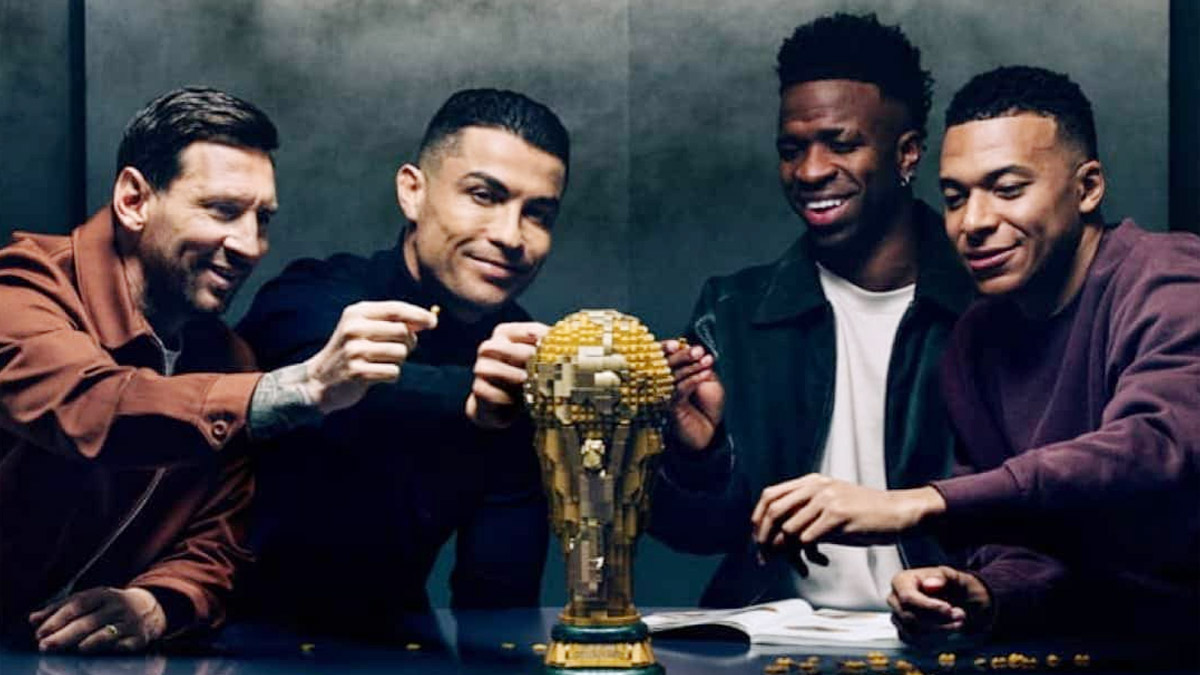
MUMBAI: Four legends, one frame and not a single tackle in sight. Lego has pulled off a crossover few thought possible, uniting Lionel Messi, Cristiano Ronaldo, Kylian Mbappé and Vinícius Júnior in a single campaign ahead of the FIFA World Cup 2026 only this time, they’re building dreams brick by brick.
Titled “Everyone wants a piece”, the campaign features the quartet assembling a Lego version of the World Cup trophy, before placing miniature versions of themselves atop it, a playful nod to football’s ultimate prize. Shared widely across social media, the ad carries a pointed disclaimer: it is not AI-generated, a subtle but telling signal in an era where even reality is often questioned.
The numbers tell their own story. The campaign has already crossed 314 million views on Instagram across the players’ accounts, with fans hailing it as a rare, almost nostalgic moment particularly for the reunion of Messi and Ronaldo, whose last shared campaign ahead of the 2022 World Cup became one of the platform’s most-liked posts.
Beyond the film, Lego is extending the play with exclusive, player-themed sets tied to each of the four stars, part of a broader football-led programme designed to ride the global momentum building towards 2026. The idea, as echoed by the players themselves, leans into the parallels between football and play experimentation, creativity, failure, and triumph.
Messi described the sets as a way to bring on-pitch moments into an imaginative, hands-on world, while Ronaldo called the transformation into a Lego figure a rare honour, blending sport with storytelling. Vinícius, meanwhile, struck a more personal note, recalling childhood moments of building with Lego and framing creativity as a universal language that transcends borders.
The timing is no accident. With the 2026 World Cup set to run from June 11 to July 19 across the United States, Canada and Mexico, and featuring an expanded 48-team format, global anticipation is already building. Argentina, led by Messi, will enter as defending champions, adding another layer of intrigue.
For Lego, the campaign does more than celebrate football, it taps into its mythology. Because when icons become figurines and rivalries turn into play, the beautiful game finds a new kind of pitch. one built, quite literally, by hand.






