MAM
Consumers prefer entertainment marketing versus traditional forms: survey


MUMBAI: A longitudinal survey conducted by Hollywood Branded Inc. to measure brand, agency and consumer perception of tactics used in entertainment marketing campaigns, and the effectiveness of entertainment marketing as a form of advertising, showcases that 51 per cent of consumers purchase products after the brand is featured in TV or film product placement, and 43 per cent purchase after exposure to celebrity endorsement campaigns. Over 1,300 individuals responded to the 48 question survey, and the data provides insight into the most effective entertainment marketing tactics currently in use.
Significant survey findings included:
72 per cent of brands and agencies use entertainment marketing in their current marketing mix, whereas 52 per cent of marketers say that TV is the most utilized platform, followed by digital. Film is used by 29 per cent of marketers, celebrities by 23 per cent, music by 20 per cent and gaming by 11 per cent. Meanwhile, as per the survey 85 per cent of marketers state that entertainment marketing works to boost sales. Almost 98 per cent of consumers report noticing product placement in television and film and 80 per cent of consumers favour product placement and see it as a form of ‘organic’ marketing.
51 per cent of consumers make cognizant decisions to purchase after seeing product in a TV show or feature film. Whereas celebrity influences 43 per cent of consumers.
“The majority of consumer respondents indicate receptiveness to entertainment marketing, and express a preference for this form of advertising over traditional advertising as long as it is kept organic and natural in approach,” explains Hollywood Branded Inc CEO Stacy Jones.
Additional findings of the survey signify that social media engagement is the preferred measurement by marketers of campaign success. The majority of agencies measure return on investment based upon digital analytics and conversion rates, followed to a lesser extent by estimated impressions. As to future implementation, marketers state that entertainment marketing budgets will increase in 2015 more than any other area of marketing, based on past success of the tactics.
Entertainment marketing has become a commonplace practice used for brand advertising, with reported consumer and marketer data demonstrating positive influence on consumer sales.
Within the survey, consumer majority state receptiveness to the practice, when kept organic and natural in approach. Consumer response also indicates a preference for entertainment marketing versus traditional forms of advertising as it shows product usage in a natural setting.
The survey results support entertainment marketing as an effective marketing tactic for brand marketers to influence consumer sales.



MAM
Lego brings Messi, Ronaldo, Mbappé, Vinicius together
Campaign clocks 314 million views ahead of FIFA World Cup 2026 buzz.
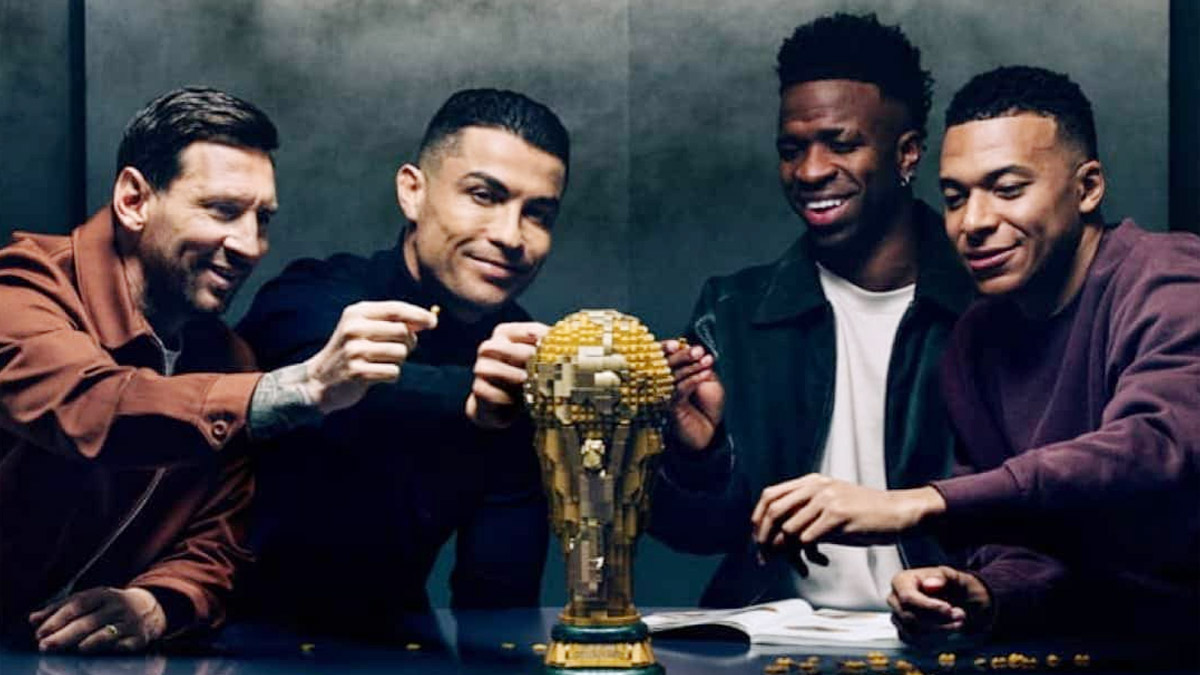
MUMBAI: Four legends, one frame and not a single tackle in sight. Lego has pulled off a crossover few thought possible, uniting Lionel Messi, Cristiano Ronaldo, Kylian Mbappé and Vinícius Júnior in a single campaign ahead of the FIFA World Cup 2026 only this time, they’re building dreams brick by brick.
Titled “Everyone wants a piece”, the campaign features the quartet assembling a Lego version of the World Cup trophy, before placing miniature versions of themselves atop it, a playful nod to football’s ultimate prize. Shared widely across social media, the ad carries a pointed disclaimer: it is not AI-generated, a subtle but telling signal in an era where even reality is often questioned.
The numbers tell their own story. The campaign has already crossed 314 million views on Instagram across the players’ accounts, with fans hailing it as a rare, almost nostalgic moment particularly for the reunion of Messi and Ronaldo, whose last shared campaign ahead of the 2022 World Cup became one of the platform’s most-liked posts.
Beyond the film, Lego is extending the play with exclusive, player-themed sets tied to each of the four stars, part of a broader football-led programme designed to ride the global momentum building towards 2026. The idea, as echoed by the players themselves, leans into the parallels between football and play experimentation, creativity, failure, and triumph.
Messi described the sets as a way to bring on-pitch moments into an imaginative, hands-on world, while Ronaldo called the transformation into a Lego figure a rare honour, blending sport with storytelling. Vinícius, meanwhile, struck a more personal note, recalling childhood moments of building with Lego and framing creativity as a universal language that transcends borders.
The timing is no accident. With the 2026 World Cup set to run from June 11 to July 19 across the United States, Canada and Mexico, and featuring an expanded 48-team format, global anticipation is already building. Argentina, led by Messi, will enter as defending champions, adding another layer of intrigue.
For Lego, the campaign does more than celebrate football, it taps into its mythology. Because when icons become figurines and rivalries turn into play, the beautiful game finds a new kind of pitch. one built, quite literally, by hand.






