Digital
“Clients can expect a seamless and intuitive experience when using AGenC’s platform”: Rishabh & Shruti

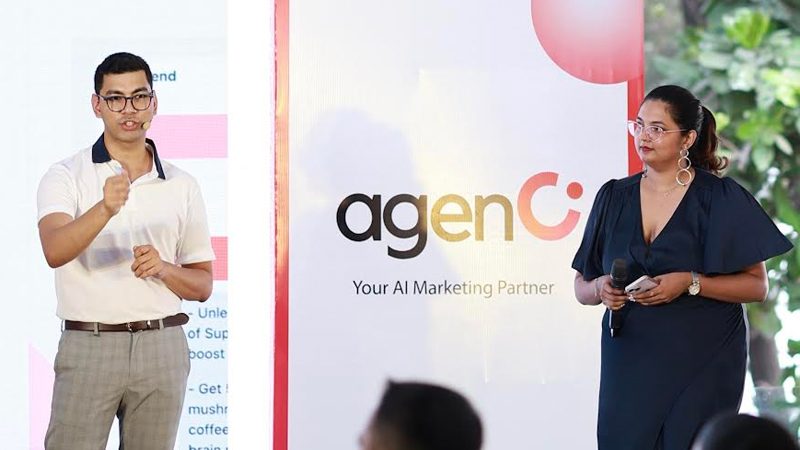
Mumbai: AGenC made its much anticipated debut on 6 April, marking a dawn of transformative content creation and management. Operating on a monthly subscription basis, AGenC’s pioneering platform grants subscribers access to a treasure trove of features and assets. Clients can unleash their imagination by generating up to 30 ideas monthly, with the flexibility to tailor settings with each renewal. Moreover, for those seeking extra campaign creation support, AGenC’s unique token system offers on-demand access to supplementary idea generation.
The agency promises a seamless and intuitive journey for clients, empowering them to unlock their creative prowess and achieve unparalleled success in their marketing endeavors. Whether crafting compelling ad campaigns, devising captivating social media content, or generating engaging blog posts, AGenC emerges as the quintessential AI marketing partner, propelling businesses toward new realms of innovation and prosperity.
Indiantelevision.com caught up with the co-founders Rishabh Kapoor & Shruti Mohan, who offered deeper insights into their agency.

Edited excerpts
On the significance of AGenC’s official launch on 6 April in the realm of content creation and management
AGenC’s official launch on 6 April signifies a new era in content creation and management, with the introduction of a cutting-edge AI-powered marketing partner. This launch brings about a transformative shift in the industry by providing unparalleled speed, efficiency, and creativity to clients. With the introduction of AGenC, the focus shifts from scaling and execution activities to unleashing human creativity, while AI handles the scaling and optimization aspects.
On leveraging advanced AI and Machine Learning technologies to benefit its clients
AGenC harnesses advanced AI and Machine Learning to revolutionize creativity in marketing. By marrying AI technology with human ingenuity, it empowers businesses to focus on crafting compelling narratives while AI handles campaign execution, scaling, and optimization.
Operating on a flexible monthly subscription model, AGenC offers clients access to a plethora of features. Subscribers can unleash their creativity with up to 30 ideas per month and adjust settings to meet evolving needs. With a unique token system, AGenC provides on-demand idea generation for additional campaign creation. This flexibility allows clients to scale marketing efforts as required.
AgenC enables users to unlock their creative potential and go bigger with their idea and drive success across multiple touch points. AGenC ensures consistent brand tonality while speaking to diverse audiences in a personalized, localised and relevant manner.
In its initial rollout, Phase 1 of AGenC introduces a comprehensive approach to content communication for all platforms providing text support across various domains. With AI precision, AGenC enables brands to effectively engage with a multitude of audiences, adjusting messaging to suit demographics, locations, and consumer behaviors. Overall, AGenC facilitates personalized and contextually relevant brand communication, fostering meaningful connections with audiences on a more intimate level which is the absolute need of the hour. Blanket targeting is ineffective and ends up burning a hole in our pockets with skyrocketing ad spends with outputs that aren’t justified.
On the subscription model offered by AGenC, and what features does it grant to subscribers
AGenC functions under a monthly subscription framework, offering clients an array of features and resources. Subscribers have the capacity to create up to 30 ideas monthly. This subscription model provides adaptability, permitting clients to modify settings with each renewal to align with their changing requirements and goals.
There are 3 subscription packages with pricing ranging between 50k to 1.5L per month. Clients can choose a subscription tier based on their needs, with each tier allowing the onboarding of a minimum of 5 brands under one subscription account. This structure provides flexibility and scalability to accommodate diverse client requirements.
Can you explain how AGenC’s token system works for clients requiring extra campaign creation
AGenC empowers marketers to amplify and enhance their ideas by relieving the challenges of execution. By entrusting AI with the tasks of scaling and optimization, marketers can dedicate their efforts to developing captivating narratives and innovative strategies. Additionally, AGenC mitigates creative exhaustion by simplifying the coordination of various platforms and their unique touchpoints, enabling marketers to uphold uniformity and significance across channels.
On the kind of experience clients can expect when using your platform
Clients can expect a seamless and intuitive experience when using AGenC’s platform, AGenC empowers marketers to focus on making ideas bigger and more creative by taking away the burden of execution hassles. The platform enables clients to achieve scale and maintain flawless consistency across multiple touchpoints and platforms, ensuring that their brand universe is maintained while speaking to different target audiences in a personalized and contextually relevant manner. With AI handling scaling and optimization, marketers can devote their energy to crafting compelling narratives and strategies. Moreover, AGenC helps prevent creative fatigue by streamlining the management of content execution across multiple platforms and their distinguished touchpoints, allowing marketers to maintain consistency and relevancy across channels. Your 2 monthly long efforts of ideating, curating and executing a campaign will be done in mere minutes with AGenC.
On Phase 1 of AGenC launch cover within its ecosystem
In its initial rollout, Phase 1 of AGenC introduces a comprehensive approach to content communication for all platforms providing text support across various domains. With AI precision, AGenC enables brands to effectively engage with a multitude of audiences, adjusting messaging to suit demographics, locations, and consumer behaviors. Overall, AGenC facilitates personalized and contextually relevant brand communication, fostering meaningful connections with audiences on a more intimate level.
On enabling brands to speak to different target audiences in a personalized and contextually relevant manner
Marketing communication has been broken down into mathematical formulas to foster personalized and localized communication, AGenC’s Choice & Input model allows clients to tailor communications to specific brand needs. This model enables users to choose touchpoints, define target groups, outline brand verticals, and set communication objectives, ensuring a tailored approach to content creation.

Digital
The creative cull: how AI is coming for the marketers, ad men and researchers
Robots aren’t taking over yet, but the writing may already be on the wall for some of the US’ most glamorous white-collar jobs.

CALIFORNIA: The robots are not, it turns out, storming the factory floor. They are sitting quietly at a MacBook in a Soho agency, rewriting your copy, summarising your focus groups and generating your mood boards, and nobody has been sacked. Yet.
A new report from Anthropic, the AI company behind the Claude chatbot, offers the most rigorous look to date at what artificial intelligence is actually doing to jobs, as opposed to what doomsayers and boosters claim it might. The verdict from economists Maxim Massenkoff and Peter McCrory is nuanced but pointed: there is no mass unemployment so far, but some sectors have good reason to be nervous. Marketing, market research and the arts are squarely in the crosshairs.

The researchers introduce a new measure called “observed exposure.” It goes beyond theoretical speculation about what AI could do and instead tracks what it is already doing, drawing on real Claude usage data. The approach is clever. They weight automated uses, where the machine performs the job entirely, more heavily than augmentative ones, where it merely assists. They then map this onto roughly 800 occupations, weighted by how much time workers actually spend on each task. For now the target user base has been the US market, but the findings offer a glimpse of what may be happening in other countries as well.
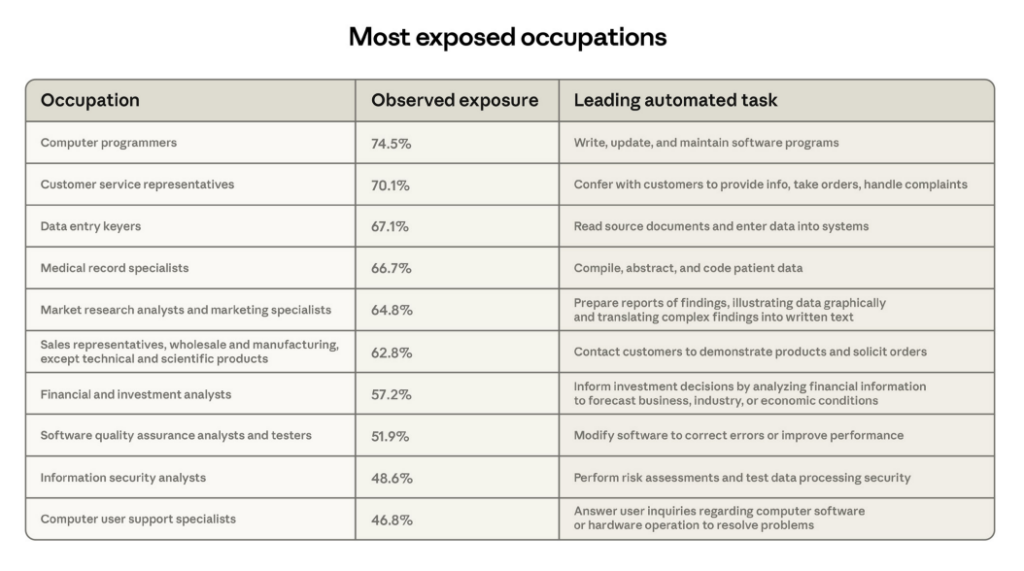
The results are sobering for the creative and analytical classes. Market research analysts and marketing specialists clock in at 64.8 per cent observed exposure, meaning nearly two-thirds of their daily tasks are already being performed, at least in part, by AI in professional settings. The leading automated task is preparing reports, illustrating data graphically and translating complex findings into written text. In other words, this is the kind of work junior analysts spend most of their days doing.
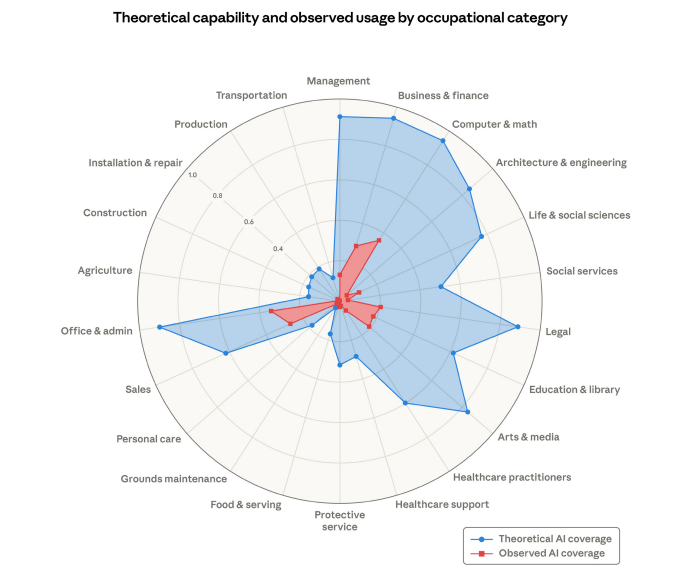
Arts and media fare little better. The sector shows meaningful theoretical exposure, as large language models can in principle handle the lion’s share of tasks, though observed usage still lags behind capability. The gap is narrowing, however, and the direction of travel is unambiguous.
Here is the sting in the tail. The workers most exposed to AI disruption are not, as popular mythology suggests, low-paid drudges. They are older, better educated, more likely to be women and considerably better paid, earning 47 per cent more per hour on average than their least-exposed counterparts. Graduate degree holders are nearly four times as prevalent in the high-exposure group. The creative professional, the senior analyst and the market researcher with an MBA are precisely the people who should be paying attention.
“We’re not talking about the checkout operator,” the paper implies. “We’re talking about the account planner.”
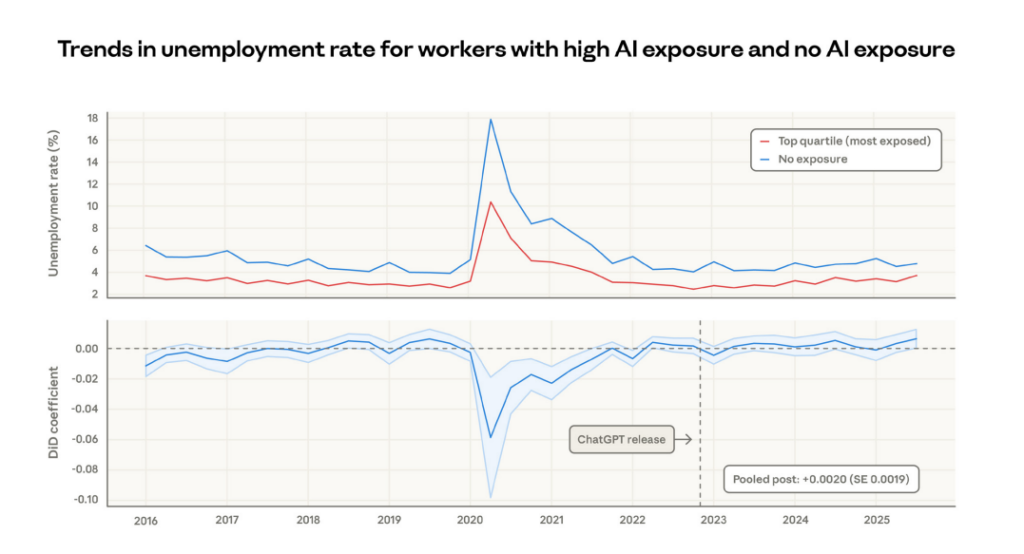
The most alarming signal in the data concerns not those already in jobs, but those trying to enter them. Among workers aged 22 to 25, hiring into highly exposed occupations has slowed measurably since the release of ChatGPT in late 2022. There has been a 14 per cent drop in the job-finding rate, a figure the authors describe as “just barely statistically significant.” Young people are, in effect, finding the door to exposed professions quietly closing. Whether they are staying in education, taking different jobs or simply giving up is not yet clear.
For a bright graduate eyeing a career in market research or media production, this is not merely an academic data point. It is a flashing amber light.
The paper is careful about what it does not find. Unemployment among highly exposed workers has not risen in any statistically meaningful way since the ChatGPT era began. The apocalypse has not arrived. Even in the Computer and Math category, the most theoretically exposed of all, Claude currently covers just 33 per cent of tasks in practice. The gap between what AI can do and what it actually does at scale in professional workflows remains vast.
Think of it less like a tsunami, the authors suggest, and more like a slowly rising tide. The internet did not destroy journalism overnight. It took 20 years and the collapse of a generation of classified advertising revenue. The China trade shock also took decades to fully register in unemployment statistics, and economists are still debating the numbers.
What does this mean for the luvvies, the admen and the pollsters? The honest answer is: not much yet, but watch this space. AI is already doing the grunt work, including data summaries, draft press releases and boilerplate creative briefs. The question is whether it stops there or continues climbing the value chain.
The authors are building a framework to track exactly that and promise to update it as new data arrives. If the tide does come in, they want to see it coming before the sandcastles are already gone.
For now, the creative industries can breathe, but perhaps not too deeply. The machine is not at the door. It is already at the desk.