MAM
China to overtake Germany as No. 3 ad economy; global ad spends recovering


MUMBAI: The rise of China as a powerhouse stretches to the advertising world as well. China will overtake Germany to become the third largest advertising economy in the world in 2011, behind the US and Japan.
While the global advertising market will continue to recover steadily over the next three years, China will outpace this growth to touch $34.24 billion in 2013, a 51 per cent growth over the next three years, according to a forecast by ZenithOptimedia.
China could soon beat Japan, a country hit by deflation and high public debt which will slow down ad growth to 5 per cent through 2013. The Chinese ad market, which is currently just over half the size of the Japanese market, will be three-quarters that of Japan in 2013, according to Zenith.

Meanwhile, Russia will enter the top ten list in 2012, outpacing Australia and Canada to take ninth place, and overtaking Italy to take the No. 8 spot in 2013.

The global ad market is on a rebound. The global ad spends will continue to recover steadily and by 2012 will surpass the 2008 levels, according to two new research studies published today.
Group M‘s forecast has predicted the $500 billion mark to be achieved “at some point in 2012”. According to the WPP-owned media buying agency network, the Internet will overtake newspapers as the second biggest global advertising medium behind TV.
ZenithOptimedia forecasts the overall ad market to grow between 4.6 per cent and 5.2 per cent annually for the next three years. Driven by the rapid growth of online video and social media, Internet advertising will lead the pack at 48 per cent growth. Outdoor advertising will grow by 18 per cent and TV and cinema 19 per cent each. Radio will lag behind with 10 per cent and newspapers and magazines will see a two per cent dip.
ZenithOptimedia global CEO Steve King said Internet advertising “will grow three times as fast as the rest of the market as a whole” and the “importance of the internet is underrepresented” in the figures.
According to Publicis‘s media buying agency network, this growth over the next three years will be sponsored by the developing markets – Asia Pacific will grow by 23 per cent and Latin America by 26 per cent.
“The key result of this update is the continued rise of developing markets and digital media, and their central role in driving global growth,” elaborated King.
“Advertisers are investing a lot more in owned and earned media, where their activities do not count as ad expenditure in the traditional sense,” adds King.





MAM
Lego brings Messi, Ronaldo, Mbappé, Vinicius together
Campaign clocks 314 million views ahead of FIFA World Cup 2026 buzz.
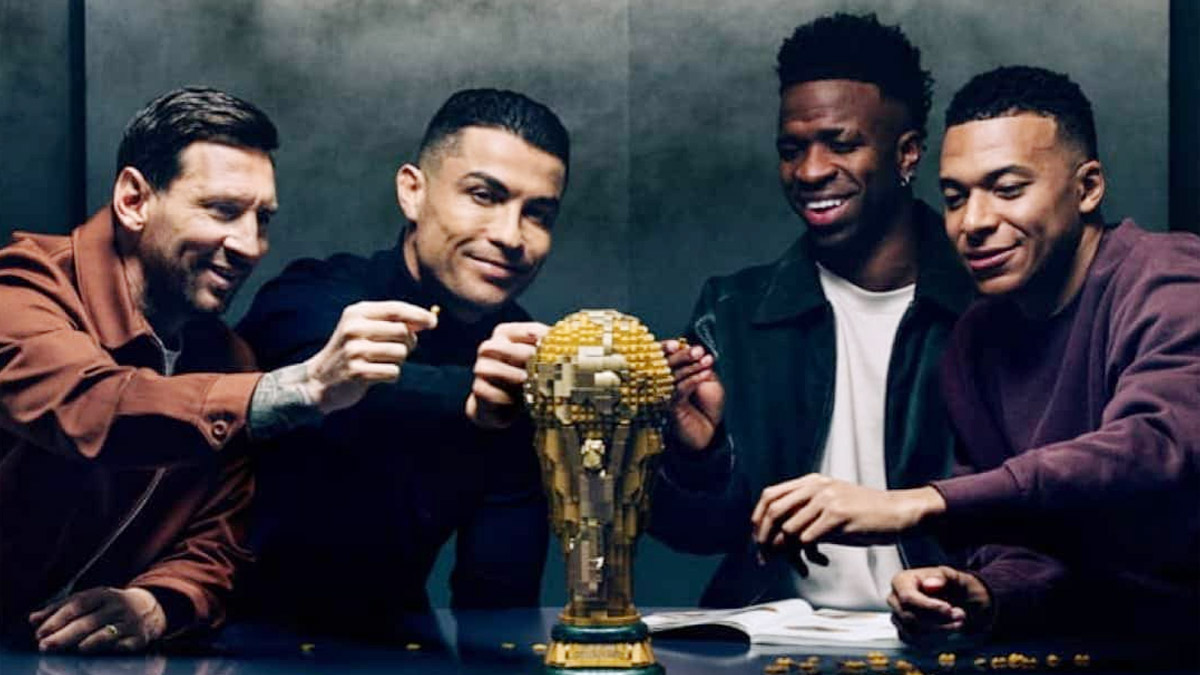
MUMBAI: Four legends, one frame and not a single tackle in sight. Lego has pulled off a crossover few thought possible, uniting Lionel Messi, Cristiano Ronaldo, Kylian Mbappé and Vinícius Júnior in a single campaign ahead of the FIFA World Cup 2026 only this time, they’re building dreams brick by brick.
Titled “Everyone wants a piece”, the campaign features the quartet assembling a Lego version of the World Cup trophy, before placing miniature versions of themselves atop it, a playful nod to football’s ultimate prize. Shared widely across social media, the ad carries a pointed disclaimer: it is not AI-generated, a subtle but telling signal in an era where even reality is often questioned.
The numbers tell their own story. The campaign has already crossed 314 million views on Instagram across the players’ accounts, with fans hailing it as a rare, almost nostalgic moment particularly for the reunion of Messi and Ronaldo, whose last shared campaign ahead of the 2022 World Cup became one of the platform’s most-liked posts.
Beyond the film, Lego is extending the play with exclusive, player-themed sets tied to each of the four stars, part of a broader football-led programme designed to ride the global momentum building towards 2026. The idea, as echoed by the players themselves, leans into the parallels between football and play experimentation, creativity, failure, and triumph.
Messi described the sets as a way to bring on-pitch moments into an imaginative, hands-on world, while Ronaldo called the transformation into a Lego figure a rare honour, blending sport with storytelling. Vinícius, meanwhile, struck a more personal note, recalling childhood moments of building with Lego and framing creativity as a universal language that transcends borders.
The timing is no accident. With the 2026 World Cup set to run from June 11 to July 19 across the United States, Canada and Mexico, and featuring an expanded 48-team format, global anticipation is already building. Argentina, led by Messi, will enter as defending champions, adding another layer of intrigue.
For Lego, the campaign does more than celebrate football, it taps into its mythology. Because when icons become figurines and rivalries turn into play, the beautiful game finds a new kind of pitch. one built, quite literally, by hand.






