MAM
Carat India onboards Aruni Panda as VP – digital


Mumbai: Carat India, from the house of dentsu India, has strengthened its leadership team for North and East. The agency has appointed Aruni Panda to lead these regions as vice president – digital.
In his new role, Panda will lead strategic thinking and oversee agency clients on the digital front, reporting into Carat India CEO Anita Kotwani. He will work closely with the office head of the regions – Carat India executive vice president – planning Dipika Bhasin.
Panda brings over 15 years of experience and is an ardent practitioner of ad-tech tools, programmatic media planning & buying, social media & content marketing, digital customer experiences management, customer acquisition and web analytics. Prior to this, he was with GTB (part of WPP’s network of companies) where he held the position of AVP and senior digital media director, handling digital media planning, buying and execution.

In his previous roles, Panda has been instrumental in helping brands and organisations develop digital marketing ecosystems by an outcome-led planning approach for the brand and the business. He has worked with brands like PepsiCo India and Ford India, to name a few across categories like FMCG, automotive, real estate, entertainment & sports, ISP & connectivity solutions, and IT-enabled executive education & training. Panda has re-positioned businesses as digital-first by setting up business-aligned digital ecosystems. He has also implemented and integrated seamless interplay between ad-tech and mar-tech stacks.
“With the changing dynamics of the media eco-system and a strong focus on digital across the clients of Carat, we felt it to be imperative to bring in a seasoned professional like Aruni to lead the digital mandate. His expertise across the full-funnel marketing will be an advantage that we would like to leverage across our existing and new client fold,” said Anita Kotwani, commenting on the appointment.
Dipika Bhasin added, “Aruni’s experience will charter current and new growth with our partners. He will hold a strong commitment to driving Carat’s digital practice and the integrated media offerings of dentsu India. We are extremely happy to have him as part of the team!”
“I am elated to embark upon this new journey with Carat India, an agency already known for its integrated approach backed by cutting-edge data tech and tools. It is critical to map, plan and build the right digital approach in this ever-evolving digital space for our clients to thrive into the future. I am looking forward to being a part of Carat’s growth story under Anita’s leadership and partnering with clients in their digital endeavour with the combination of media, data, commerce and technology,” commented Aruni Panda.





Brands
KKR sixes to power EV charger rollout under VIDA campaign
Cricket meets clean mobility as big hits spark India’s charging growth
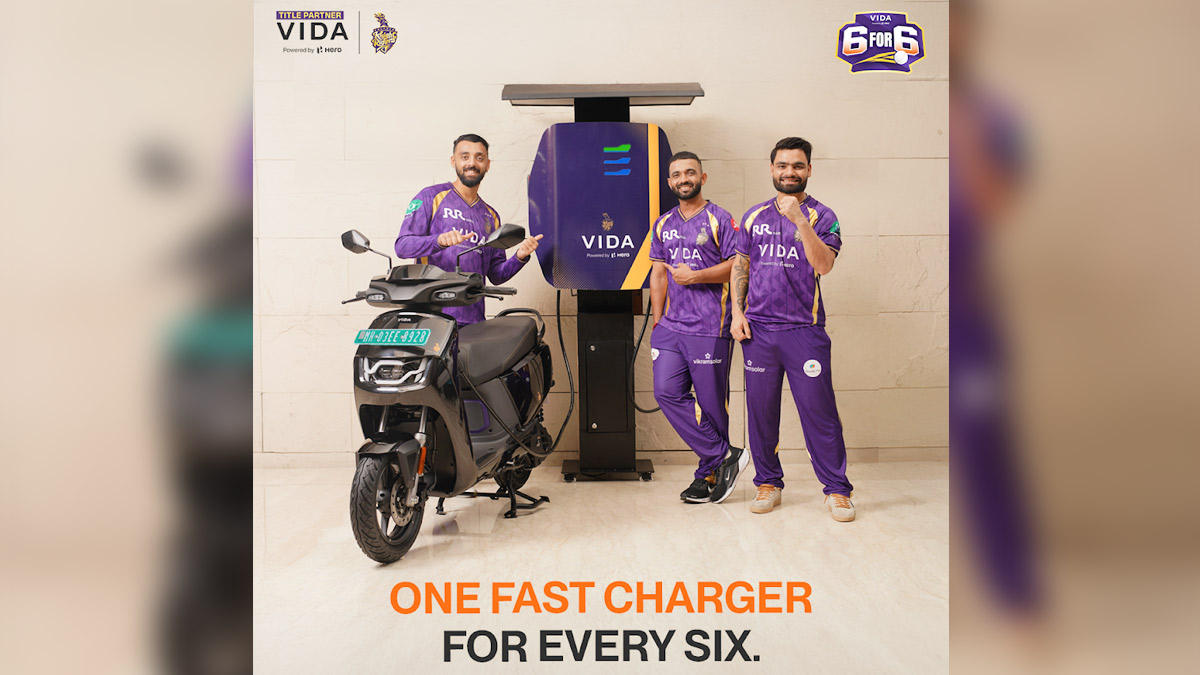
NEW DELHI: VIDA, the electric mobility arm of Hero MotoCorp, has teamed up with Kolkata Knight Riders to launch a campaign that turns cricketing flair into real-world impact.
Titled ‘6 for 6’, the initiative promises to install a 6kW fast EV charger for every six hit by KKR during the ongoing Indian Premier League season. The idea is simple but powerful, as each big hit on the field contributes directly to expanding India’s fast-charging infrastructure.
The campaign builds on VIDA’s growing network, which already spans over 5,300 fast-charging points across more than 430 cities. With EV adoption gaining pace, the brand is using cricket’s mass appeal to accelerate both awareness and infrastructure growth.
Explaining the thinking behind the move, Hero MotoCorp emerging mobility business unit chief business officer Kausalya Nandakumar said, “Cricket has an incredible ability to unite and inspire millions across the country. With the ‘6 for 6’ campaign, we are turning every big hit on the field into a step towards a cleaner and a more accessible mobility future.”
She added that VIDA’s expanding fast-charging network and removable battery technology are designed to make EV ownership more convenient and practical for everyday users.
From the franchise’s side, the campaign is also about giving on-field moments a larger purpose. Kolkata Knight Riders chief executive officer Venky Mysore said, “The ‘6 for 6’ campaign exemplifies the potential of sport as a platform for meaningful, real-world impact. By linking every six to the expansion of EV charging infrastructure, this partnership transforms fan excitement into tangible progress.”
As part of the rollout, VIDA has introduced co-branded charging stations in KKR’s signature colours, with a flagship installation unveiled alongside team players. The chargers are designed for quick top-ups, powering VIDA scooters from zero to 80 percent in about an hour, while also being positioned along key highways to support longer journeys.
The initiative also taps into VIDA’s removable battery system, which allows users to charge using standard household plug points, adding flexibility to the charging ecosystem.
By blending the thrill of cricket with the urgency of clean mobility, VIDA and KKR have found a neat way to make every six count twice, once on the scoreboard and again on India’s road to an electric future.








