Brands
Brijendra Singh joins Emcure Pharmaceuticals as executive vice-president


MUMBAI: Emcure Pharmaceuticals has appointed Brijendra Singh as executive vice-president, roping in one of the industry’s most seasoned commercial leaders as it sharpens its focus on scale, launches and market expansion.
Singh brings more than 40 years of experience across pharmaceutical sales, product launches and market strategy, with a career built on taking therapies from pipeline to patients at scale. He joins Emcure after a long stint at Lupin, where he most recently served as vertical head and senior vice-president for sales and marketing across cardiology, diabetes, metabolic and ophthalmology portfolios.
At Lupin, Singh led teams of more than 1,000 professionals and managed a business worth over Rs 800 crore. He played a central role in launching and scaling the company’s diabetes care division, now ranked No. 1 in sales at Lupin and among the top three therapy areas in the Indian pharmaceutical market.

Singh’s career spans every rung of the sales ladder, from medical sales representative to national and regional leadership roles, giving him a rare ground-up understanding of execution in India’s complex pharma markets.
As Emcure looks to accelerate growth across chronic and speciality therapies, Singh’s appointment signals a renewed push for scale, speed and on-ground excellence.






Brands
Google secures AP discom licence to power $15bn Vizag AI hub
First-of-its-kind move gives tech giant grid control for massive 1GW campus
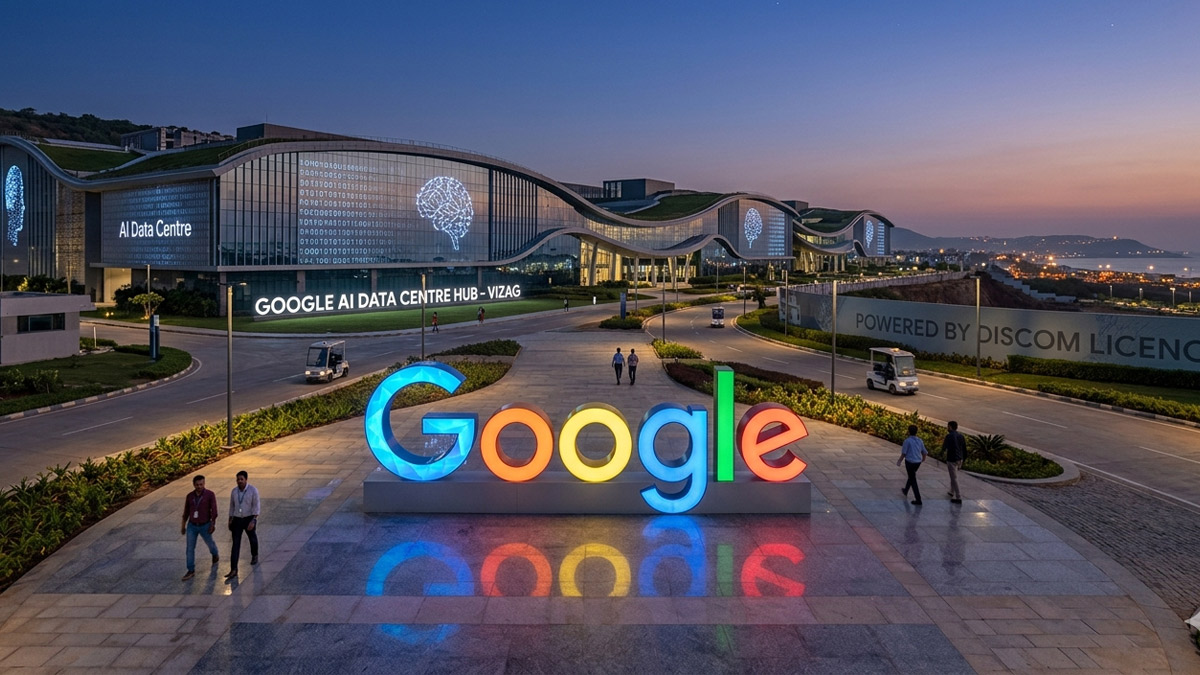
VISAKHAPATNAM: Google has secured a rare electricity distribution company licence in Andhra Pradesh, marking a decisive shift from being just a power consumer to becoming a power distributor for its upcoming mega data centre hub in Visakhapatnam.
The move effectively rewrites the rulebook for hyperscalers in India. Instead of relying on state utilities, Google will be able to procure electricity directly from generators, including its own renewable sources. This not only cuts out intermediaries but also gives the company tighter control over supply, reliability and long-term costs.
For a business where electricity can account for up to 60 per cent of operating expenses, the economics are hard to ignore. Even more critical is uptime. Data centres demand near-perfect reliability, and owning the distribution layer allows Google to manage outages and load balancing with far greater precision.
At the heart of the plan is a sprawling 1-gigawatt data centre ecosystem spread across more than 600 acres in three locations near Vizag. With an estimated investment of $15 billion over five years, the project is set to become India’s largest single foreign direct investment and Google’s biggest AI-focused facility outside the United States.
The campus is being designed with artificial intelligence workloads in mind, housing the company’s custom tensor processing units to power services such as Gemini, Search and Google Cloud. In scale, the planned capacity is comparable to powering a small city.
Google is not building alone. It has partnered with Adani Infrastructure to develop the physical campuses, while Bharti Airtel will set up an international subsea cable landing station. This connectivity backbone is expected to link the hub directly to a dozen countries, ensuring low latency for global data traffic.
Vizag’s coastal location plays a key role in that strategy. It enables direct access to subsea cables and provides the large volumes of water needed for cooling data centre operations. Equally important is policy backing from the Government of Andhra Pradesh, which fast-tracked approvals and granted the uncommon discom licence to anchor the investment.
Groundbreaking is scheduled for April 28, 2026, with phased commissioning expected to begin by July 2028.
The broader signal is clear. As AI workloads surge, hyperscalers are no longer content plugging into existing infrastructure. They are beginning to build and control it. In Vizag, Google is not just setting up a data centre, it is wiring up its own future.







