MAM
Bridging the urban-rural gap


MUMBAI: It was in the early 90s that India opened up to trade and investment with the rest of the world and ever since there has been no looking back.
Liberalisation has upped the purchasing power and standard of living of the middle class but it has also deepened the urban-rural divide, what with marketers focusing more on major towns and metros as compared to rural areas in the country.

Initiatives such as HUL’s Project Shakti – which aims to create livelihood for underprivileged women in villages – have been very few and far between.
Speaking of similar such endeavours at the Rural Marketing Forum were the likes of Avinash Oza, Ashish Tandon, Ravi Shankar, Rajendra Dhandhukia, Sanjeev Goyle, Sharad Varshney, Taranbir Singh, Vinay Thakker and Veerendra Jamdade.
Part of the three-day Asia Retail Congress – a global platform to promote world-class retail practices – the forum saw discussions titled Agriculture Sector – Challenges & Opportunities, Is it possible to decode Rural Consumer Behaviour and Bus Stations – New Hub for Rural Marketing among others.
According to Fullerton India Credit Company marketing and rural business head Ravi Shankar, government-introduced welfare schemes such as NREGA come with their fair share of challenges. “We have to educate people, especially youngsters who don’t want to follow their parents into farming that there are a lot more initiatives like dairy farming, poultry farming etc. that they can indulge in and earn well without leaving their villages or smaller cities,” he said.
ING Vysya Bank business head for agriculture and rural banking Taranbir Singh gave the example of what Nestle did to Moga in Punjab. “The city is a perfect example of how corporates can transform lives and hopefully, more corporates will help change rural India by starting more branches, manufacturing units etc,” he said.
JCB India rural GM and head Puneet Vidyarathi was of the view that citizens as a whole, need to start contributing to agriculture and work on challenges including increasing land banks, managing water resources and building on infrastructure.
A majority of the participants felt that regional players would gain apart from the people in rural areas if the required importance was given to rural development by both government and corporates.
On the topic of how brands can reach out to rural areas, Vritti Solutions founder and director Veerendra Jamade suggested that instead of waiting for melas, schools and pilgrims to reach out to rural consumers, bus stations should be utilised for the purpose. “Melas, schools, etc. have their own limitations whereas bus stations, if used to our advantage, can optimise the presence of the brand in that area,” he said.
A key observation that emerged was: rural consumers follow a herd mentality and go by what their elders advise and hence, brands have a tough job convincing them about their products. However, mobile penetration seems to be changing that.
A related takeaway was that brands need to focus on different age groups in rural areas and target them accordingly.







Brands
KKR sixes to power EV charger rollout under VIDA campaign
Cricket meets clean mobility as big hits spark India’s charging growth
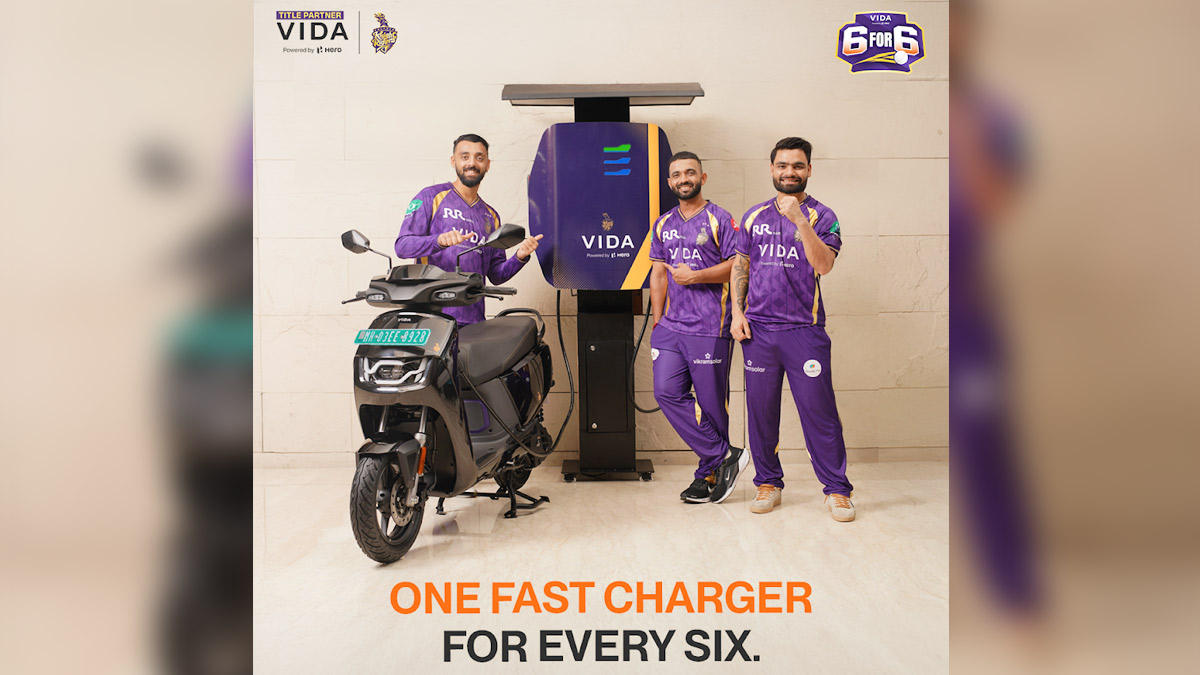
NEW DELHI: VIDA, the electric mobility arm of Hero MotoCorp, has teamed up with Kolkata Knight Riders to launch a campaign that turns cricketing flair into real-world impact.
Titled ‘6 for 6’, the initiative promises to install a 6kW fast EV charger for every six hit by KKR during the ongoing Indian Premier League season. The idea is simple but powerful, as each big hit on the field contributes directly to expanding India’s fast-charging infrastructure.
The campaign builds on VIDA’s growing network, which already spans over 5,300 fast-charging points across more than 430 cities. With EV adoption gaining pace, the brand is using cricket’s mass appeal to accelerate both awareness and infrastructure growth.
Explaining the thinking behind the move, Hero MotoCorp emerging mobility business unit chief business officer Kausalya Nandakumar said, “Cricket has an incredible ability to unite and inspire millions across the country. With the ‘6 for 6’ campaign, we are turning every big hit on the field into a step towards a cleaner and a more accessible mobility future.”
She added that VIDA’s expanding fast-charging network and removable battery technology are designed to make EV ownership more convenient and practical for everyday users.
From the franchise’s side, the campaign is also about giving on-field moments a larger purpose. Kolkata Knight Riders chief executive officer Venky Mysore said, “The ‘6 for 6’ campaign exemplifies the potential of sport as a platform for meaningful, real-world impact. By linking every six to the expansion of EV charging infrastructure, this partnership transforms fan excitement into tangible progress.”
As part of the rollout, VIDA has introduced co-branded charging stations in KKR’s signature colours, with a flagship installation unveiled alongside team players. The chargers are designed for quick top-ups, powering VIDA scooters from zero to 80 percent in about an hour, while also being positioned along key highways to support longer journeys.
The initiative also taps into VIDA’s removable battery system, which allows users to charge using standard household plug points, adding flexibility to the charging ecosystem.
By blending the thrill of cricket with the urgency of clean mobility, VIDA and KKR have found a neat way to make every six count twice, once on the scoreboard and again on India’s road to an electric future.








