Brands
Beauty for all: Unilever says no to ‘normal’

NEW DELHI: Pop queen Rihanna's Fenty Beauty shook up the beauty space in 2017 when it came out with 40 different shades of foundations that catered to a rainbow of skin tones, finding immediate favour with deep-skinned beauties. Fenty sparked an epochal shift in the beauty industry, with make-up brands waking up to the idea of inclusivity and smashing stereotypical beauty standards. More recently, the impact of the Black Lives Matter movement has been such that it sparked introspection among beauty brands in India, leading to several cosmetic manufacturers attempting to be more inclusive and diversity-friendly in terms of their products and marketing.
The latest is Dove soap maker Unilever, which has taken the call to remove the word "normal" from its beauty and personal care products, as well as stop digital alterations of body shapes and skin colour of models used in its advertising in a drive to be more inclusive.
The move from the multinational consumer goods giant, which is one of the top advertisers in the world, comes as it tries to move beyond the backlash it has faced in recent times for some of its advertising campaigns.

Just last year, Unilever deigned to drop the word “fair” from its Fair & Lovely skin lightening products in India in the face of rising consumer ire over its negative stereotyping of darker skin tones’ instead renaming its top selling skin-lightening brand to "Glow & Lovely".
While in 2017, the company faced a social media outcry over an advert for Dove body wash which showed a black woman removing her top to reveal a white woman. The ad was dropped after it was accused of racism. The company had then apologised stating that the ad “was intended to convey that Dove Body Wash is for every woman and be a celebration of diversity, but we got it wrong”.
In another instance, an ad for its TRESemmé haircare forced Unilever to pull all its TRESemme products from South African retail stores for 10 days due to backlash. It described images of African black hair as "frizzy and dull," and "dry and damaged" while a white woman's hair was referred to as "normal", a case of tone-deaf advertising in a racially diverse country, which predictably resulted in furore on social media, and even public protests.
"We know that removing 'normal' alone will not fix the problem, but we believe it is an important step towards a more inclusive definition of beauty," Unilever beauty and personal care president Sunny Jain told Reuters.
Unilever plans to roll out this policy worldwide and in India, which will take a year to implement. Globally, more than a hundred Unilever brands will have the word "normal" removed to describe skin type or hair texture, and replaced with terms such as "grey hair" for shampoos or "moisture replenish" for skin creams by March next year.
Unilever said a poll it conducted of about 10,000 people globally showed that more than half the respondents felt using "normal" to describe hair or skin made people feel excluded, while 70 per cent said using the word in advertising had a negative impact.
"Who is to decide what is normal? Is curly hair normal? Or dry skin normal?" Indian subsidiary of Unilever, HUL executive director beauty & personal care Priya Nair said as quoted by The Economic Times. The company also plans to raise the number of advertisements portraying people from diverse groups who are under-represented, the report said.
The company also said it would stop digitally altering body shape, size, proportion and skin tones of models it uses in its own advertisements, or those of its paid influencers across all its brands, a move that started with the Dove brand in 2018.
Whether Unilever’s push for inclusivity and diversity is merely cosmetic tokenism in response to social ‘wokeness’ or a sign of more positive things to come, only time will tell.




Brands
Lotus Herbals unveils HydroActivated sunscreen with high-impact campaign
Harnaaz Sandhu fronts digital push spotlighting breakthrough sun care tech
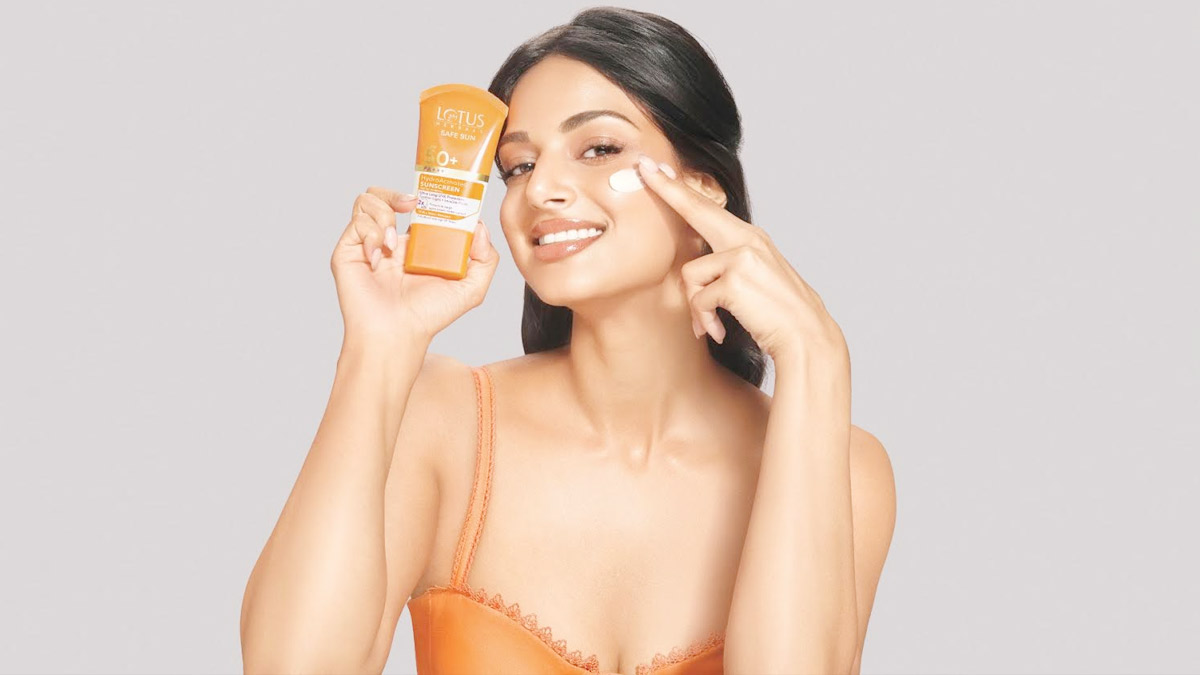
MUMBAI: Lotus Herbals has rolled out a high-decibel marketing campaign to introduce what it calls India’s first hydro-activated sunscreen, aiming to reshape how consumers think about sun protection.
At the centre of the launch is the Safe Sun HydroActivated Sunscreen SPF 50+ PA+++, a formulation built on a patent-pending Hydrosome Technology that activates on contact with moisture. Unlike conventional sunscreens that can weaken with sweat, this product is designed to do the opposite, boosting protection when the skin is exposed to water or perspiration.
The campaign is led by Harnaaz Sandhu and is being amplified across OTT platforms, social media and outdoor locations in key metro cities. The brand film takes a light, relatable approach to everyday sunscreen struggles such as uneven application and fading protection, while positioning the new product as a reliable, high-performance alternative for active lifestyles.
Beyond its core technology, the sunscreen features next-generation UV filters and Edelweiss Flower Extract, offering hydration alongside protection. The formula claims up to 10 hours of water resistance and even, all-round defence against sun exposure and tanning, targeting consumers who want both skincare and performance in one product.
Speaking about the launch, Lotus Herbals chairman and managing director Nitin Passi said, “We are excited to launch India’s first sunscreen with hydroactivated technology which is our most innovative product launch. This isn’t just a sunscreen; it’s a technological breakthrough that utilises a novel manufacturing process. We’ve created a product that stays invisible on the skin yet becomes a performance powerhouse when the user is most active.”
Sharing her experience, Lotus Herbals brand ambassador Harnaaz Sandhu said, “I am thrilled to be associated with Lotus Herbals Safe Sun for their new sun protection campaign. In my world, there is no room for shortcuts, and I need functional and reliable products that work as hard as I do. The hydroactivated sunscreen is a game-changer because it blends with my skin and protects me better when I’m pushing my limits.”
The campaign is being distributed across platforms including JioStar connected TV integrations and ZEE5, along with television placements such as Sa Re Ga Ma Pa in West Bengal. A large influencer push involving over a thousand creators, along with in-store branding and retail activations, is also part of the rollout.
With a blend of science-led positioning and mass-market storytelling, Lotus Herbals is betting on innovation to stand out in the crowded sun care segment, hoping its moisture-powered promise strikes the right chord with today’s always-on consumers.






