MAM
Be prepared to tackle new trends: Marketers tell TV industry

MUMBAI: It is the age of Digital Video Recorders (DVR) like Tivo, which helps to skip ads and how the industry is going to tackle such challenges powered by technology? What happens when creative professionals turn self-indulgent and forget the basic purpose of call-for-sale when they do ads? Would niche channels and Direct-to-Home (DTH) phenomenon contribute significantly to TV’s brand building power? Does weak television content deter the growth? Where would India’s TV advertising stand from two years down the line?
These were some of the issues came up during a panel discussion on “The Power of Television: Television Advertising Helps Build Robust Brands” conducted on the first day of the India Brand Summit. The enlightening and at times whacky discussion, hosted by Star TV at the end of the day, was lead by elite panel comprising Mindshare managing director Vikram Sakhuja, Air Deccan managing director Capt. G R Gopinath, Starcom Worldwide managing director Ravi Kiran, Madison Media Group CEO Punitha Arumugham, Ambience Publicis national creative director Pushpinder Singh, Mattel Toys Pvt Ltd V-P marketing Nanette Dsa, DAKS London country head Reetika Dalal, Reliance Infocomm marketing and branding head Sanjay Behl, Indiantelevision Dot Com founder and CEO Anil Wanvari making many vital and valid points on the future of television advertising in India. The discussion was moderated by former Kelvinator CEO Rajeev Karwal.
Opening the session, Ambience Publicis’ Singh spoke about the important role played by television in the success of ad campaigns like Close Up and Amaron. “TV as a medium played a crucial role in the success of those campaigns. Audacity is the way out to make look any ad different and television serves that purpose,” said Singh. Taking part on the debate about the purpose of a creative, Singh said the purpose of an ad is to generate favorable top-of-mind recall. He also expressed his concern on the lack of interaction between creative agency and media agency while conceptualising an ad. “To a lot of ads, it is the power of the medium that is working, not the message,” he concluded.
Behl pointed out that the scope for convergence on television media with the advent of mobile phones was huge. “We will move from static TV to interactive TV,” he said. He asked the advertisers to re-evaluate the medium as it is beckoning innovations like pause function (where you can pause a live content like cricket telecast) and then vital technologies like DVR. Forecasting a significant change in the media-eco system, Behl asked television channels to bring drastic improvement in the quality of the content. “We feel run out of quality content. In the era of interactive TV media, good content is what matters and not the owner,” he said.
Behl also made futuristic observations on various innovations that would enter the scenario within two years. He listed out novel ideas such as Narrowcast Advertising to specific target group (TG), Dynamic Advertising (Placing an air conditioner ad at the instant it is shown that temperature is rising in a particular city, withdrawing an ad — which was originally placed for a cricket match telecast — when a favourite player is dismissed) and Interactive Advertising (where a certain character in a sitcom is ordering for a pizza and a pizza ad with a helpline number comes as a pop-up).

Wanvari stressed on the significance of in-TV ads and in-programme placements as they would play a key role in checking the onslaught of technology innovations such as DVR. “Media planners and ad sales guys can get together and work towards more such innovations. TV ad is entertaining in the current stage and hence it holds an audience. But the future of TV is changing, especially with the invention of mobile TV. It is important to come up with innovative ways of playing your product or ads.” Wanvari named gameshows Indian Idol and Kaun Banega Crorepati as case studies of successful brand integration. He pointed out that the entry of niche channels and DTH would soon open up an interesting scenario for advertisers and planners.
Arumugham spoke about the crucial role played by TV in the birth of successful Indian brands such as Ujala, Ghadi, Air Deccan and All Out. However, she suggested that TV was losing significance as an ad vehicle due to market fragmentation. “TV is not hungry enough for advertiser’s business. TV is not a creator, sorry to say,” Arumugham said. Speaking about the importance of TG-driven advertising, she said we needed to target consumers instead of audiences.
Taking part in the discussion, Mindshare’s Sakhuja called for immediate actions to reverse the trend of fewer ads spend on TV. “Ads are increasingly losing the call-to-action quality. Creatives must sell. Activation must marry advertising. To change the possibility of TV ending up on the losing side, unique content programming should happen,” he said.
Air Deccan’s G R Gopinath spoke about the wonders TV as a medium has done to the Air Deccan promotions. He explained the successful strategy that Air Deccan adopted to release their first ever ad on TV. “We were not embarrassed about our brand going to TV. We marketed the Air Deccan commercial as a feature film. We spend around Rs 60 million to promote the ad film in the first five days after releasing it. Our successful experimented has proved that TV can be a very powerful medium for an advertiser who is targeting the lower middle class section of the society. The ad helped to break the socio-cast barriers for flying through TV,” he said.
Diverting the discussion to a less-trodden path, Starcom’s Kiran spoke on the insignificance of television as an ad medium to groom certain consumer brands in the market. He relied on the market success of certain B2B brands including technology products such as iPod to support his theory. Opining that the industry is over-glamourisng the role of advertising in brand building, Kiran asked the advertisers to use unconventional strategies including word-of-mouth as promotional tools. “We should understand the consumer first, brand then and only then the media,” he said excusing his media agnostic stance on the topic.
Speaking on the occasion, Reetika Dalal and Nanette Dsa explained the good things TV, as an ad medium, has done to their products. Dsa spoke about the power of TV in tackling the TG called kids. “Kids don’t read and TV is the most effective medium to reach out to them. The fact that, they can’t differentiate between commercial and product also serves the purpose,” she pointed out.

Brands
Jubilant FoodWorks faces Rs 47.5 crore GST demand, plans appeal
Tax authorities flag alleged misclassification of restaurant services
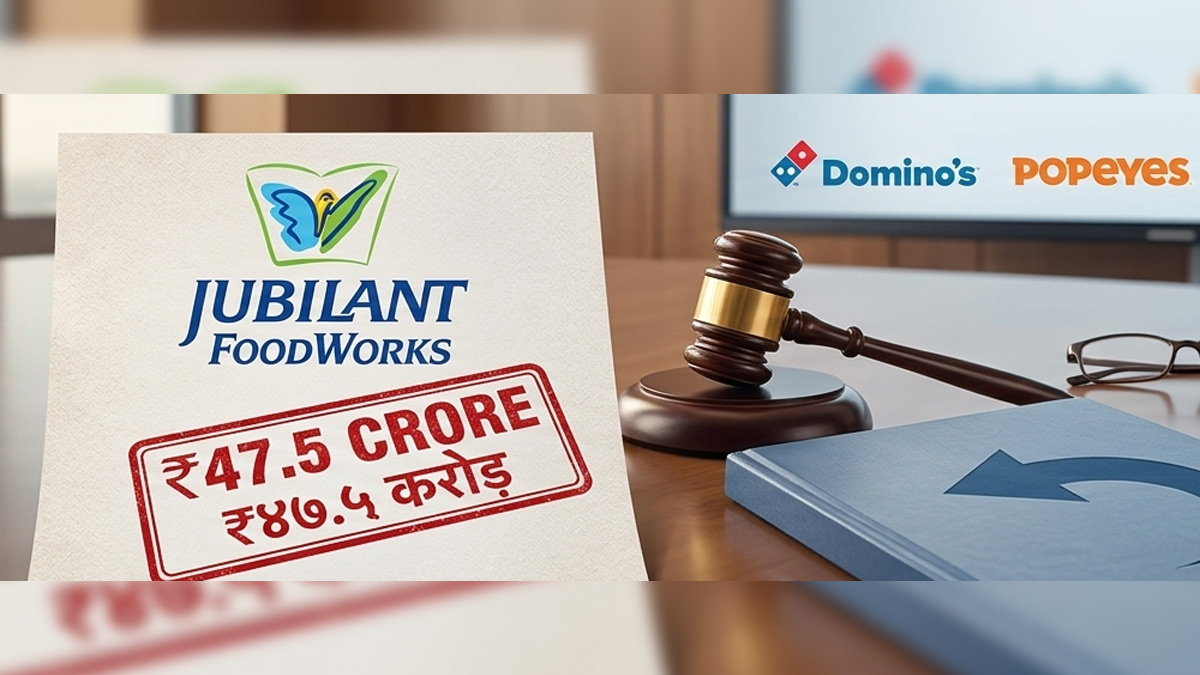
MUMBAI: Jubilant FoodWorks Limited has landed in a tax tussle after receiving a GST demand of Rs 47.5 crore from the office of the additional commissioner of CGST and central excise in Thane, Maharashtra.
The order, issued under the provisions of the Central Goods and Services Tax Act, 2017, relates to an alleged incorrect classification of certain services under the category of restaurant services. According to the tax authorities, this classification resulted in a short payment of goods and services tax for the period between the financial years 2019-20 and 2021-22.
The demand includes Rs 47.5 crore in GST along with an equal amount as penalty, in addition to applicable interest. The order was received by the company on March 13, 2026.
In a regulatory filing to the BSE Limited and the National Stock Exchange of India Limited, the company said it disagrees with the order and believes its arguments were not adequately considered.
The company is preparing to challenge the decision and plans to file an appeal. It added that once the redressal process is complete, the demand is likely to be dropped.
Despite the sizeable figure attached to the notice, the company said it does not expect any material impact on its financials, operations or other activities.
The disclosure was signed by Suman Hegde, EVP and chief financial officer, who confirmed that the company received the order at 19:06 IST on March 13 and has already initiated steps to contest it.
The development places the quick service restaurant major in the middle of a tax debate that could hinge on how certain restaurant-linked services are classified under GST rules. For now, the company appears ready to take the matter from the tax office to the appeals desk.