MAM
BARC starts process for new TV viewership measurement architecture

MUMBAI: The Broadcast Audience Research Council (BARC) on Thursday called for information on state-of-the art television audience measurement from players across the globe, in a first step towards creating India‘s own architecture for computing television viewership ratings.
 The BARC has issued a global Request for Information (RFI) to seek understanding of the state-of-the art in the area of television audience measurement research in particular and audience measurement research in more general terms.
In a statement, BARC says the RFI seeks ideas, templates, experiences, that will help BARC to blueprint the new television audience measurement system. It has sought responses to a list of questions which respondents may consider addressing as a part of their response to the RFI. The responses have to be submitted to BARC by 5 February.
Punit Goenka, chairman BARC and MD & CEO, ZEE, said, “BARC is committed to building a Television Audience Measurement System that becomes ipso facto the Gold Standard in its class worldwide. Given that BARC addresses a population of over 1 billion, of which over 0.6 Billion have access to television in some form, I am confident that BARC will settle for nothing less than being the best.”

BARC said respondents would also have to make a presentation, in addition to providing their credentials, information on TV measurement markets currently in their portfolio, their organisation structure, their focus towards India and finally their experience with TV audience measurement research.
Shashi Sinha, Chairman, Technical Committee of BARC and CEO-Lodestar UM & CEO-IPG Mediabrands India said, “It is clear that legacy architecture of the (audience measurement) system, that has evolved incrementally, is now ready for seminal change. However, what is not clear is the contours of the new system, which BARC aims to define.”
At various times, more than one vendor has attempted to provide audience measurement but from 2002, TAM Media Research, India — a joint venture of Nielsen and Kantar, has been the de facto provider of the measurement currency, being widely used by all stakeholder constituencies for all commercial and marketing decision-making.
The BARC Technical Committee members comprising Shashi Sinha (representing Advertising Agencies Association of India), Paritosh Joshi, Principal, Provocateur Advisory (representing Indian Broadcasting Foundation) and Smita Bhosale, Head, CMI-Brand Building-South Asia, Hindustan Unilever Ltd (representing Indian Society of Advertisers) would evaluate the responses received.
Respondents will receive the Request for Proposal (RFP) after BARC concludes its study of the responses received.
Television audience measurement in India has been around for nearly three decades. Beginning with a simple diary based system in the early 1980s covering Doordarshan, then the state-owned monopoly broadcaster, it evolved parallel to the evolution of the Indian television market. By the mid-1990s, it was already covering satellite television and in the early part of this century, India was one of the earliest television markets to have a pure Peoplemeter based system.
The challenges for an audience measurement system in an era of digital delivery of television channels brings in its wake a massive expansion in choice of content coupled with accelerating adoption of new technologies that are shifting consumption away from the fixed time chart (FTC); and shifting it to personal digital appliances are altogether different from the era when television meant living rooms, common choices and shared family experience.
BARC said it understands that a good system rests as much on a sound understanding of the footprint of the medium: the Establishment Study; as it does on continuous tracking of viewing behaviour: the Television Meter Panel.
BARC is also aware of a number of technologies at varying stages of development that promise non-intrusive or minimally intrusive viewership measurement. BARC is also aware of developments in the area of integrated media consumption metrics, e.g. IPA‘s Touchpoints 4 exercise scheduled for next year.
“All these are of interest to the architecture of the future system in India. BARC expects respondents to incorporate their own experiences in these areas as items of emphasis in the response to this RFI,” said BARC.
The following are some of the areas BARC expects respondents to address:
1. In-house knowledge and experience in the Television and more broadly, Media Audience Measurement space
2. Global best practices in a number of areas including
a. Vendor owned and managed vs. Joint Industry Body (JIB) or Joint Industry Committee (JIC) owned and managed – Advantages and Disadvantages
b. System architecture- Establishment, Metering, other services
c. One vendor or many vendors
d. If multiple vendors, how scopes of work are clearly delineated
e. If multiple vendors, how accountability is clearly defined
3. Sampling design: How viewership volume, viewing intensity, audience economic attractiveness and other factors are accommodated
4. Measuring viewing across multiple screens
5. Measuring viewing across individual, family and community settings
6. Familiarity with Ascription, Data Fusion and Data Synthesis in multimedia measurement
a. Need for fusing consumption data from multiple media
b. How fused data are being introduced into commercial application
7. Typical relative error levels in measurement systems operating in different geographies.
a. Levels considered generally acceptable for a robust Peoplemeter system
b. Sampling designs that will ensure a systematically lower relative error
8. Audit mechanisms typically put in place to ensure reportability of data
9. Keeping Panels representative of a fast changing Universe while allowing for continuity of data reads without trend breaks.





MAM
India’s financial sector spent less on TV ads in 2025 but flooded the internet
Banks, insurers and lenders cut tv ads as digital jumps, LIC and Muthoot lead tv and Axis Bank tops online
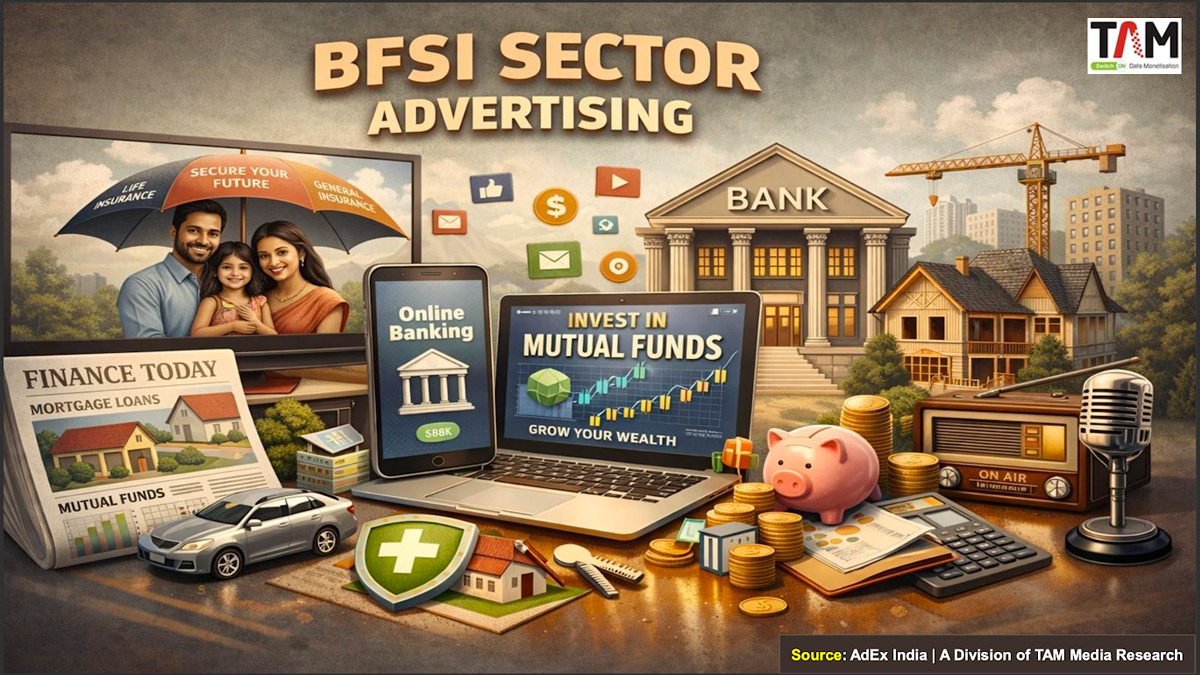
MUMBAI: India’s banking, financial services and insurance sector, one of the most prolific advertisers in the country, delivered a split verdict on media in 2025. It spent less on television, held its nerve in print, turned up the volume on radio and deluged the internet with a ferocity that left every other medium looking pedestrian. The picture that emerges from TAM AdEx’s cross-media report for the BFSI sector is of an industry in transition, still wedded to the news bulletin but increasingly seduced by the algorithm.
Television: a retreat with caveats
TV ad volumes for the BFSI sector fell 16 per cent in 2025 compared with 2024, a sharp reversal after two years of consistent growth that had pushed volumes 16 per cent above 2021 levels by 2023 and a further 7 per cent higher by 2024. Within 2025 itself, the drop was concentrated in the middle of the year: the second and third quarters saw ad volumes slide 35 per cent each against the first quarter, with a partial recovery of 13 per cent in the fourth.
The retreat did not reshuffle the deck. Life insurance retained first place among TV categories with 19 per cent of ad volumes, mortgage loans held second with 16 per cent, and the top ten categories together accounted for 82 per cent of all BFSI television advertising. The dominance of news channels was equally pronounced: news claimed 68 per cent of ad volumes, general entertainment channels a distant 14 per cent and movies 12 per cent. Together, news and GEC captured 82 per cent of the sector’s television spend. News bulletins alone took 48 per cent of programme-genre volumes, with feature films second at 12 per cent. Prime time, between 6pm and 11pm, drew 34 per cent of ad volumes, followed by afternoon at 22 per cent and morning at 20 per cent. A full 82 per cent of all ads ran between 20 and 40 seconds.
Life Insurance Corporation of India was the sector’s biggest TV spender with 11 per cent of ad volumes. Muthoot Financial Enterprises came second with 9 per cent, followed by National Payments Corporation of India at 6 per cent, Tata AIG General Insurance at 5 per cent and State Bank of India at 5 per cent. The top ten advertisers together accounted for 51 per cent of total TV volumes. Three names were new to the top ten in 2025: Tata AIG General Insurance, IIFL Finance and Tata Capital. At brand level, Muthoot Finance Loan Against Gold led with 9 per cent share, Tata AIG Health Insurance entered the top ten for the first time, and the top ten brands together contributed 35 per cent of ad volumes.
Print: the long climb continues
Print told a different story. Ad space for the BFSI sector has grown every year since 2021, rising 16 per cent in 2022, 30 per cent in 2023, 51 per cent in 2024 and 64 per cent in 2025, all measured against a 2021 baseline. Within 2025, ad space was flat in the second quarter but surged 46 per cent in the third and 33 per cent in the fourth compared with the first. Life insurance led print categories with 21 per cent of ad space, followed by mutual funds and banking services and products at 13 per cent each, and corporate financial institutes at 11 per cent. The top ten categories together took 82 per cent of print ad space. LIC led print advertisers with 6 per cent share, and the top ten together covered just 19 per cent of ad space, a reflection of how fragmented print spending remains. Three new entrants joined the top ten in 2025, with Billion Brains Garage Ventures the only exclusive presence not seen in 2024’s list. In the top ten brands, LIC dominated with a 2 per cent share, while Nippon India Mutual Fund rose to third position from fourth in 2024. English accounted for 62 per cent of print ad space, Hindi for 20 per cent. Business and finance publications took 59 per cent of the genre split. The south zone led regional spending with 33 per cent of print ad space, Bangalore topping that zone, while New Delhi and Mumbai were the leading cities nationally.
Radio: louder than ever
Radio ad volumes for the BFSI sector have climbed steadily, rising 12 per cent above 2021 levels in 2023, 36 per cent in 2024 and 45 per cent in 2025. The quarterly pattern within 2025 was volatile: a sharp drop of 43 per cent in the second quarter and 42 per cent in the third, followed by a near-full recovery in the fourth. Life insurance led radio categories with 22 per cent of volumes, banking services and products second at 14 per cent and corporate NBFCs third at 11 per cent. LIC of India held its position as the leading radio advertiser with 20 per cent of ad volumes; the top ten radio advertisers together covered 69 per cent. Muthoot Financial Enterprises led radio brands with 10 per cent share, five of the top ten brands belonged to LIC alone, and SBI Mutual Fund made a remarkable leap to fifth position from 272nd in 2024. Evening and morning time-bands together captured 84 per cent of radio ad volumes, with evenings at 44 per cent and mornings at 40 per cent. Maharashtra was the leading state for radio BFSI advertising with 18 per cent share; Maharashtra, Gujarat and Uttar Pradesh together accounted for 43 per cent.
Digital: the five-times surge
If one number defines the 2025 BFSI advertising story, it is five. Digital ad impressions for the sector multiplied fivefold between 2021 and 2025, having already doubled in 2023 and doubled again in 2024 before the 2025 leap. Within the year, impressions dipped 19 per cent in the second quarter and 12 per cent in the third before recovering 8 per cent above the first quarter by the fourth. Banking services and products led digital categories with 27 per cent of impressions, life insurance and credit cards tied at 19 per cent each, and securities and sharebroking organisations fell from first place in 2024 to fourth in 2025. Axis Bank was the runaway leader among digital advertisers with 12 per cent of impressions, followed by ICICI Bank at 9 per cent, IDFC First Bank at 7 per cent and Kotak Mahindra Bank at 6 per cent. The top ten digital advertisers covered 59 per cent of impressions, and seven of them were new entrants compared with 2024, signalling rapid churn in the digital spending hierarchy. At brand level, Axis Bank led with 9 per cent, ICICI HPCL Super Saver Credit Card vaulted to third place from 921st in 2024, and six of the top ten digital brands were new to the list. Programmatic buying accounted for 91 per cent of all digital BFSI transactions; combined with ad networks, it captured 96 per cent.
The data from TAM AdEx paints the portrait of a sector that still believes in the power of the television news bulletin to sell insurance to the masses, but increasingly knows that the next generation of borrowers, investors and cardholders is scrolling, not watching. The race is now on to reach them before the algorithm serves up someone else’s loan offer first.






