MAM
All hands on deck as The Lifeboat sails into deeper waters in Season 3


MUMBAI: When success stories start sounding too polished, The Lifeboat prefers choppier seas. The long-form conversation podcast, ideated and hosted by Vinayak Burman, is returning for its third season on December 30, 2025, promising deeper dives into resilience, reinvention and the quiet moments that rarely make it to LinkedIn posts.
After strong engagement across its first two seasons, Season 3 widens the emotional lens. The new chapters move beyond career milestones to explore vulnerability, purpose and the internal recalibrations that shape founders, creators and leaders when the spotlight fades. The intent this time is intimacy over instruction, reflection over rhetoric.
The upcoming season features a diverse slate of voices spanning entrepreneurship, investing and creative industries. Among those stepping aboard are Karan Motwani, Gynoveda founders Rachana Gupta and Vishal Gupta, Neo Group founder and managing director Nitin Jain, and actor-turned-entrepreneur Pooja Bedi, alongside others. Each episode traces not just professional decisions but personal value systems, inflection points and moments of unlearning.

The Lifeboat first launched in November 2023 as a candid space for entrepreneurs and investors to speak plainly about the realities of building businesses. Season 1 featured founders such as Shashank Kumar of Dehaat, Vikas Lachhwani of mCaffeine, Josh Talks co-founders Supriya Paul and Shobhit Banga, Smriti Chandra of Abler Nordic India, and Kaushik Mukherjee of Sugar Cosmetics, with conversations centred on navigating early uncertainty and growth pressure.
Season 2 pushed the format further, shifting focus to leadership, communication, spirituality and personal evolution. Its guest list included Shweta Shalini, Priyavrata Mafatlal, Arjun Vaidya, Vineet Rai, Koreel Lahiri, Geetanjali Saxena, Aditya Hegde, Rohan More, Mrunalini Deshmukh and Avanne Dubash, signalling a move from boardroom lessons to inner work.
Burman says the third season raises the bar on honesty and depth, with more diverse perspectives and stories that feel less rehearsed and more lived-in. The aim, he notes, is not motivation-by-numbers but conversations that linger after the episode ends.
Season 3 of The Lifeboat will stream across Youtube and all major podcast platforms, inviting listeners once again to step away from smooth sailing and listen to what happens when the waters get real.




MAM
India’s financial sector spent less on TV ads in 2025 but flooded the internet
Banks, insurers and lenders cut tv ads as digital jumps, LIC and Muthoot lead tv and Axis Bank tops online
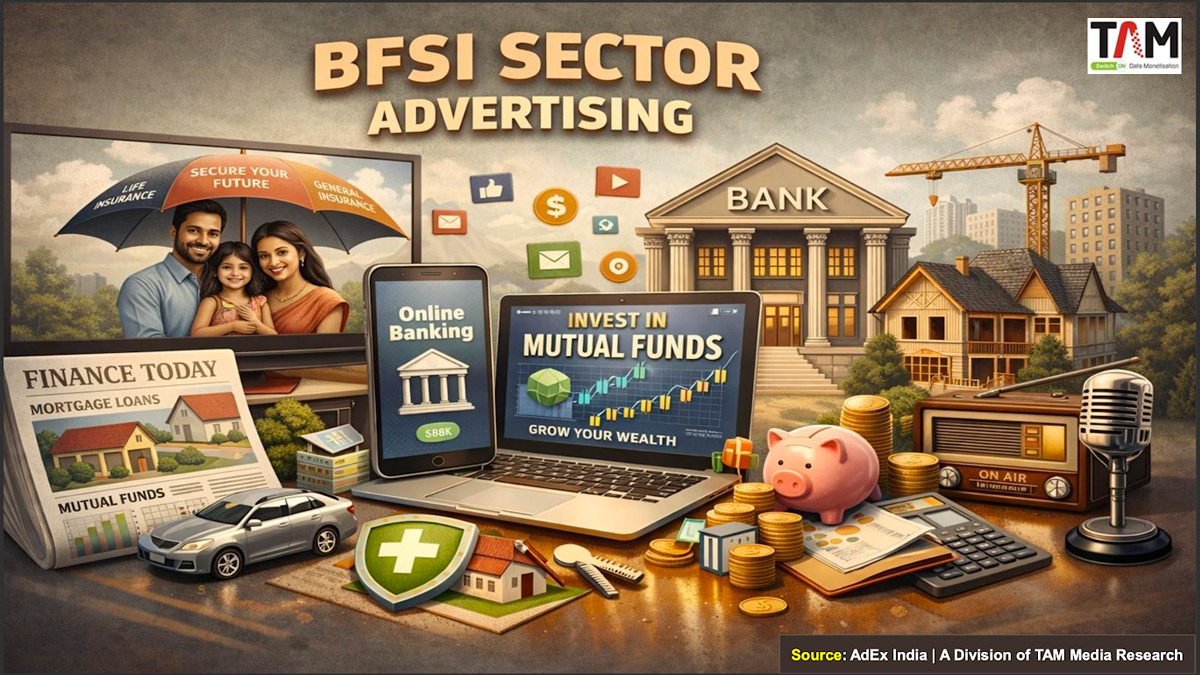
MUMBAI: India’s banking, financial services and insurance sector, one of the most prolific advertisers in the country, delivered a split verdict on media in 2025. It spent less on television, held its nerve in print, turned up the volume on radio and deluged the internet with a ferocity that left every other medium looking pedestrian. The picture that emerges from TAM AdEx’s cross-media report for the BFSI sector is of an industry in transition, still wedded to the news bulletin but increasingly seduced by the algorithm.
Television: a retreat with caveats
TV ad volumes for the BFSI sector fell 16 per cent in 2025 compared with 2024, a sharp reversal after two years of consistent growth that had pushed volumes 16 per cent above 2021 levels by 2023 and a further 7 per cent higher by 2024. Within 2025 itself, the drop was concentrated in the middle of the year: the second and third quarters saw ad volumes slide 35 per cent each against the first quarter, with a partial recovery of 13 per cent in the fourth.
The retreat did not reshuffle the deck. Life insurance retained first place among TV categories with 19 per cent of ad volumes, mortgage loans held second with 16 per cent, and the top ten categories together accounted for 82 per cent of all BFSI television advertising. The dominance of news channels was equally pronounced: news claimed 68 per cent of ad volumes, general entertainment channels a distant 14 per cent and movies 12 per cent. Together, news and GEC captured 82 per cent of the sector’s television spend. News bulletins alone took 48 per cent of programme-genre volumes, with feature films second at 12 per cent. Prime time, between 6pm and 11pm, drew 34 per cent of ad volumes, followed by afternoon at 22 per cent and morning at 20 per cent. A full 82 per cent of all ads ran between 20 and 40 seconds.
Life Insurance Corporation of India was the sector’s biggest TV spender with 11 per cent of ad volumes. Muthoot Financial Enterprises came second with 9 per cent, followed by National Payments Corporation of India at 6 per cent, Tata AIG General Insurance at 5 per cent and State Bank of India at 5 per cent. The top ten advertisers together accounted for 51 per cent of total TV volumes. Three names were new to the top ten in 2025: Tata AIG General Insurance, IIFL Finance and Tata Capital. At brand level, Muthoot Finance Loan Against Gold led with 9 per cent share, Tata AIG Health Insurance entered the top ten for the first time, and the top ten brands together contributed 35 per cent of ad volumes.
Print: the long climb continues
Print told a different story. Ad space for the BFSI sector has grown every year since 2021, rising 16 per cent in 2022, 30 per cent in 2023, 51 per cent in 2024 and 64 per cent in 2025, all measured against a 2021 baseline. Within 2025, ad space was flat in the second quarter but surged 46 per cent in the third and 33 per cent in the fourth compared with the first. Life insurance led print categories with 21 per cent of ad space, followed by mutual funds and banking services and products at 13 per cent each, and corporate financial institutes at 11 per cent. The top ten categories together took 82 per cent of print ad space. LIC led print advertisers with 6 per cent share, and the top ten together covered just 19 per cent of ad space, a reflection of how fragmented print spending remains. Three new entrants joined the top ten in 2025, with Billion Brains Garage Ventures the only exclusive presence not seen in 2024’s list. In the top ten brands, LIC dominated with a 2 per cent share, while Nippon India Mutual Fund rose to third position from fourth in 2024. English accounted for 62 per cent of print ad space, Hindi for 20 per cent. Business and finance publications took 59 per cent of the genre split. The south zone led regional spending with 33 per cent of print ad space, Bangalore topping that zone, while New Delhi and Mumbai were the leading cities nationally.
Radio: louder than ever
Radio ad volumes for the BFSI sector have climbed steadily, rising 12 per cent above 2021 levels in 2023, 36 per cent in 2024 and 45 per cent in 2025. The quarterly pattern within 2025 was volatile: a sharp drop of 43 per cent in the second quarter and 42 per cent in the third, followed by a near-full recovery in the fourth. Life insurance led radio categories with 22 per cent of volumes, banking services and products second at 14 per cent and corporate NBFCs third at 11 per cent. LIC of India held its position as the leading radio advertiser with 20 per cent of ad volumes; the top ten radio advertisers together covered 69 per cent. Muthoot Financial Enterprises led radio brands with 10 per cent share, five of the top ten brands belonged to LIC alone, and SBI Mutual Fund made a remarkable leap to fifth position from 272nd in 2024. Evening and morning time-bands together captured 84 per cent of radio ad volumes, with evenings at 44 per cent and mornings at 40 per cent. Maharashtra was the leading state for radio BFSI advertising with 18 per cent share; Maharashtra, Gujarat and Uttar Pradesh together accounted for 43 per cent.
Digital: the five-times surge
If one number defines the 2025 BFSI advertising story, it is five. Digital ad impressions for the sector multiplied fivefold between 2021 and 2025, having already doubled in 2023 and doubled again in 2024 before the 2025 leap. Within the year, impressions dipped 19 per cent in the second quarter and 12 per cent in the third before recovering 8 per cent above the first quarter by the fourth. Banking services and products led digital categories with 27 per cent of impressions, life insurance and credit cards tied at 19 per cent each, and securities and sharebroking organisations fell from first place in 2024 to fourth in 2025. Axis Bank was the runaway leader among digital advertisers with 12 per cent of impressions, followed by ICICI Bank at 9 per cent, IDFC First Bank at 7 per cent and Kotak Mahindra Bank at 6 per cent. The top ten digital advertisers covered 59 per cent of impressions, and seven of them were new entrants compared with 2024, signalling rapid churn in the digital spending hierarchy. At brand level, Axis Bank led with 9 per cent, ICICI HPCL Super Saver Credit Card vaulted to third place from 921st in 2024, and six of the top ten digital brands were new to the list. Programmatic buying accounted for 91 per cent of all digital BFSI transactions; combined with ad networks, it captured 96 per cent.
The data from TAM AdEx paints the portrait of a sector that still believes in the power of the television news bulletin to sell insurance to the masses, but increasingly knows that the next generation of borrowers, investors and cardholders is scrolling, not watching. The race is now on to reach them before the algorithm serves up someone else’s loan offer first.






