MAM
Airport advertising makes a comeback with Times OOH new campaign ‘The Runway Restart’


NEW DELHI: As airports resume functioning, Times OOH has started airport advertising with a new campaign The Runway Restart. The Runway restart is a key moment for the aviation industry and for brands for whom advertising at airports has been an ideal medium to reach the premium NCCS-A audiences of the country over the years.
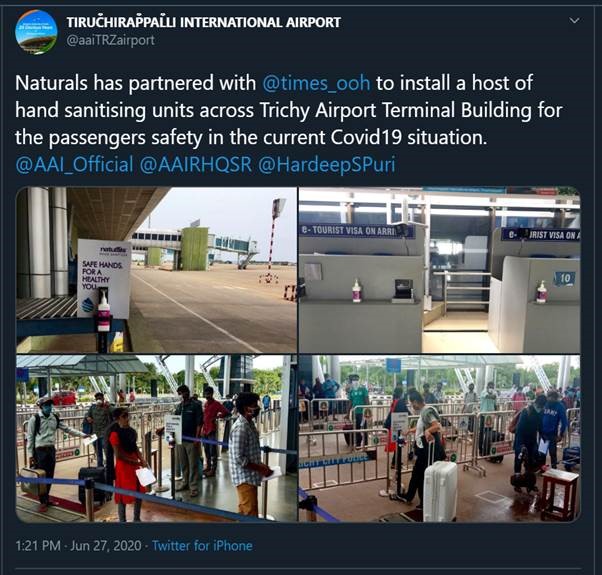
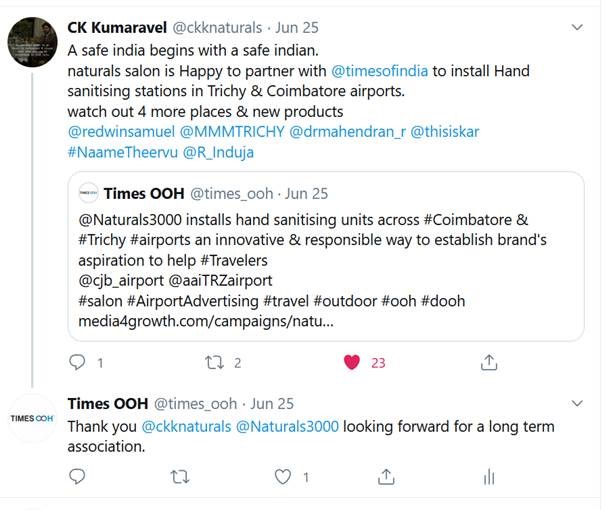
Looking at a few examples from down South, at Coimbatore and Trichy Airports, Times OOH partnered with Naturals, a leading salon chain that sponsored hand sanitisers at the two airports thereby participating in a larger cause and seamlessly merging with the need of passengers and airport. The sanitising units emphasise the importance of hand sanitisation and reinstate safe travel practices.
For another such campaign from the Healthcare Industry by Dr Vanchilingam Hospital at Trichy Airport, MD Dr Sophia Somesh says, “We chose the airport advertising to reach out Indians residing overseas. OOH, advertising has always helped in establishing ourselves as a hospital that comprises state-of-the-art technology with all facilities available and we will continue to advertise in OOH medium in future.”

Brands like Naturals are innovating with unique opportunities like the hand sanitiser utility sponsorship, while there are others that are continuing where they stopped in the pre-COVID2019 times and now post COVID reaching to audiences who now have more dwell time at the airports.
Airport operations began countrywide from 25 May as the lockdown was eased. Till end of July, over 4.2 million domestic passengers took air travel in the Indian soil post-travel restrictions were lifted alongside the International flights under the Vande Bharat Mission. These numbers continue to grow day on the day as we inch towards normalization.
“Travelling in flight is the safest mode of travel when compared to others during a pandemic,” said AIIMS, New Delhi director Dr Randeep Guleria.
Addressing a webinar titled ''Reposing the Faith in Flying'' hosted by GMR Group, Dr Guleria said, "If an asymptomatic person is seating next to you during a short flight and both the persons are wearing masks and face shields, there is less chance of spreading the virus. Travelling in flight is the safest mode of travel & the way airports and airlines are taking precaution during travel in a pandemic situation is commendable.”
Pandemic has introduced new perspectives and fueled consumers to change their behaviour and lifestyle. Even travel behaviours are changing and we are witnessing various initiatives are taken by the airport operators to ensure the safety of the passengers. Some initiatives include mandatory web check-ins, reaching airports at least two hours before departure leading to even higher audience dwell times, going through thermal screening, maintaining social distancing norms via floor markers and marked seats, wearing face masks at all times and pasting PNR on bags by self.
As per Kantar Barometer research, 92 per cent of consumers think brands should continue to advertise to be recognized. In another such research by Edelman research conducted in 12 nations including India, 63 per cent of consumers believed that brands will play a critical role in making their country fight the pandemic.
Omnicom Media Group vice president – investment- Ajay Varghese says, “VW has always believed in connecting with the right audience on the right platform. Keeping in mind the communication for Tiguan and T-Roc the ideal touchpoints have always been the Mumbai & Delhi Airports, known for their captive audience. With the resumption of travel a month and a half ago, airports saw a sudden surge in eyeballs. It made sense at this time to use airport-centric OOH to drive advertising about SUVs that are often used for travel purposes. Airports are currently one of the very few public spaces where people can assemble. While social distancing protocols have ensured that the passenger dwell time at the airport has gone up substantially. In this context, it’s important to capitalise tactically on specific airport spots and locations like Departure Lounges and Security Hold Areas. This is where passengers are spending a majority of their airport time, and therefore placing ads here results in better eyeballs & ROI.”
Mumbai and Delhi Airport, two of the busiest airports in India are also gradually witnessing an increase in flights and are quickly adapting to the new normal. Times OOH is working closely with the airport authorities to understand the new paradigms and innovating to introduce new opportunities for brands.
Call it a Health Care Zone by a leading diagnostic chain, an e-insurance kiosk for availing insurance on the go, food delivery self-ordering kiosks that make contactless deliveries, a contactless automobile experience lounge using the VR technology and more are few areas where new opportunities for brands will arise at airports.





Brands
Maharashtra panel orders Lodha to refund Rs 5 crore to homebuyers
Consumer court flags unfair practices in long-running property dispute case
MUMBAI: In a sharp rebuke to one of India’s biggest real estate players, the Maharashtra State Consumer Disputes Redressal Commission has directed Macrotech Developers to refund nearly Rs 5 crore to a senior citizen couple, Uttam and Anindita Chatterjee. The ruling, delivered on March 13, 2026, calls out the developer for “deficiency in service” and “unfair trade practices”, bringing closure to a dispute that has stretched over a decade.
The case traces back to 2015, when the couple booked a 3-BHK flat at World Towers in Lower Parel for Rs 12.22 crore, with possession promised within a year. What followed was a series of changes that complicated matters. After deciding to exit the project, they were persuaded to shift to a 4-BHK in another development priced at Rs 8 crore, with delivery scheduled for 2018. However, within months, the price was allegedly increased to Rs 10 crore. After demonetisation reshaped the market, similar flats were reportedly being offered at lower prices, but the couple were not given the benefit.
Despite paying over Rs 2.83 crore, the couple neither received possession nor clarity. Instead, in 2018, the developer unilaterally cancelled the booking, retained part of the amount as earnest money, and argued that the buyers were investors rather than consumers. The commission rejected this claim, observing that casual references to “investment” do not take away consumer rights when the purchase intent is residential.
The bench also held that the developer could not penalise buyers for payment delays while failing to meet its own delivery commitments. It noted the lack of formal documentation for revised terms and termed the prolonged retention of funds without delivering a home as exploitative.
As part of its order, the commission directed the developer to refund Rs 2.83 crore paid by the couple, along with interest at 10 per cent per annum, amounting to around Rs 2.12 crore. In addition, Rs 1 lakh has been awarded for mental agony and Rs 50,000 towards litigation costs, taking the total payout to over Rs 5 crore. The developer has been asked to comply within two months.
For now, the ruling serves as a reminder that in real estate, shifting terms and delayed promises can carry a significant cost.







