Ad Campaigns
Abbott launches Chakkar ko Check Kar campaign to raise vertigo awareness

Mumbai: Abbott, the global healthcare leader, launched its ‘Chakkar Ko Check Kar’ campaign in India to highlight an often-overlooked balance disorder, vertigo, which affects close to 70 million people in India. Vertigo is a condition that can make people feel like the world is spinning around them. Through this campaign, Abbott aims to help people take control of their health and better manage their condition.
To give the world a window into the disorienting reality of vertigo, Abbott kickstarted the campaign through a digital film, which features Bollywood actor and UNICEF India Ambassador, Ayushmann Khurrana. It paints a vivid picture of how vertigo’s sudden spinning episodes can throw life off balance, urging those who resonate with these experiences to take action.
Ayushmann Khurrana, sharing his personal experience with vertigo, said, “Dealing with vertigo has been a challenge, but it taught me the power of resilience. Diagnosed in 2016, every sudden movement made the world spin around me. Amidst demanding film schedules, the constant fear of an impending dizzy spell was daunting. However, finding the right medication

and embracing meditation helped me manage my condition completely. While it can feel like a tough condition to manage but it’s crucial to remember that it’s a battle you can win. I hope my journey inspires others to seek the help they need and navigate life with renewed confidence.”
His experience is not uncommon. Millions are suffering from this condition silently and confusing it for a normal chakkar. Getting the right diagnosis and treatment at the right time and making key lifestyle changes is important to manage this condition and stay in control of your health.
Abbott India medical director Dr Jejoe Karankumar, added, “Around 70 million Indians experience vertigo. While this balance disorder can affect people’s quality of life, it can be managed. Abbott aims to simplify the journey of people living with vertigo by raising awareness and empowering them with knowledge and tools that can help recognize signs of the condition, get timely medical advice and support and live fulfilling lives.”
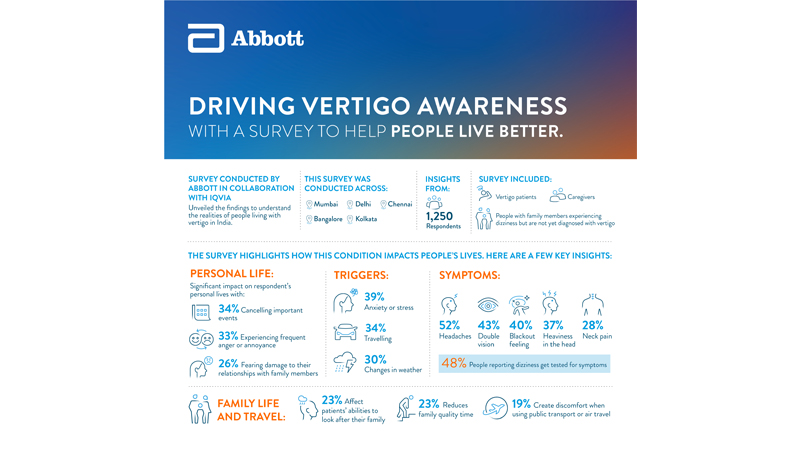
An integral part of the campaign is the survey conducted by Abbott in collaboration with IQVIA. The survey findings help us understand the realities of people living with vertigo in India. This survey was conducted across Mumbai, Delhi, Chennai, Bangalore, and Kolkata, with insights from 1,250 respondents. These included vertigo patients and caregivers as well as people with family members experiencing dizziness who have not yet been diagnosed with the condition.
Vertigo: A Significant Struggle
Imagine a world that spins uncontrollably, causing headaches, double vision, and a blackout feeling. This is the reality for those living with vertigo. The Abbott and IQVIA survey sheds light on how this condition impacts people’s lives, personally, and for people around them too.
1 Personal Life: Vertigo doesn’t just cause spinning. It has a significant impact on personal lives, with 34 per cent cancelling important events, 33 per cent experiencing frequent anger or annoyance, and 26 per cent fearing damage to their relationships with family members.
2 Triggers: The leading triggers of vertigo are anxiety or stress (39 per cent), travelling (34 per cent), and weather changes (30 per cent).
3 Symptoms: Each vertigo episode can bring a range of symptoms, including headaches (52 per cent), double vision (43 per cent), a blackout feeling (40 per cent), heaviness in the head (37 per cent), and neck pain (28 per cent).
4 Family Life and Travel: Vertigo can affect patients’ abilities to look after their family (23 per cent) and reduce family quality time (23 per cent). It also creates discomfort when using public transport or air travel (19 per cent).
Despite its effects, only 48 per cent of people reporting dizziness get tested for symptoms. On average, vertigo is diagnosed at 38 years of age, with around one-fourth of patients experiencing an attack once a month. Certain myths persist around vertigo, with 21 per cent of patients believing that this condition only affects the elderly, and 15 per cent feeling that it is untreatable and contagious. Only half of vertigo patients take medication, despite the far-reaching impact on their personal lives, which can include avoiding travelling in vehicles (34 per cent), and reducing screen time (30 per cent) to minimize the likelihood of a vertigo episode. This data paints a vivid picture of the hidden struggles faced by those living with vertigo.
The survey also uncovered interesting findings in Delhi specifically. For example, vertigo has a great impact on patients’ professional lives in the region, including affecting concentration resulting in lower performance (18 per cent) and impacting the ability to take on more responsibility (28 per cent) as well as career progression (29 per cent). Additionally, vertigo also impacts people’s personal lives in the city: 44 per cent cancel important events, while 50 per cent frequently get angry or annoyed.
As part of this awareness initiative, Abbott has also initiated an online assessment tool. This is a chatbot-based survey, to help people identify vertigo symptoms and support early detection. This survey is available in 7 languages (English, Hindi, Malayalam, Kannada, Telugu, Tamil and Bengali) and can be accessed here: LINK.







NATIONAL: Amazon Ads has laid out a sharply tech-led vision for the advertising industry in 2026, arguing that artificial intelligence, streaming TV and creator partnerships will combine to turn brand building into a more precise, performance-driven business.
At the heart of the shift, the company says, is the fusion of AI with Amazon’s vast trove of shopping, browsing and streaming signals, allowing advertisers to move beyond blunt reach metrics to campaigns designed around real customer behaviour.
“The future of advertising is not about reaching more people, but the right people with messages that resonate,” said Amazon Ads India head and vice president Girish Prabhu. “By combining AI with deep customer insights, we help brands move from broadcasting campaigns to having meaningful conversations wherever audiences spend their time.”
One of the biggest changes, according to Amazon Ads, will be the collapse of the wall between media planning and creative development. Retail media, powered by first-party data, is increasingly shaping everything from brand discovery to final purchase, pushing marketers to design campaigns around audience insight rather than internal instinct.
AI is also moving from a support tool to a creative engine. Agentic AI, which automates and accelerates production, is expected to make high-quality creative accessible even to small businesses, compressing weeks of work into hours and giving challengers the ability to compete with larger brands on speed and scale.
Behind the scenes, AI-driven analytics will take on a bigger role in campaign optimisation, identifying patterns, spotting opportunities and recommending actions that would previously have required teams of analysts.
Streaming TV is another big battleground. With India’s video streaming audience now above 600 million and connected TV users at 129.2 million in 2025, advertisers are set to treat streaming not just as a branding channel but as a performance engine, measured increasingly by sales, sign-ups and bookings rather than just reach.
Finally, Amazon Ads sees creators and contextual advertising reshaping how brands tell stories. Creators will act less like influencers and more like long-term partners, while scene-aware ads on streaming platforms will allow brands to insert hyper-relevant offers into the flow of what viewers are watching.
Taken together, Amazon Ads argues, these shifts mark a move towards advertising that is both more human and more measurable, where AI handles the complexity, and creativity does the persuading.